Suitcase carry
- Dumbbells
- Carry
- 20–40 m
- Needs some technique
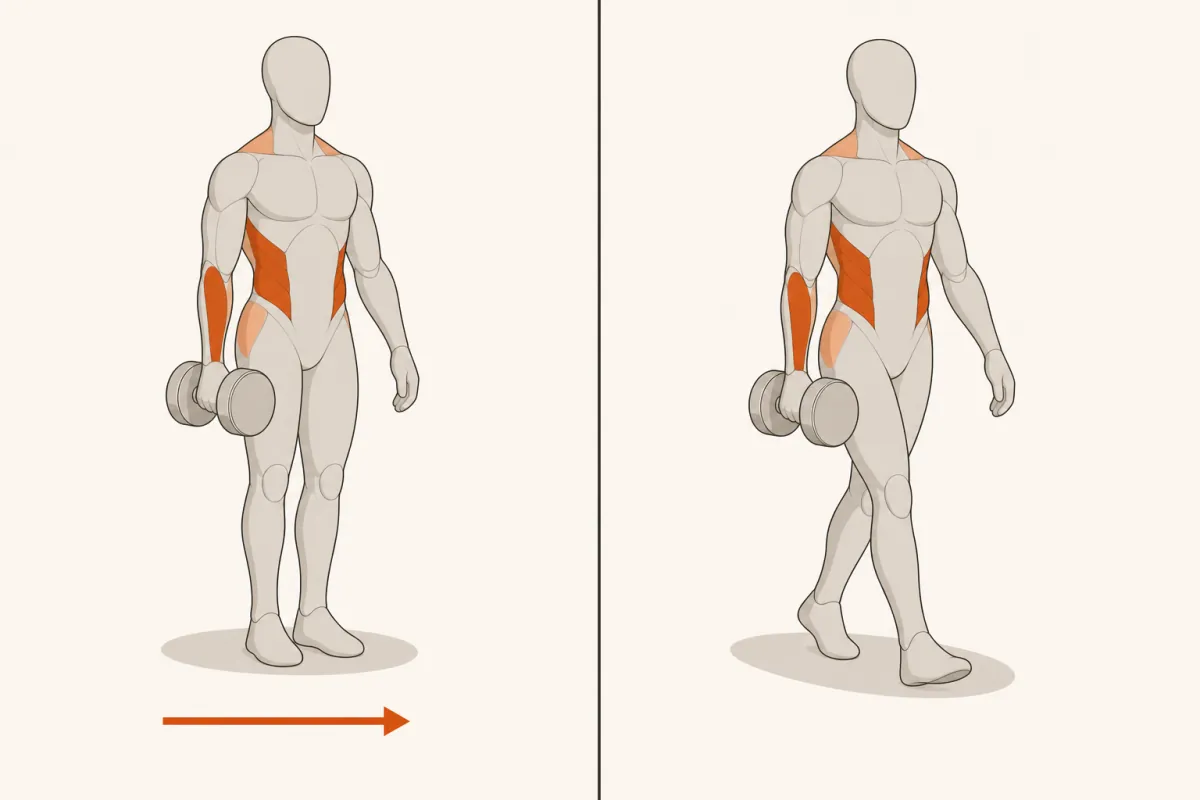
Generated illustration — follow the cues.
Setup
Pick up one dumbbell or kettlebell from a rack, or from the floor with a hip hinge, and stand tall with it at your side, free arm relaxed or slightly out; walk 20–40 m, then switch hands.
Cues
- Stand perfectly upright: lean neither toward nor away from the weight.
- Brace your abs and tense the side opposite the weight, as if resisting a push from the side.
- Keep your shoulders level: the loaded shoulder neither drops nor shrugs up.
- Take short, controlled steps; keep the weight from bumping your leg.
- Breathe in short breaths behind the brace.
- Walk the same distance with each hand and log the distance per side.
Common mistakes
- Leaning away from the weight (or toward it).
- Twisting the torso or letting the hips swing.
- Picking the weight up or setting it down with a rounded, twisted back.
- Going heavier than you can carry perfectly upright.
Muscles
- Main: Forearm flexors (grip), Obliques, Quadratus lumborum
- Helping: Gluteus medius, Spinal erectors, Upper traps
Alternatives
Machine busy or missing? Closest first.
Pick your gym to see which of these it has: Gyms
Warm-up
No ramp sets: make the first set a little easier and build into it.
5 min of easy cardio (bike, rower or brisk incline walk) until you are warm and breathing a little faster, then lighter ramp sets before the first working set of each big exercise.
Facts
- Equipment
- Dumbbells
- Movement
- Carry
- Swap group
- Grip & carries
- Load step
- 2 kg
- Rep range
- 20–40 m
- Difficulty
- Needs some technique
- Support
- You stabilise yourself
- Lower-back load
- Moderate
- Sides
- One side at a time
- Typical start
- 16 kg (untrained 80 kg man)
Also called: One-arm farmer's carry · Single-arm farmer's walk · Unilateral carry · Suitcase walk
Sources
- McGill, Marshall, Andersen. Low back loads while walking and carrying: comparing the load carried in one hand or in both hands — Ergonomics, 2013. doi.org/10.1080/00140139.2012.752528
- McGill, McDermott, Fenwick. Comparison of different strongman events: trunk muscle activation and lumbar spine motion, load, and stiffness — J Strength Cond Res, 2009. pubmed.ncbi.nlm.nih.gov/19528856/
- Taylor, Reed. Increase hip and trunk stability with loaded carries — NSCA Coach 7.3, 2020. nsca.com/contentassets/927868f8d4bb45f2ac4429631d558d83/coach-7.3.6-increase-hip-and-trunk-stability-with-loaded-carries-for-injury-prevention-rehabilitation-and-performance.pdf