Dead hang
- Bodyweight
- Grip
- 20–60 s
- Beginner-friendly
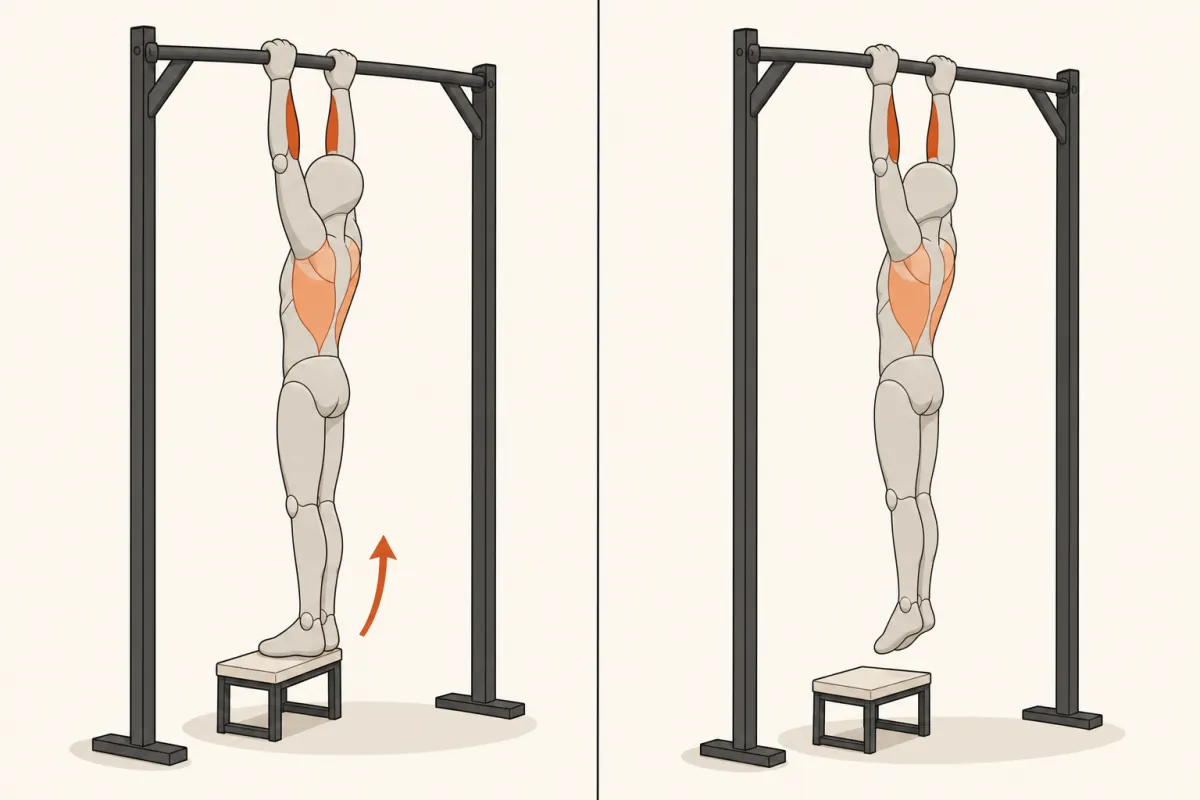
Generated illustration — follow the cues.
Setup
Stand on a box or step under a pull-up bar, take an overhand grip just outside shoulder-width with your thumbs wrapped around the bar, then lift your feet and hang with straight arms.
Cues
- Full grip: thumbs wrapped around the bar.
- Arms straight, shoulders gently pulled down away from your ears (an active hang).
- Ribs down, legs still and slightly in front of you; don't swing.
- Breathe slowly and steadily for the whole hold.
- Finish by stepping back onto the box instead of dropping.
- Build time first: 60 s is a good target before making it harder.
Common mistakes
- Dropping off the bar instead of stepping down, which jars the shoulders and ankles.
- Hanging through pain at the front or top of the shoulder: set the shoulders down or stop.
- Kipping or swinging the body.
- Holding your breath.
Muscles
- Main: Forearm flexors (grip)
- Helping: Lats, Lower traps, Rotator cuff
Alternatives
Machine busy or missing? Closest first.
Pick your gym to see which of these it has: Gyms
Warm-up
No ramp sets: make the first set a little easier and build into it.
5 min of easy cardio (bike, rower or brisk incline walk) until you are warm and breathing a little faster, then lighter ramp sets before the first working set of each big exercise.
Facts
- Equipment
- Bodyweight
- Movement
- Grip
- Swap group
- Grip & carries
- Load step
- bodyweight
- Rep range
- 20–60 s
- Difficulty
- Beginner-friendly
- Support
- You stabilise yourself
- Lower-back load
- Low
Also called: Bar hang · Passive hang · Active hang · Hang from a pull-up bar
Sources
- Leong et al. Prognostic value of grip strength: findings from the PURE study — Lancet, 2015. doi.org/10.1016/S0140-6736(14)62000-6
- Dodds et al. Grip strength across the life course: normative data from twelve British studies — PLoS One, 2014. doi.org/10.1371/journal.pone.0113637