Plate pinch hold
- Barbell
- Grip
- 20–40 s
- Beginner-friendly
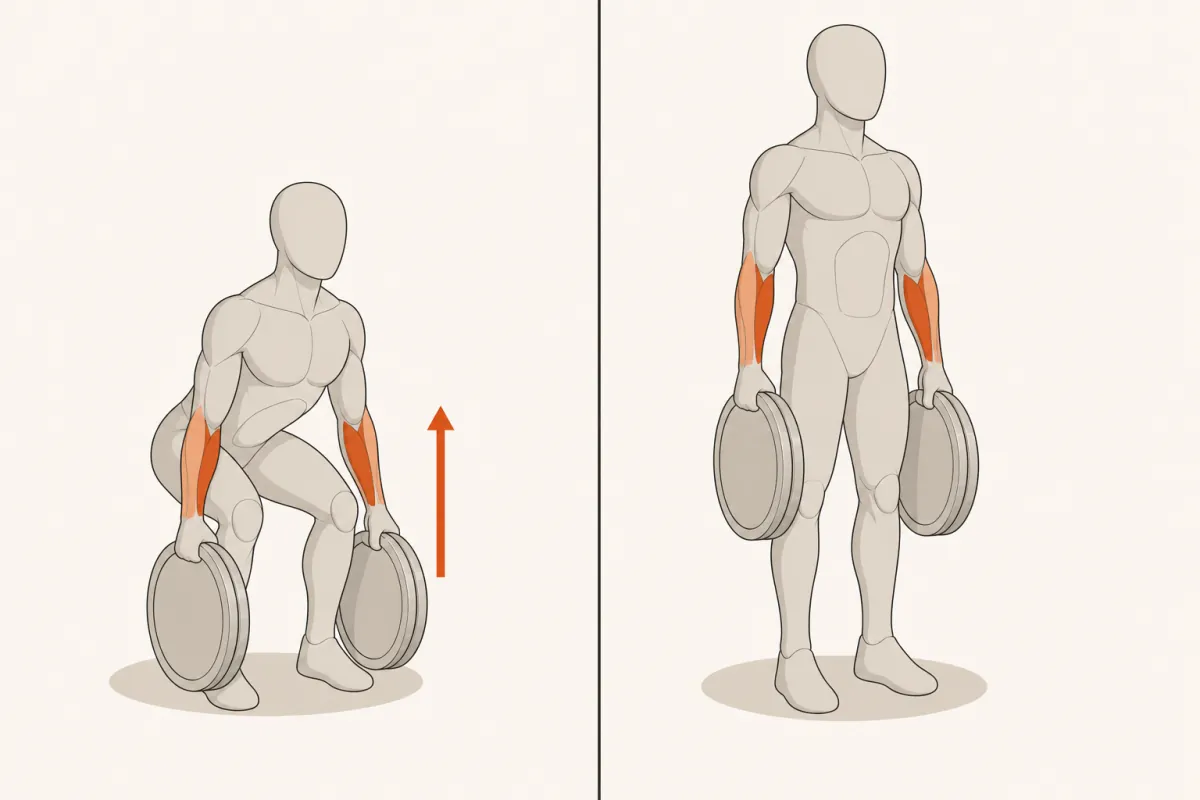
Generated illustration — follow the cues.
Setup
Stand two smooth-faced plates of the same size together, smooth sides out, on a bench or the floor; pinch them along the top rim, fingers on one side and thumb on the other, one pair in each hand, and stand up tall with a flat back.
Cues
- Smooth sides out; fingers straight and together on one side, thumb flat on the other.
- Squeeze the thumb hard toward the fingers so the plates can't swivel.
- Stand tall, shoulders down, arms straight, plates beside your legs.
- Hold for the target time, breathing steadily.
- Set the plates down with a hip hinge before your grip gives out.
- Progress by time first, then by a third plate or bigger plates.
Common mistakes
- Holding the plates over your feet or training in open shoes: a slipped plate lands on your toes.
- Curling the fingers over the rim, which turns the pinch into an ordinary grip.
- Leaning or shrugging to cope with the load.
- Holding on until the plates slip out of your hands.
Muscles
- Main: Forearm flexors (grip)
- Helping: Forearm extensors
Alternatives
Machine busy or missing? Closest first.
Pick your gym to see which of these it has: Gyms
Warm-up
No ramp sets: make the first set a little easier and build into it.
5 min of easy cardio (bike, rower or brisk incline walk) until you are warm and breathing a little faster, then lighter ramp sets before the first working set of each big exercise.
Facts
- Equipment
- Barbell
- Movement
- Grip
- Swap group
- Grip & carries
- Load step
- 5 kg
- Rep range
- 20–40 s
- Difficulty
- Beginner-friendly
- Support
- You stabilise yourself
- Lower-back load
- Low
- Typical start
- 10 kg (untrained 80 kg man)
Also called: Plate pinch · Pinch grip hold · Two-plate pinch · Plate pinch carry (walking version)
Sources
- Leong et al. Prognostic value of grip strength: findings from the PURE study — Lancet, 2015. doi.org/10.1016/S0140-6736(14)62000-6
- Dodds et al. Grip strength across the life course: normative data from twelve British studies — PLoS One, 2014. doi.org/10.1371/journal.pone.0113637