McGill curl-up
- Bodyweight
- Crunch
- 5–10 reps
- Beginner-friendly
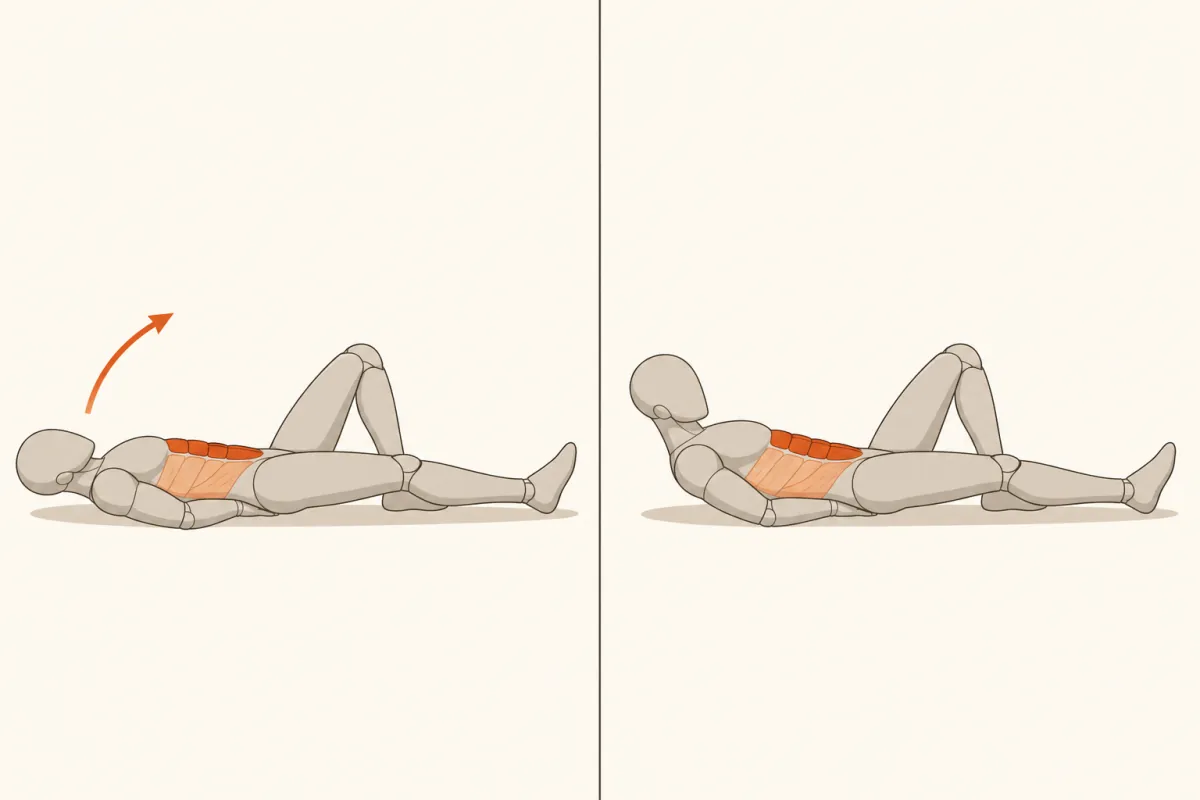
Generated illustration — follow the cues.
Setup
Lie on your back with one knee bent and the other leg straight. Slide both hands, palms down, under the arch of your lower back to keep its natural curve.
Cues
- Brace the abdominal wall: stiffen it without sucking it in or pushing it out.
- Lift the head and shoulders just off the floor as one unit, pivoting at the breastbone.
- Keep the neck straight and the curve of the lower back unchanged — it is a small movement.
- Hold 5–10 s while breathing, lower, repeat; swap the bent leg halfway through the set.
- Progress: lift the elbows off the floor, then take deep breaths during the hold.
Common mistakes
- Flattening the lower back into the floor instead of keeping its curve.
- Cranking the chin to the chest — the neck bends instead of the trunk lifting.
- Coming up too high and turning it into a sit-up.
- Holding the breath.
Muscles
- Main: Rectus abdominis
- Helping: Obliques, Transverse abdominis
Alternatives
Machine busy or missing? Closest first.
Pick your gym to see which of these it has: Gyms
Warm-up
No ramp sets: make the first set a little easier and build into it.
5 min of easy cardio (bike, rower or brisk incline walk) until you are warm and breathing a little faster, then lighter ramp sets before the first working set of each big exercise.
Facts
- Equipment
- Bodyweight
- Movement
- Crunch
- Swap group
- Crunches
- Load step
- bodyweight
- Rep range
- 5–10 reps
- Difficulty
- Beginner-friendly
- Support
- Seat or pad supports the torso
- Lower-back load
- Low
Also called: Modified curl-up · Curl-up (McGill 'big 3') · Скручивание Макгилла
Sources
- Exercises for spine stabilization: motion/motor patterns, stability progressions and clinical technique (McGill & Karpowicz) — Arch Phys Med Rehabil, 2009. pubmed.ncbi.nlm.nih.gov/19154838/
- Low back loads over a variety of abdominal exercises: searching for the safest abdominal challenge (Axler & McGill) — Med Sci Sports Exerc, 1997. pubmed.ncbi.nlm.nih.gov/9219209/
- Intramuscular activity of psoas and the abdominal wall during a wide variety of tasks (Juker et al.) — Med Sci Sports Exerc, 1998. pubmed.ncbi.nlm.nih.gov/9502361/