Bicycle crunch
- Bodyweight
- Crunch
- 10–20 reps
- Beginner-friendly
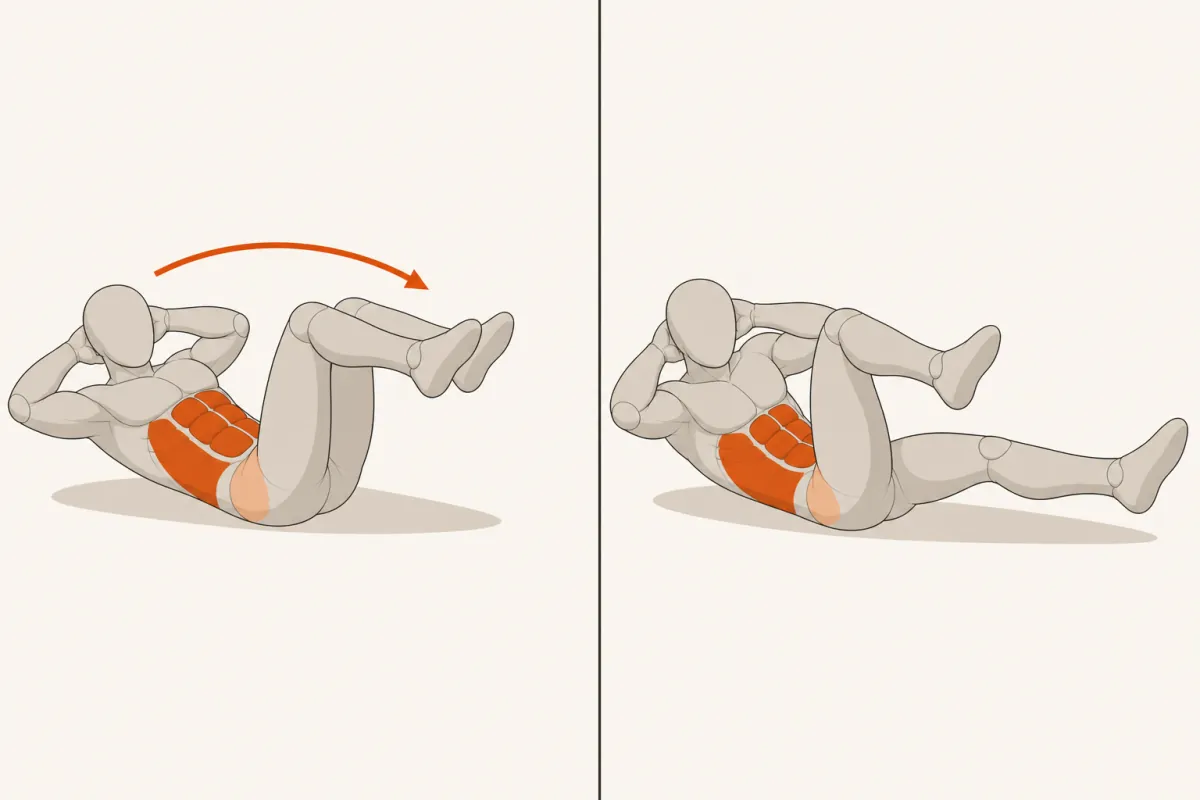
Generated illustration — follow the cues.
Setup
Lie on your back with the lower back lightly pressed to the floor and fingertips beside your head. Lift the knees to about 45° and the shoulder blades just off the floor.
Cues
- Pedal slowly: one leg straightens low while the other knee comes in.
- Turn the ribcage so the shoulder, not just the elbow, travels toward the opposite knee.
- Keep the lower back on the floor; straighten the leg higher if it starts to arch.
- About 2 s per side with even, relaxed breathing; reps are counted per side.
- Hands only cradle the head; elbows stay wide.
Common mistakes
- Yanking the head forward with the hands.
- Flapping the elbows without turning the ribcage.
- Racing through reps on momentum.
- Lower back arching as the straight leg drops too low.
Muscles
- Main: Rectus abdominis, Obliques
- Helping: Hip flexors
Alternatives
Machine busy or missing? Closest first.
- McGill curl-up
- Seated machine crunch
- Kneeling cable crunch
- Captain's chair knee raise
- Reverse crunch
- Decline sit-up
Pick your gym to see which of these it has: Gyms
Warm-up
No ramp sets: make the first set a little easier and build into it.
5 min of easy cardio (bike, rower or brisk incline walk) until you are warm and breathing a little faster, then lighter ramp sets before the first working set of each big exercise.
Facts
- Equipment
- Bodyweight
- Movement
- Crunch
- Swap group
- Crunches
- Load step
- bodyweight
- Rep range
- 10–20 reps
- Difficulty
- Beginner-friendly
- Support
- Seat or pad supports the torso
- Lower-back load
- Low
- Sides
- One side at a time
Also called: Bicycle maneuver · Cross-body bicycle crunch · Велосипед
Sources
- New study puts the crunch on ineffective ab exercises (ACE-commissioned EMG study, San Diego State University) — ACE FitnessMatters, 2001. acefitness.org/getfit/studies/BestWorstAbExercises.pdf
- To crunch or not to crunch: spinal flexion exercises, their potential risks and program design (Contreras & Schoenfeld) — Strength Cond J, 2011. doi.org/10.1519/SSC.0b013e3182259d05