Trap-bar deadlift
- Barbell
- Hip hinge
- 4–8 reps
- Needs some technique
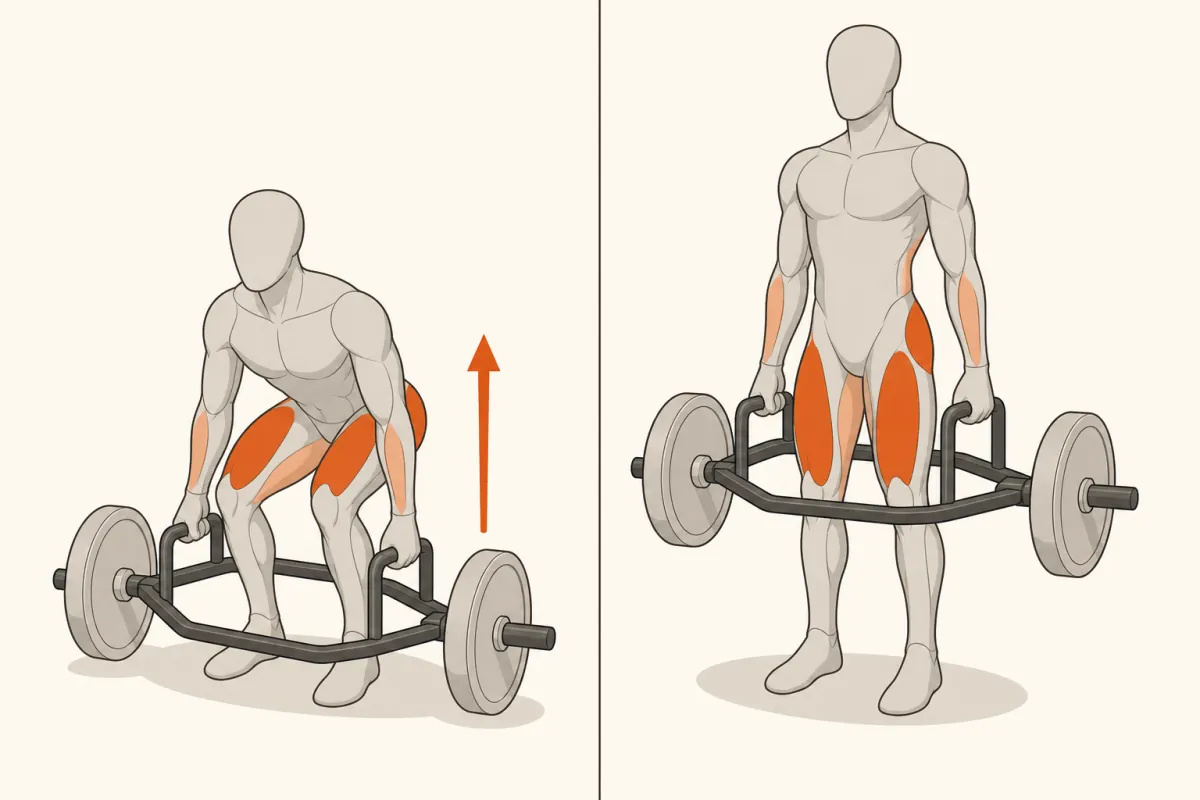
Generated illustration — follow the cues.
Setup
Step into the centre of the bar with feet hip-width and the handles in line with the middle of your feet. Use the raised handles while you learn — they shorten the pull.
Cues
- Push your hips back and bend your knees to grip the middle of the handles; back flat, chest up, arms long.
- Breathe into your belly, brace, and pull the slack out of the bar before it leaves the floor.
- Push the floor away with your legs; hips and shoulders rise together.
- Finish standing tall with the glutes squeezed — don't lean back.
- Lower by pushing the hips back first, then bending the knees; set the bar down, don't drop it.
- Re-brace before every rep and end the set as soon as your back position changes.
Common mistakes
- Rounding the lower back to reach the handles.
- Jerking the bar off the floor instead of building tension first.
- Hips shooting up first, turning the lift into a stiff-legged pull.
- Leaning back or shrugging hard at the top.
- Standing off-centre so the bar tilts or hits your legs.
Muscles
- Main: Gluteus maximus, Quadriceps
- Helping: Hamstrings, Spinal erectors, Adductors, Forearm flexors (grip)
Alternatives
Machine busy or missing? Closest first.
- Conventional deadlift
- Cable pull-through
- Kettlebell swing
- Barbell Romanian deadlift
- Dumbbell Romanian deadlift
- 45° back extension
Pick your gym to see which of these it has: Gyms
Warm-up
| Set | Load | Reps |
|---|---|---|
| Warm-up 1 | 25 kg | 8 |
| Warm-up 2 | 35 kg | 4 |
| Warm-up 3 | 42.5 kg | 2 |
| Working sets | 50 kg | 4–8 reps |
Example for the planner's first working load (50 kg, an 80 kg beginner). The train page builds the same ramp from your own working weight. Before it: 5 min of easy cardio (bike, rower or brisk incline walk) until you are warm and breathing a little faster, then lighter ramp sets before the first working set of each big exercise.
Facts
- Equipment
- Barbell
- Movement
- Hip hinge
- Swap group
- Hip hinges
- Load step
- 2.5 kg
- Rep range
- 4–8 reps
- Difficulty
- Needs some technique
- Support
- You stabilise yourself
- Lower-back load
- High
- Typical start
- 60 kg (untrained 80 kg man)
Also called: Hex bar deadlift · Hexagonal bar deadlift · Trap bar lift
Sources
- Hex Bar Deadlift Standards (kg) — Strength Level, 2026. strengthlevel.com/strength-standards/trap-bar-deadlift/kg
- A biomechanical analysis of straight and hexagonal barbell deadlifts using submaximal loads — J Strength Cond Res, 2011. doi.org/10.1519/JSC.0b013e3181e73f87
- An examination of muscle activation and power characteristics while performing the deadlift exercise with straight and hexagonal barbells — J Strength Cond Res, 2016. doi.org/10.1519/JSC.0000000000001352
- A comparison of bone-targeted exercise strategies to reduce fracture risk in middle-aged and older men with osteopenia and osteoporosis (LIFTMOR-M) — J Bone Miner Res, 2020. doi.org/10.1002/jbmr.4008