Dumbbell pullover
- Dumbbells
- Pullover
- 8–15 reps
- Needs some technique
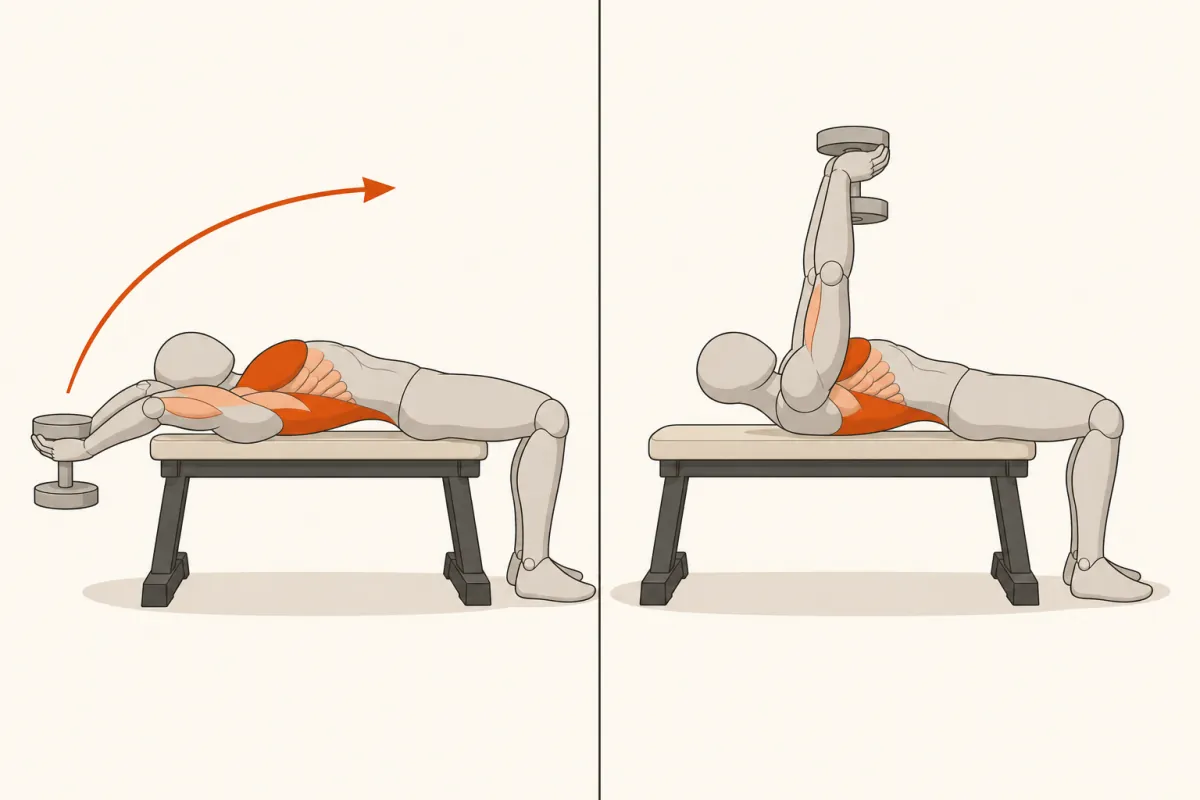
Generated illustration — follow the cues.
Setup
Lie on a flat bench with your head and upper back supported and the feet flat. Hold one dumbbell with both palms cupped under the top plate, arms over the chest, elbows slightly bent.
Cues
- Brace: ribs down and the lower back lightly in contact with the bench.
- Lower the dumbbell behind your head in an arc, keeping the elbow bend fixed.
- Stop when the upper arms are in line with your torso or at a comfortable stretch.
- Inhale on the way down, exhale as you pull it back.
- Bring it back only to above the forehead so the lats and chest stay loaded.
Common mistakes
- Arching the lower back as the weight goes behind the head.
- Bending and straightening the elbows, which turns it into a triceps extension.
- Lowering past a comfortable shoulder stretch or with a heavy, uncontrolled weight.
- A loose grip on the handle instead of cupping the top plate (the dumbbell is over your face).
Muscles
- Main: Lats, Mid chest (sternal pec)
- Helping: Teres major, Lower chest (costal pec), Triceps long head, Serratus anterior
Alternatives
Machine busy or missing? Closest first.
Pick your gym to see which of these it has: Gyms
Warm-up
| Set | Load | Reps |
|---|---|---|
| Warm-up 1 | 4 kg | 8 |
| Working sets | 8 kg | 8–15 reps |
Example for the planner's first working load (8 kg, an 80 kg beginner). The train page builds the same ramp from your own working weight. Before it: 5 min of easy cardio (bike, rower or brisk incline walk) until you are warm and breathing a little faster, then lighter ramp sets before the first working set of each big exercise.
Facts
- Equipment
- Dumbbells
- Movement
- Pullover
- Swap group
- Lat isolation (pullovers)
- Load step
- 2 kg
- Rep range
- 8–15 reps
- Difficulty
- Needs some technique
- Support
- Seat or pad supports the torso
- Lower-back load
- Low
- Stretch
- Hardest where the muscle is long
- Typical start
- 10 kg (untrained 80 kg man)
Also called: Lying dumbbell pullover · Bench pullover · Cross-bench pullover
Sources
- Effects of the pullover exercise on the pectoralis major and latissimus dorsi muscles as evaluated by EMG — J Appl Biomech, 2011. doi.org/10.1123/jab.27.4.380
- Electromyographic analysis of latissimus dorsi activation during common resistance training exercises: a narrative review — J Funct Morphol Kinesiol, 2026. doi.org/10.3390/jfmk11030315
- Dumbbell Pullover Standards — Strength Level, 2026. strengthlevel.com/strength-standards/dumbbell-pullover/kg