Barbell back squat
- Barbell
- Squat & leg press
- 4–8 reps
- Technical
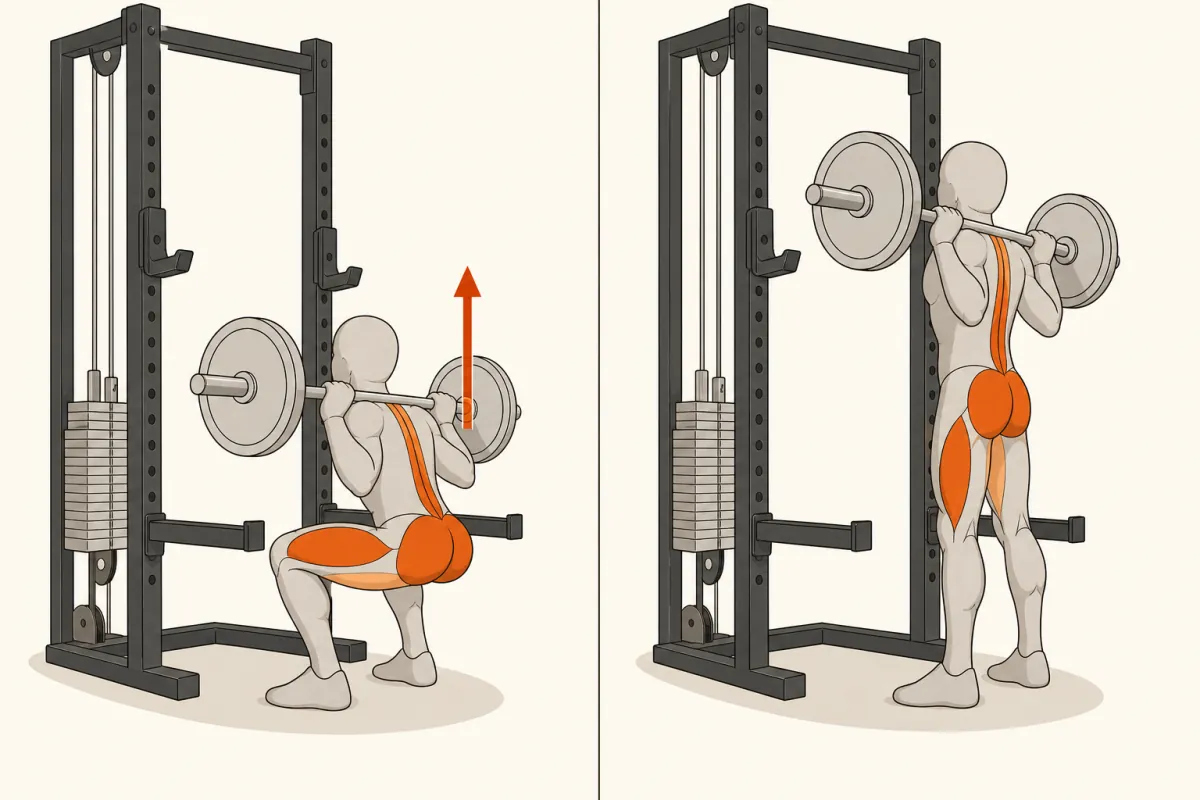
Generated illustration — follow the cues.
Setup
In a power rack, set the J-hooks at mid-chest height and the safety arms just below your bottom position. Bar on the upper back (on the traps, not the neck), hands just outside the shoulders; unrack, take two or three steps back and set the feet shoulder-width, toes out 15–30°.
Cues
- Breathe into your belly and brace before every rep; keep the upper back tight and pull the bar into your back.
- Sit down between your heels (2–3 s) until the thighs are at least parallel, keeping a neutral spine.
- Let the knees travel forward over the toes along the line of the second toe; keep the whole foot planted.
- Drive up so the chest and hips rise together; breathe out near the top.
- First weeks: learn the pattern with the empty bar and add load only while every rep looks the same.
- Training alone: squat only inside the rack with the safety arms set — if a rep fails, sit down and let the bar rest on them.
Common mistakes
- Squatting outside a rack, or without safety arms, when training alone.
- Lower back rounding at the bottom (pelvis tucking under) or over-arching at the top.
- Hips shooting up first so the squat turns into a good-morning.
- Knees caving inward on the way up.
- Bar on the neck, or adding weight faster than your technique allows.
Muscles
- Main: Quadriceps, Gluteus maximus
- Helping: Adductors, Spinal erectors
Alternatives
Machine busy or missing? Closest first.
- Hack squat
- Smith machine squat
- Belt squat
- 45° leg press
- V-squat machine
- Goblet squat
- Bulgarian split squat
Pick your gym to see which of these it has: Gyms
Warm-up
| Set | Load | Reps |
|---|---|---|
| Warm-up 1 | 20 kg | 8 |
| Warm-up 2 | 27.5 kg | 4 |
| Warm-up 3 | 32.5 kg | 2 |
| Working sets | 37.5 kg | 4–8 reps |
Example for the planner's first working load (37.5 kg, an 80 kg beginner). The train page builds the same ramp from your own working weight. Before it: 5 min of easy cardio (bike, rower or brisk incline walk) until you are warm and breathing a little faster, then lighter ramp sets before the first working set of each big exercise.
Facts
- Equipment
- Barbell
- Movement
- Squat & leg press
- Swap group
- Squats & leg presses
- Load step
- 2.5 kg
- Rep range
- 4–8 reps
- Difficulty
- Technical
- Support
- You stabilise yourself
- Lower-back load
- High
- Stretch
- Hardest where the muscle is long
- Typical start
- 45 kg (untrained 80 kg man)
Also called: Back squat · High-bar squat · Low-bar squat · Barbell squat
Sources
- Squat Standards (kg) — Strength Level, 2026. strengthlevel.com/strength-standards/squat/kg
- Effect of knee position on hip and knee torques during the barbell squat — J Strength Cond Res, 2003. pubmed.ncbi.nlm.nih.gov/14636100/
- Effects of squat training with different depths on lower limb muscle volumes — Eur J Appl Physiol, 2019. doi.org/10.1007/s00421-019-04181-y
- A comparison of bone-targeted exercise strategies to reduce fracture risk in middle-aged and older men with osteopenia and osteoporosis (LIFTMOR-M) — J Bone Miner Res, 2020. doi.org/10.1002/jbmr.4008