1Introduction
A book of private notes is not a set of rules. The Meditations return again and again to a few convictions (that we are parts of one whole, that judgments are up to us, that everything passes), but they do so in scattered entries, in images rather than definitions, and never in an order of argument. A reader who wants to live by them has to do the gathering: find where the same thing is said, decide what it is that is said, and remember where it came from.
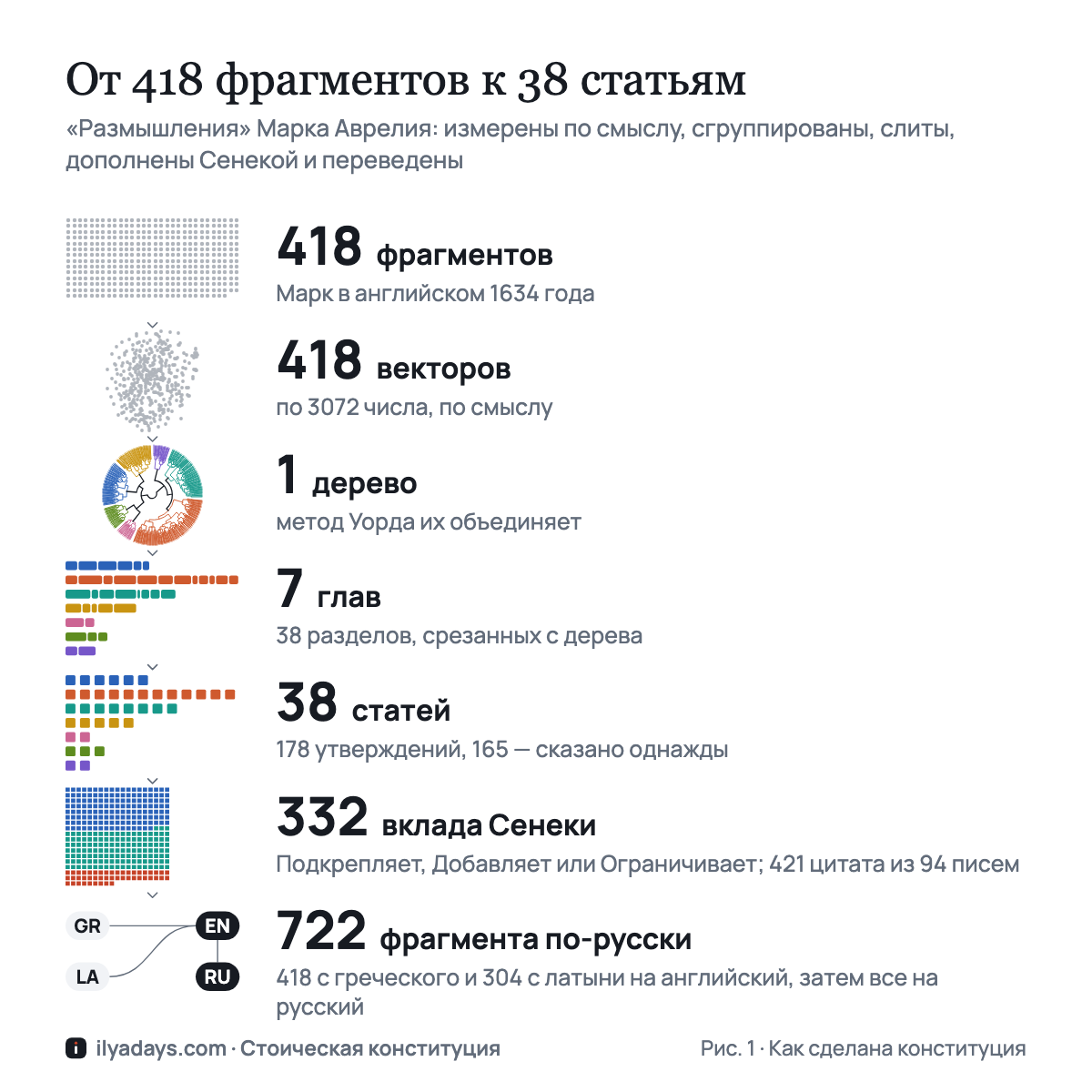
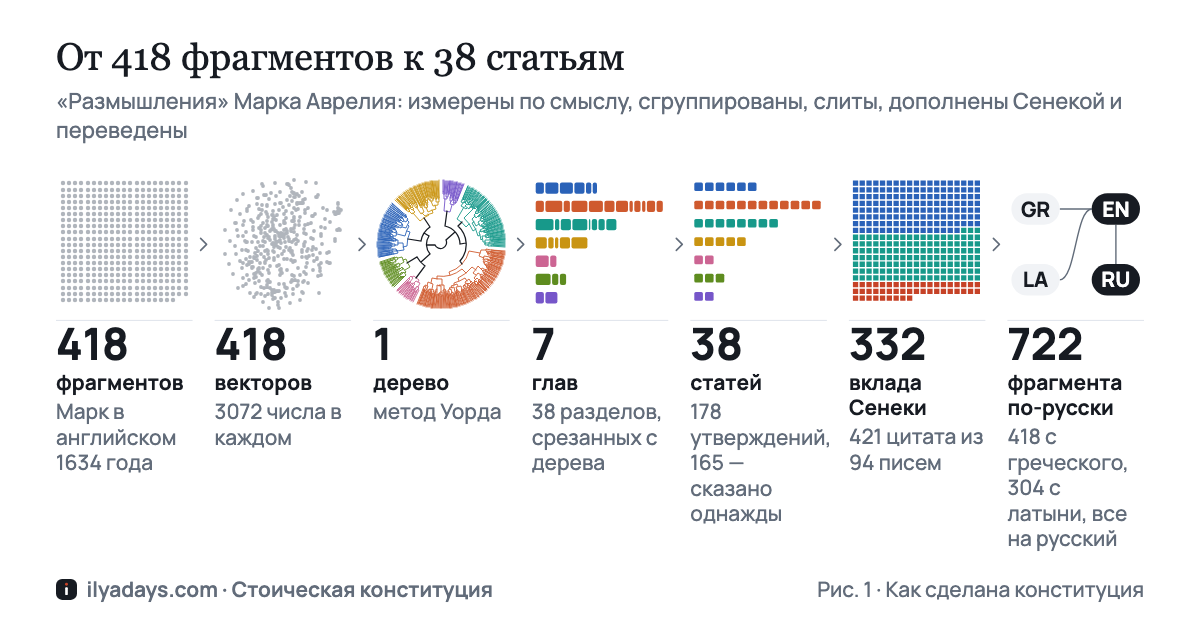
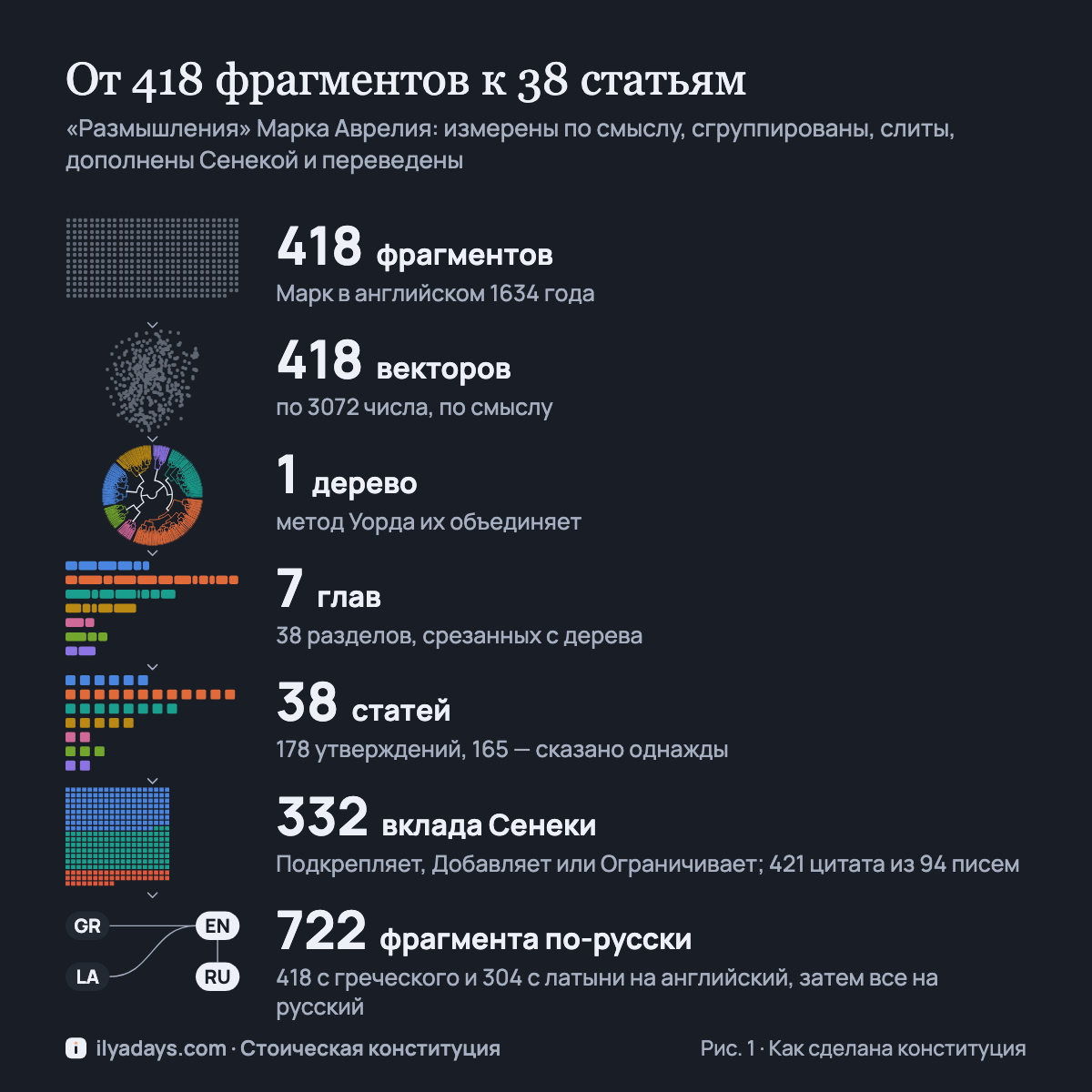
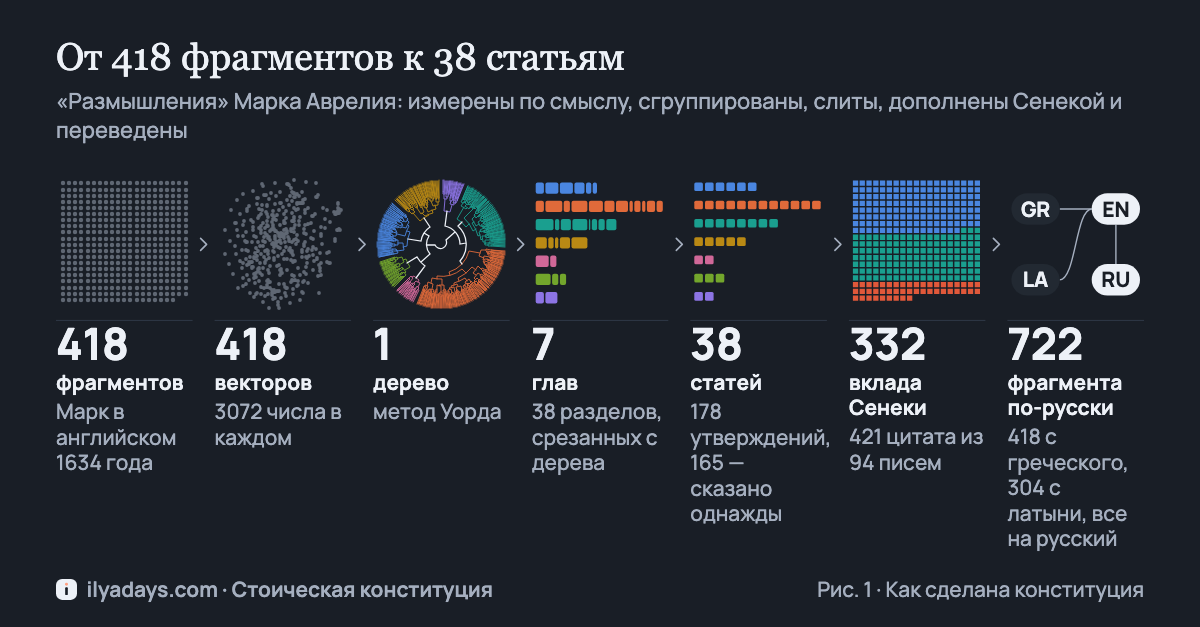
The project described here does that gathering in a way that can be checked. Its goal is a constitution: short first-person articles, each stating one thing, each phrase of which can be followed back to the exact words of the source, and each step the source does not take marked as the editor’s. “Testable” is meant narrowly. A script checks the tracing: a quote either is or is not an exact span of its passage, each phrase a quote is said to give either is or is not in its claim, and a claim either does or does not rest on two passages. Whether a quote really supports the phrase it is mapped to is checked by no script: it is the judgment of the article’s writer and of an independent reviewer, both language models (Section 3), and it awaits the owner’s review. Figure 1 shows the path from passages to articles.
What the project provides is listed below. The paper does not survey related work (on text reuse, the detection of parallel passages, or translation with language models), so none of it is claimed as new against that work.
- a pipeline in which passages are grouped by embedding similarity and each group is fused into claims that rest on at least two passages, with every phrase traced to an exact quote (Sections 3.1–3.4);
- a fixed article schema: one statement, five sides (why, in action, practice, when it breaks, if I doubt it), points said once kept apart, and the editor’s inferences marked (Sections 3.4–3.5);
- a way to add a second author, Seneca, whose every contribution is typed as backing, adding or limiting and whose clauses never rewrite the first author (Section 3.6);
- a three-reader translation procedure from Greek and Latin, and a Russian edition in which every quote is re-cut and every rule is checked again (Section 3.7);
- a feedback loop that turns each of the owner’s remarks into a dated rule applied to all articles, and into a mechanical gate where possible (Sections 3.8 and 4);
- the whole record, scripts, prompts and translations, published; the translations are dedicated to the public domain.
DownloadLightPNG squarePNG landscapeSVG squareSVG landscapeDarkPNG squarePNG landscapeSVG squareSVG landscapeAll figures
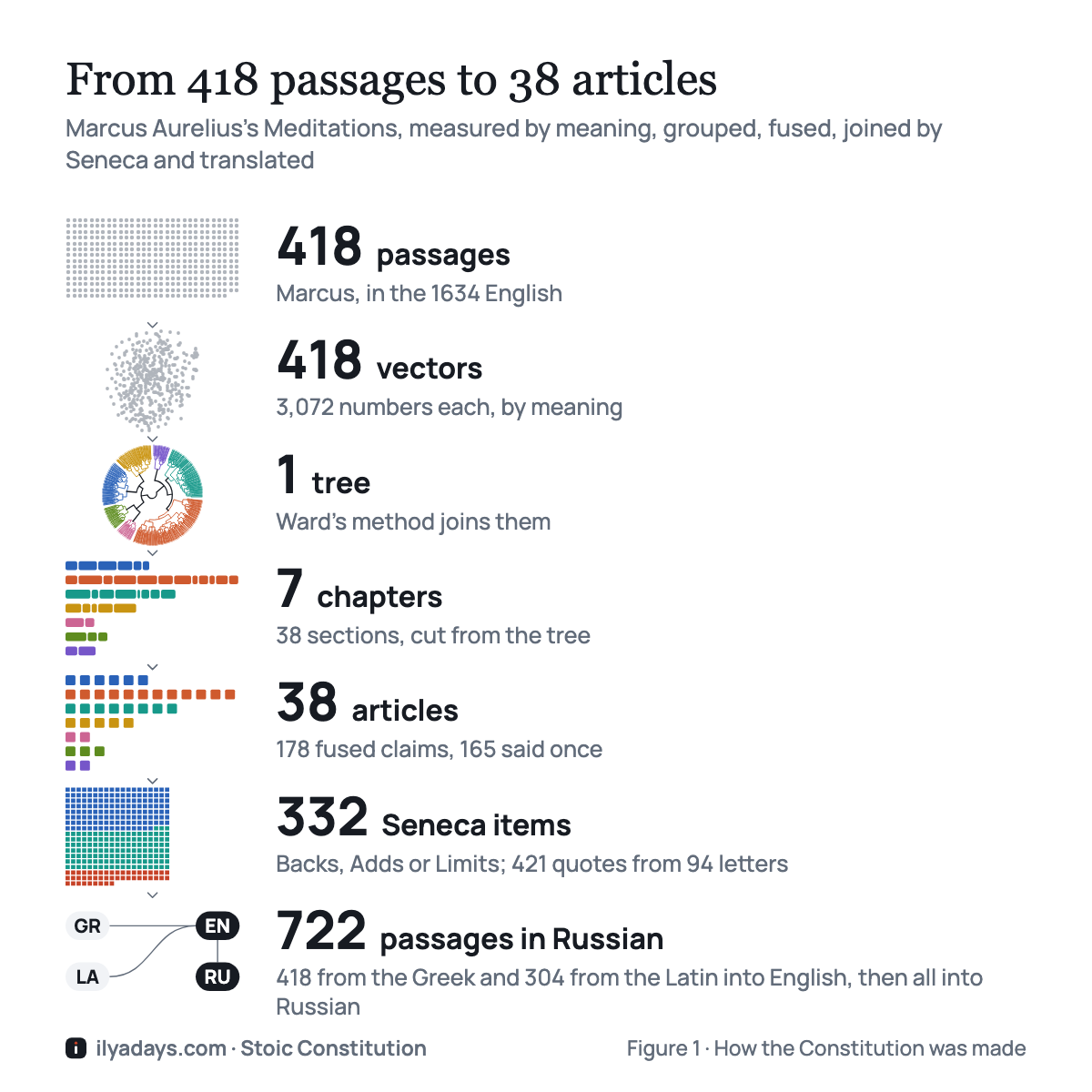
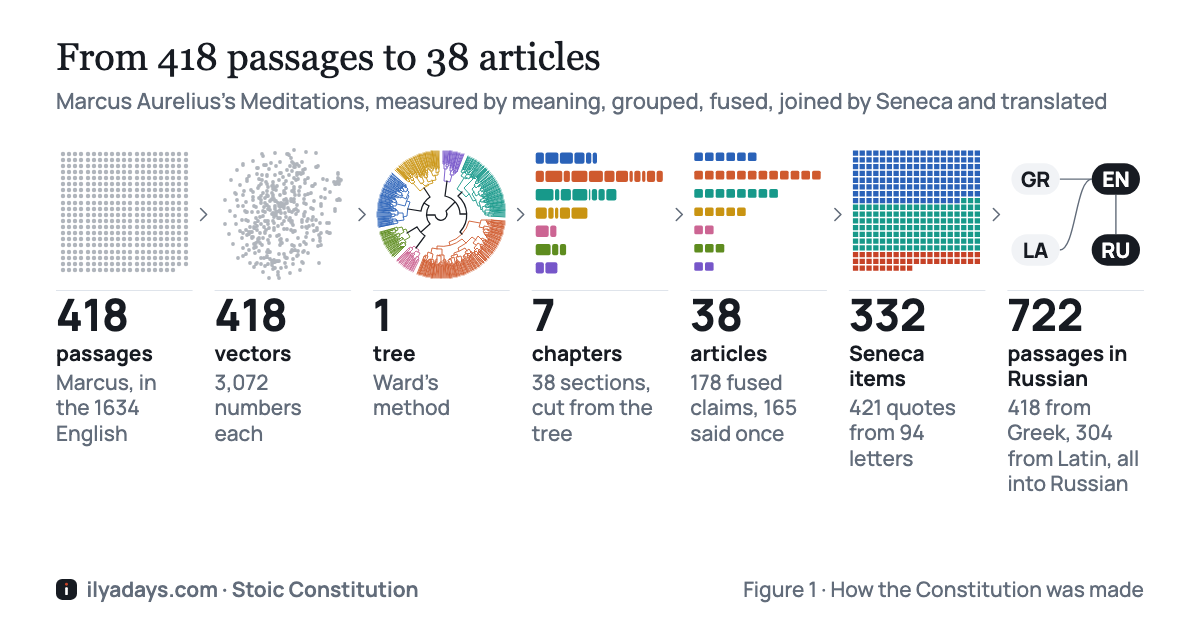


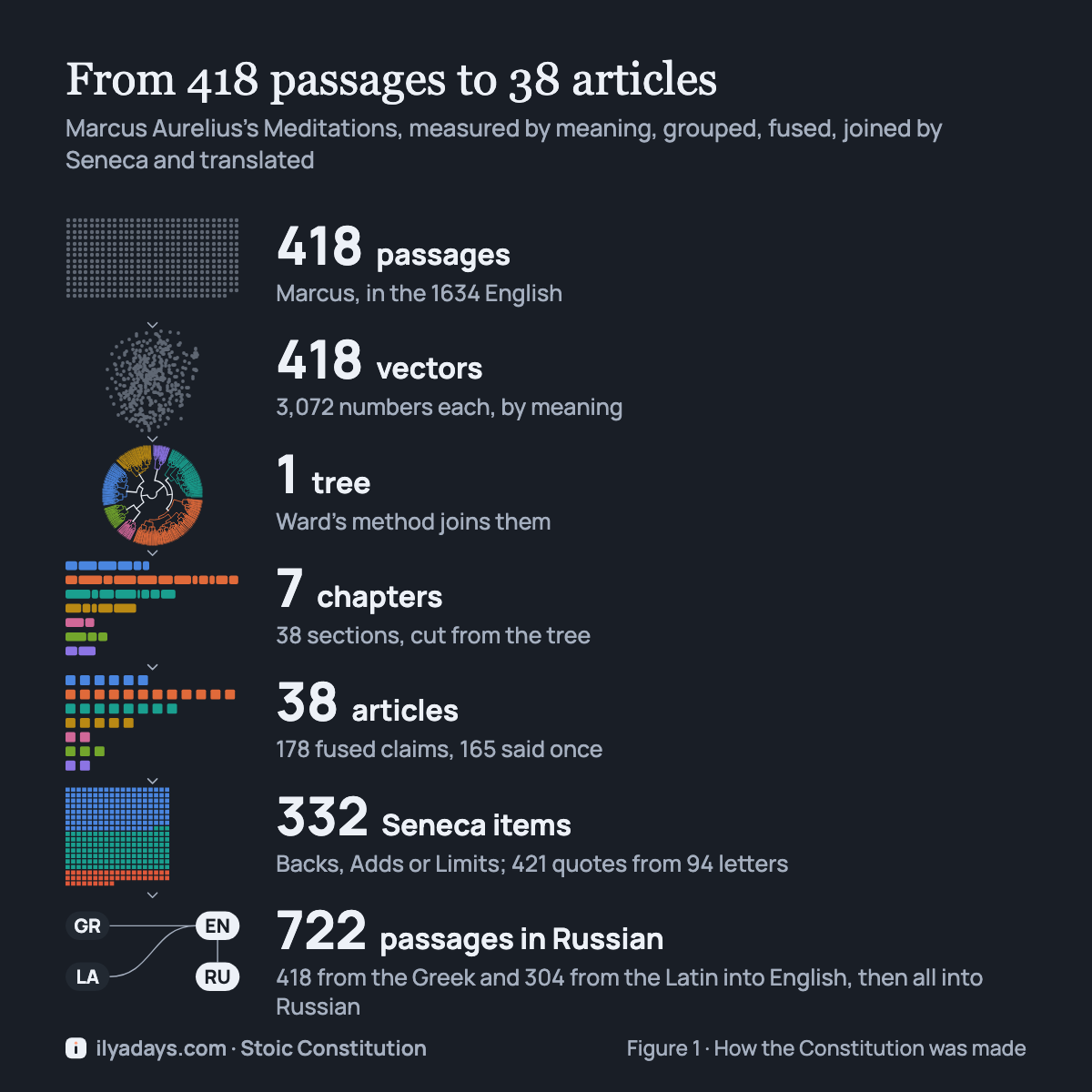
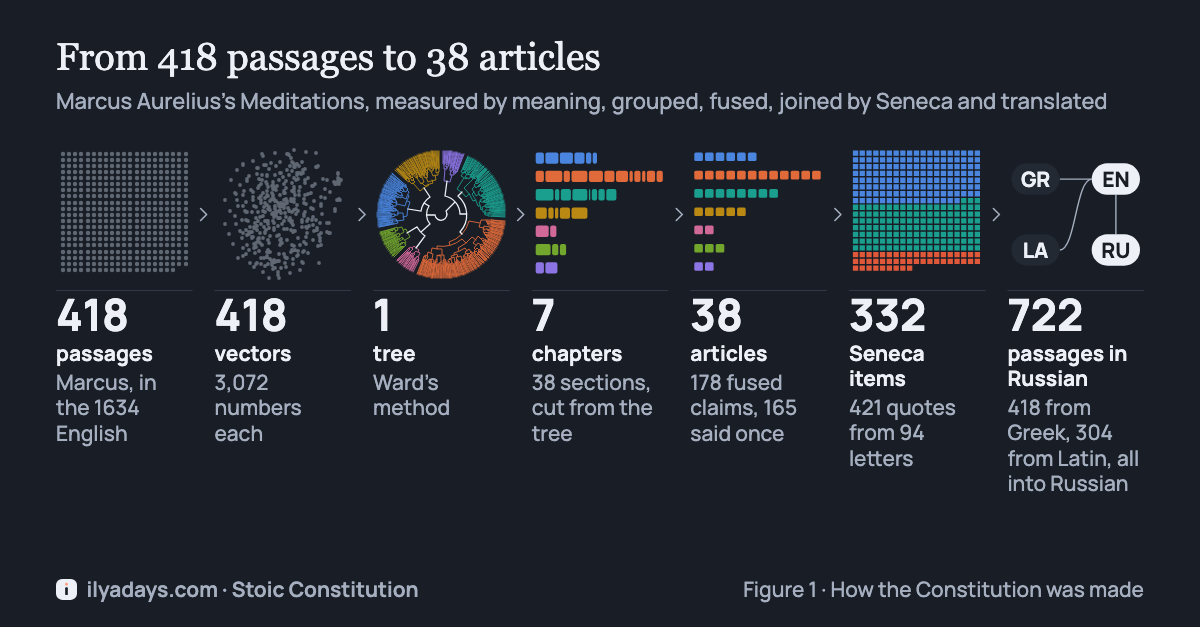


This paper describes the method as it was run on 23–24 November 2026. The articles themselves are on the Constitution page; a hand-worked example of joining two passages, three ways, is the composition study.
2Materials
Five texts are involved, each with one role (Table 1). The corpus that was measured is Meric Casaubon’s English translation of 1634 [1], divided into 418 numbered passages. The chapters and sections were found on this text, and every passage keeps its 1634 number and an immutable revision id as its identity, even though the articles now quote a new translation. The Greek is J. H. Leopold’s edition of 1908 [2]. Seneca’s Moral Letters to Lucilius were searched in Richard Mott Gummere’s Loeb translation [3] and are quoted only in the project’s own translation from the Latin [4].
| Text | Role | Source | Rights |
|---|---|---|---|
| Marcus, English, Casaubon 1634 | Corpus embedded and clustered; identity of passages; shown for comparison | Project Gutenberg 2680 | Translator died 1671: free everywhere |
| Marcus, Greek, Leopold 1908 | Source of the new translation; shown beside each passage | Perseus Digital Library, tlg0562.tlg001.perseus-grc2 | Editor died 1925; the digital file is CC BY-SA |
| Marcus, project English (project-v1) | The text every article quotes | This project, from the Greek | Dedicated to the public domain (CC0) |
| Seneca, Latin | Source of the Seneca translation | The Latin Library, checked against Latin Wikisource | Older public-domain text |
| Seneca, project English (seneca-v1) | The text every Seneca quote is cut from: 304 sections of 94 letters, 303 quoted | This project, from the Latin | CC0 |
| Seneca, English, Gummere 1917–25 | Private search corpus only; never quoted | English Wikisource | Translator died 1969: free in the US; protected in the EU, UK and Turkey through 2039 |
The build refuses to publish any clause of 30 or more characters that appears in Gummere and not in the project’s English. The 304th translated Seneca section (66.5) serves a frozen test record. The project’s English of Marcus and of the Seneca selection, and their Russian, can be downloaded under CC0 [13] as EPUB, Markdown and plain text: Marcus EPUB · Markdown · text; Seneca EPUB · Markdown · text; Russian Marcus · Seneca. They contain English or Russian only, so the CC BY-SA of the Greek file does not attach to them.
3Methods
Three kinds of tool were used. Numerical work (embedding, clustering, layout) used the OpenAI embedding model [7] and NumPy [11], SciPy [9] and scikit-learn [10]. Reading and writing were done by language models from Anthropic [12], each with a written brief and, except the Russian translator when it settled its points (Section 3.7), in a fresh context: Claude Fable 5.2 (the three readings of every Greek and Latin translation; article writers and the first reviews), Claude Opus 5.5 (article writers and reviewers after the paid budget was spent; the Russian translation) and Claude Sonnet 5.5 (checking the Russian). Every rule a script can check was checked by script (Section 4).
3.1Embedding
Each of the 418 passages, in Casaubon’s exact text, was sent to OpenAI’s text-embedding-3-large [7], which returns a vector of 3,072 numbers. The full length was kept; shorter vectors, which the model can return, were not used. Vectors are cached under a hash of the exact text and the model settings and are kept privately with the corpus; the published files hold only references and derived numbers.
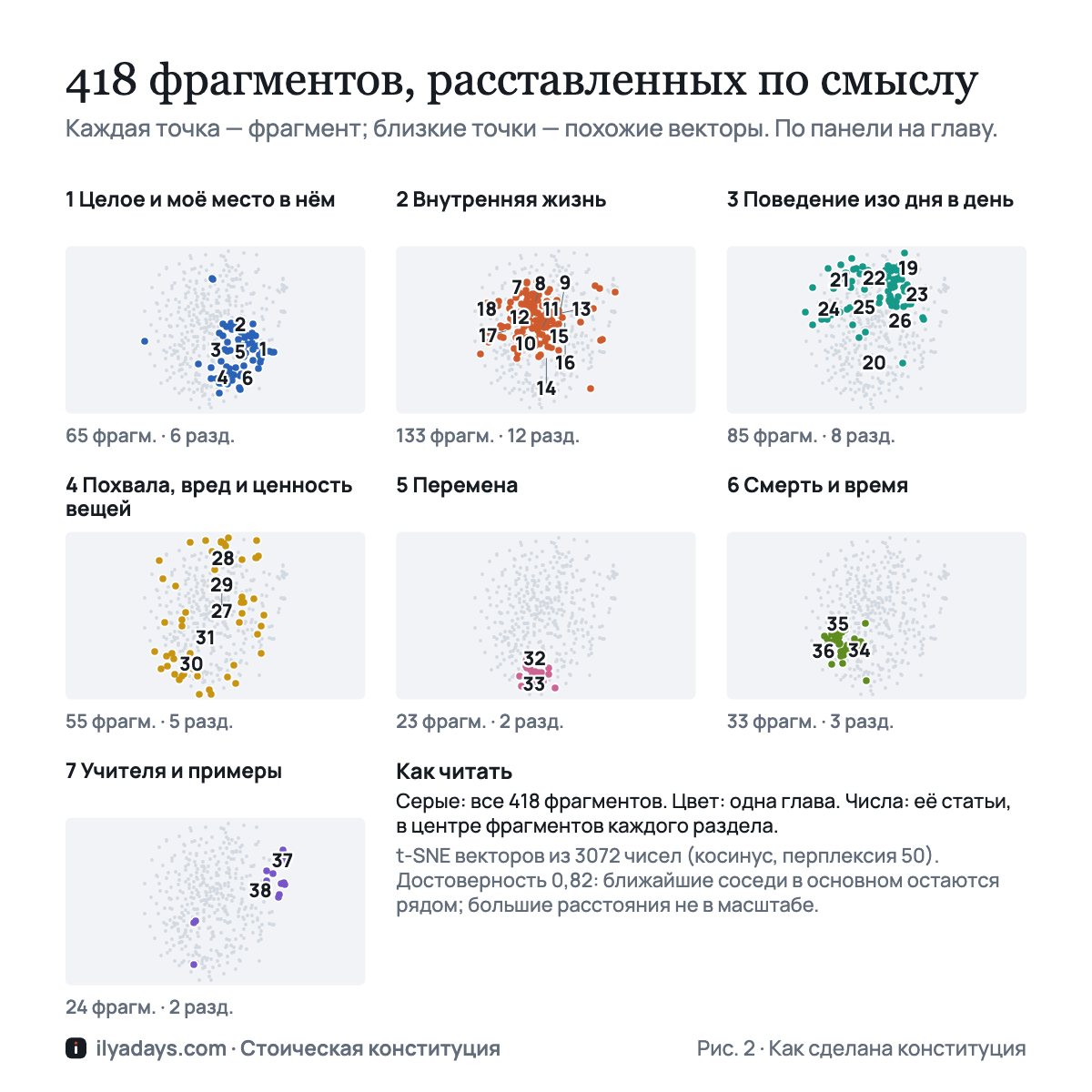
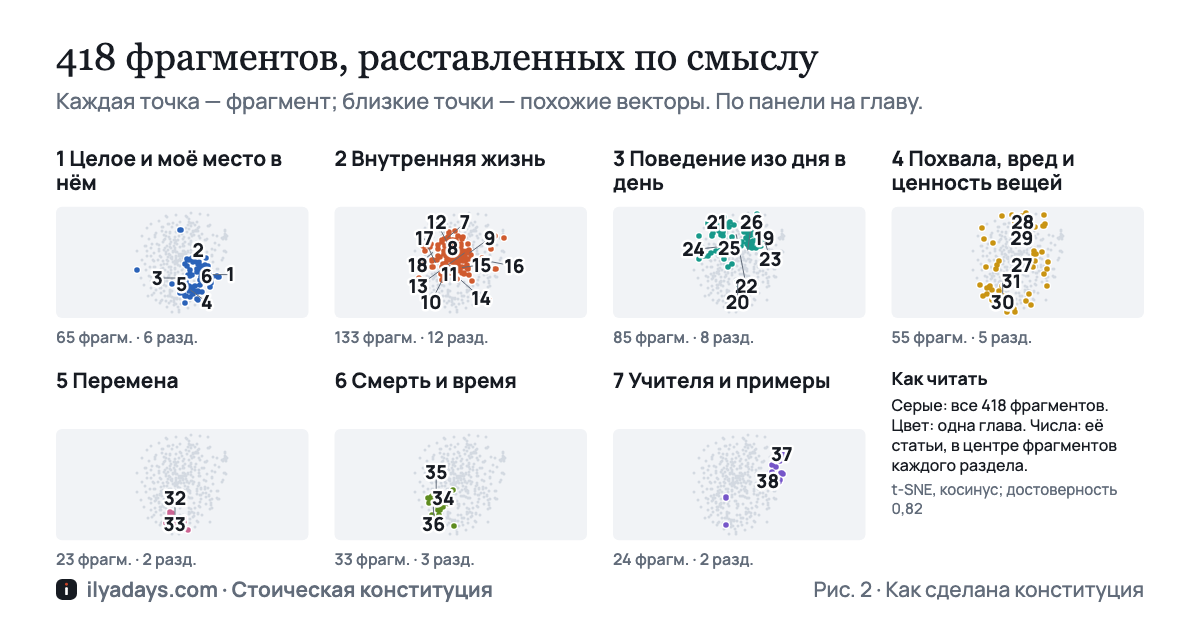
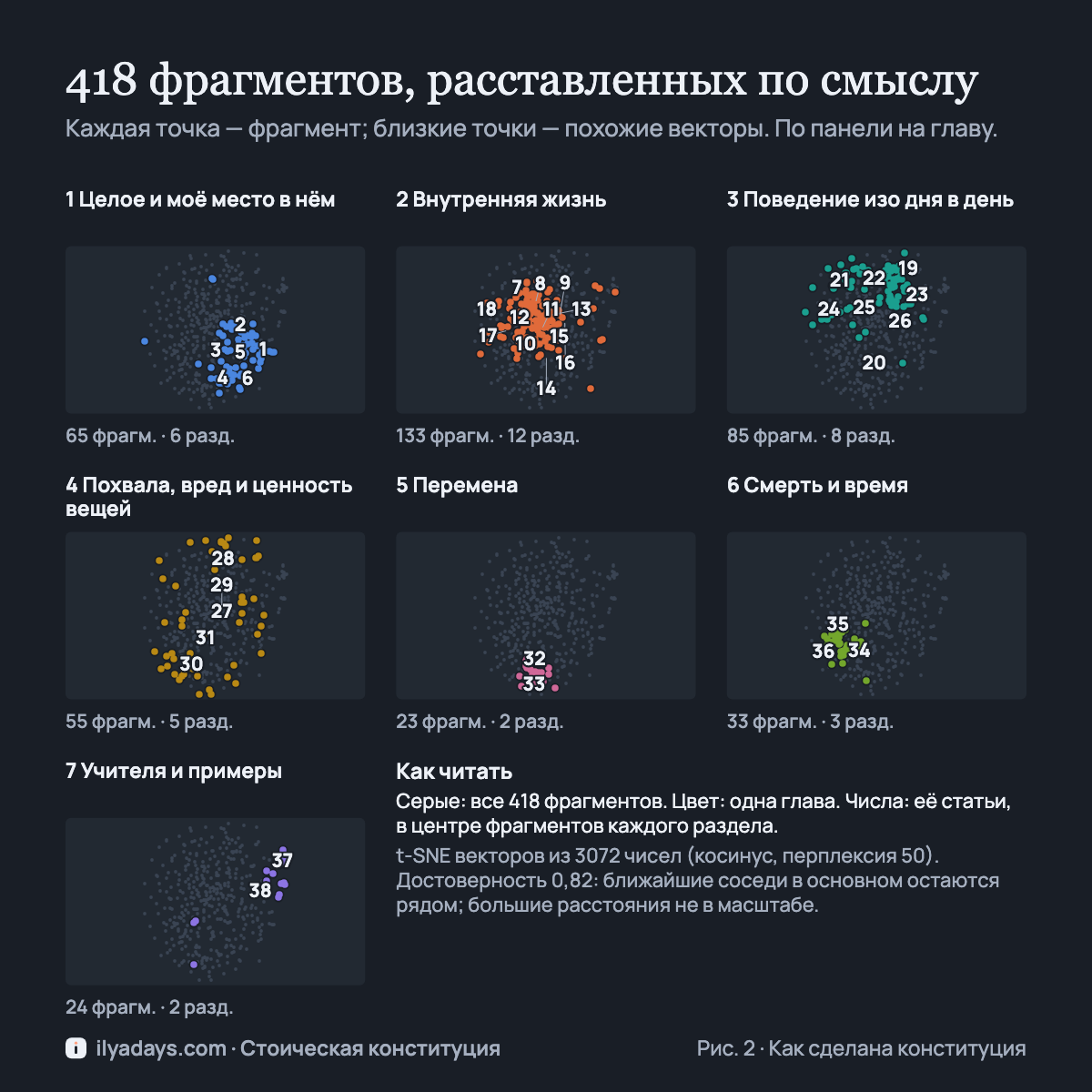
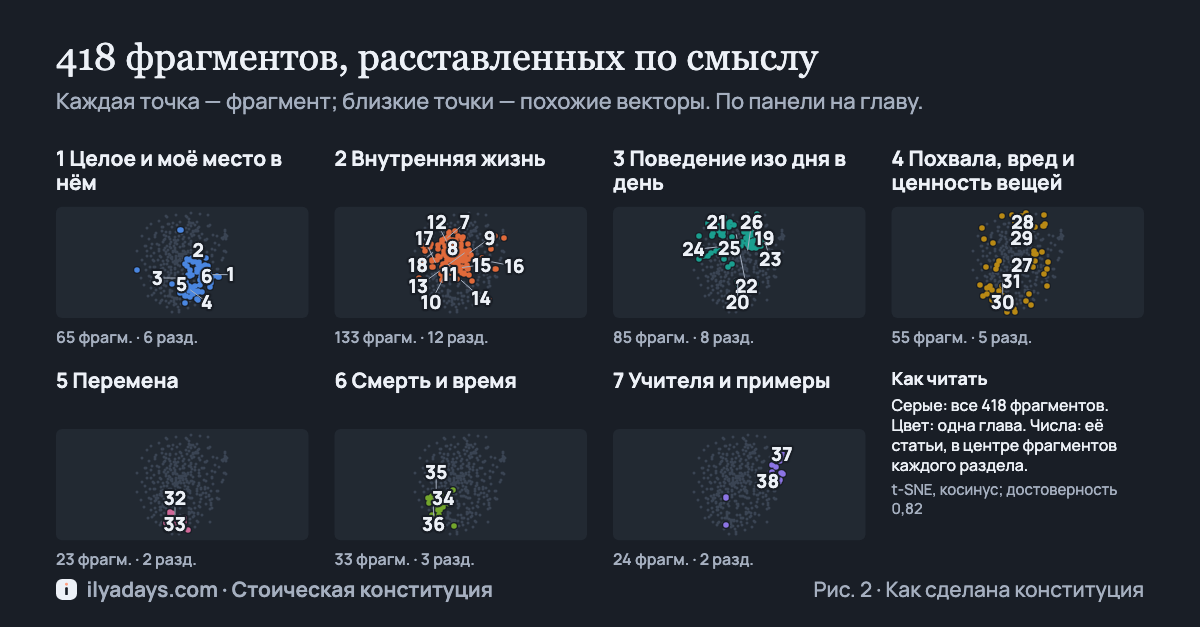
Closeness is cosine similarity, the cosine of the angle between two vectors: passages 9.7 and 7.10 of Article 1’s section have similarity 0.655, an angle of 49°. Figure 2 places all passages by closeness, flattened to two dimensions by t-SNE [14] (cosine distance, perplexity 50, one fixed seed). Its trustworthiness [15], which measures how far the picture’s near neighbours are near in the full space as well (one is perfect), is 0.822 over 10 neighbours: near dots are similar, far dots are not to scale. Across the whole book the median similarity of two passages is 0.468; inside the section behind Article 1, the pairs of its ten passages run from 0.439 to 0.756. A section’s centre is the mean of its members’ vectors, each first scaled to unit length, and a passage’s closeness to a section is its similarity to that centre. A section’s tightness is a different measure: the mean similarity of all pairs of its passages (Section 5.3). When the project’s own English existed, it was embedded with the same model, and every article reports closeness on both texts.
DownloadLightPNG squarePNG landscapeSVG squareSVG landscapeDarkPNG squarePNG landscapeSVG squareSVG landscapeAll figures
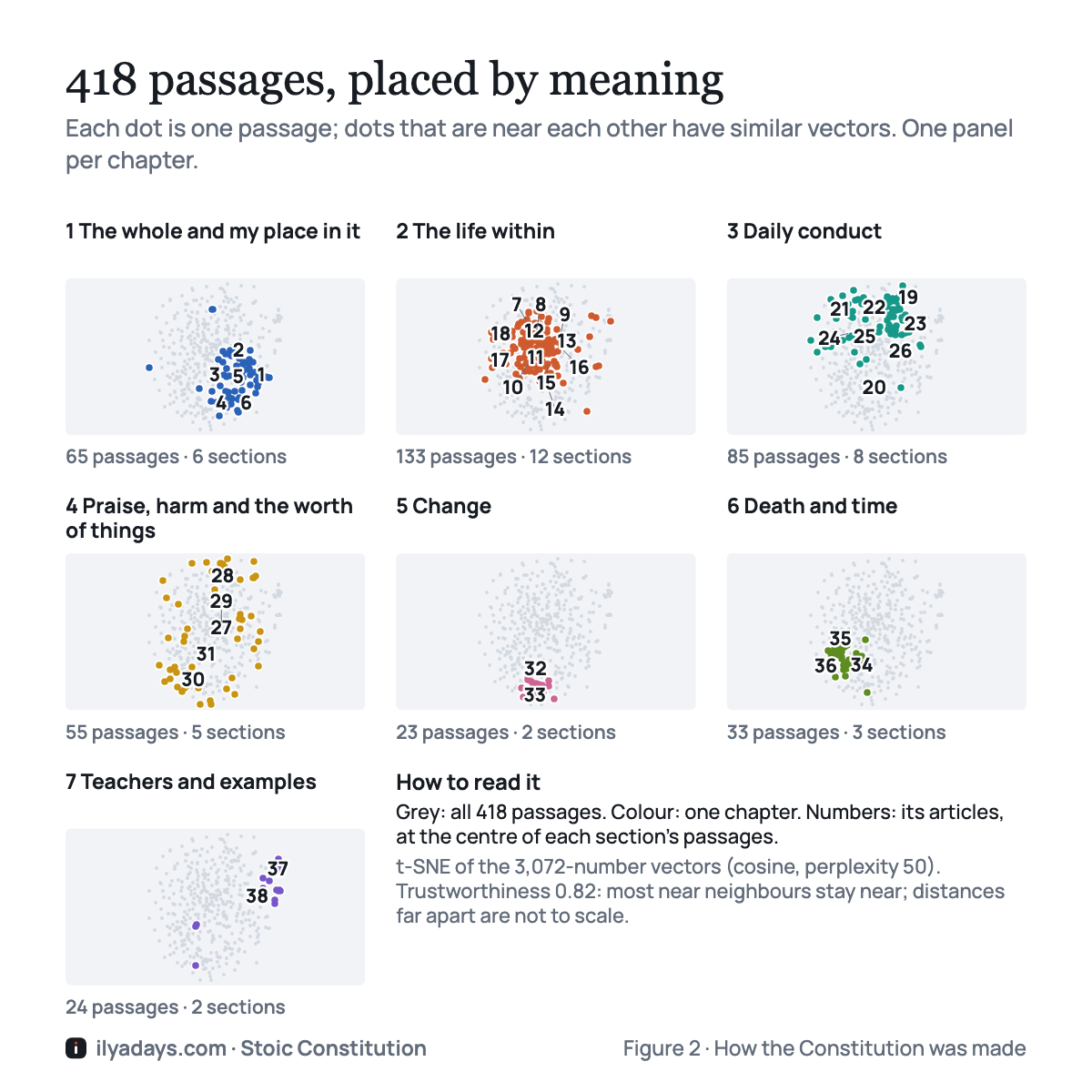
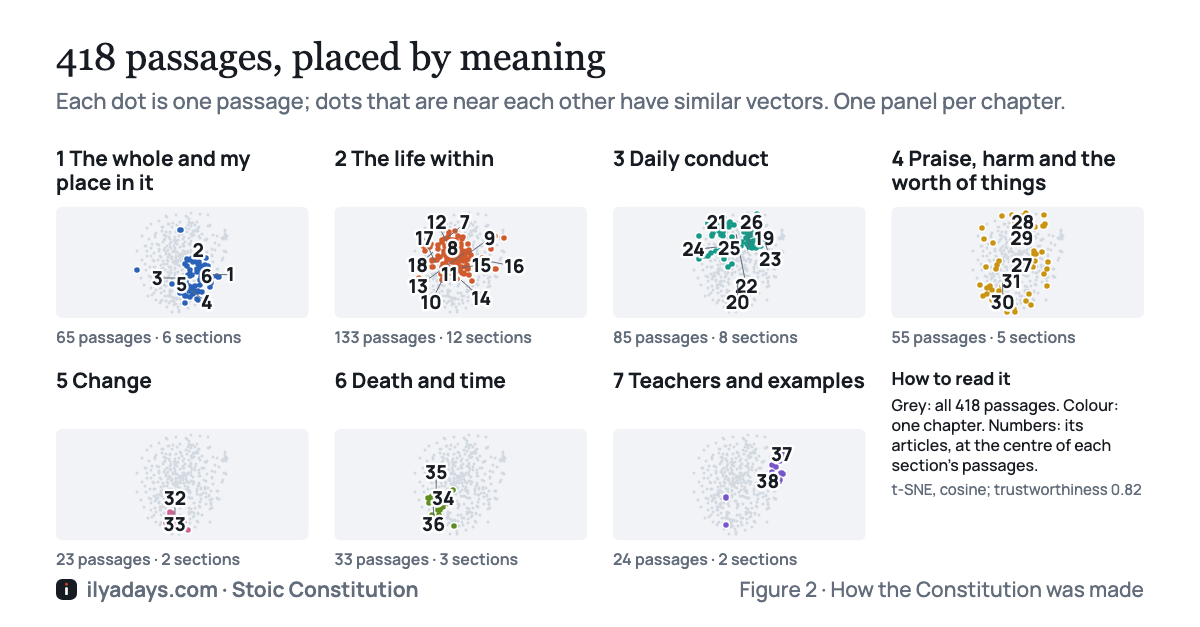


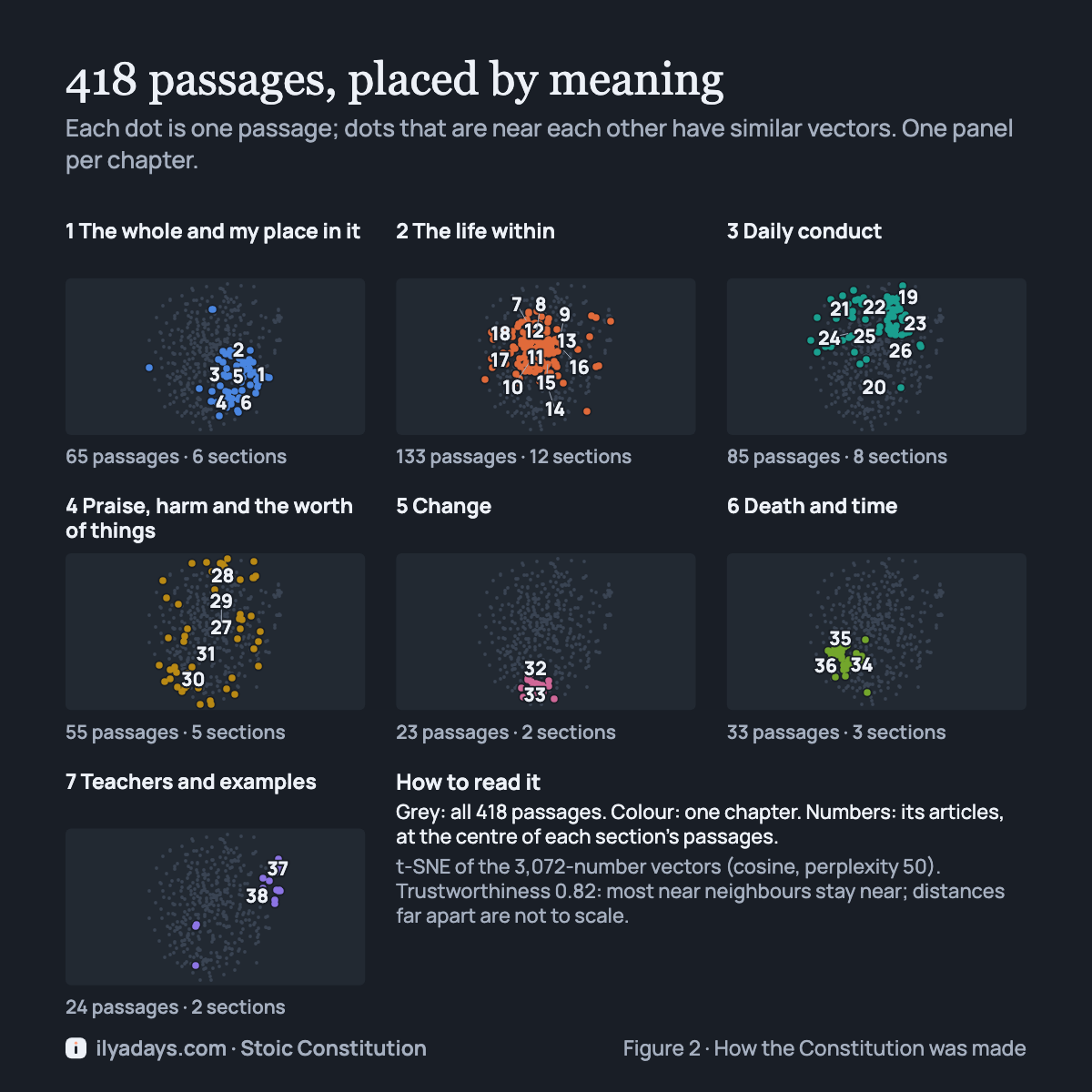
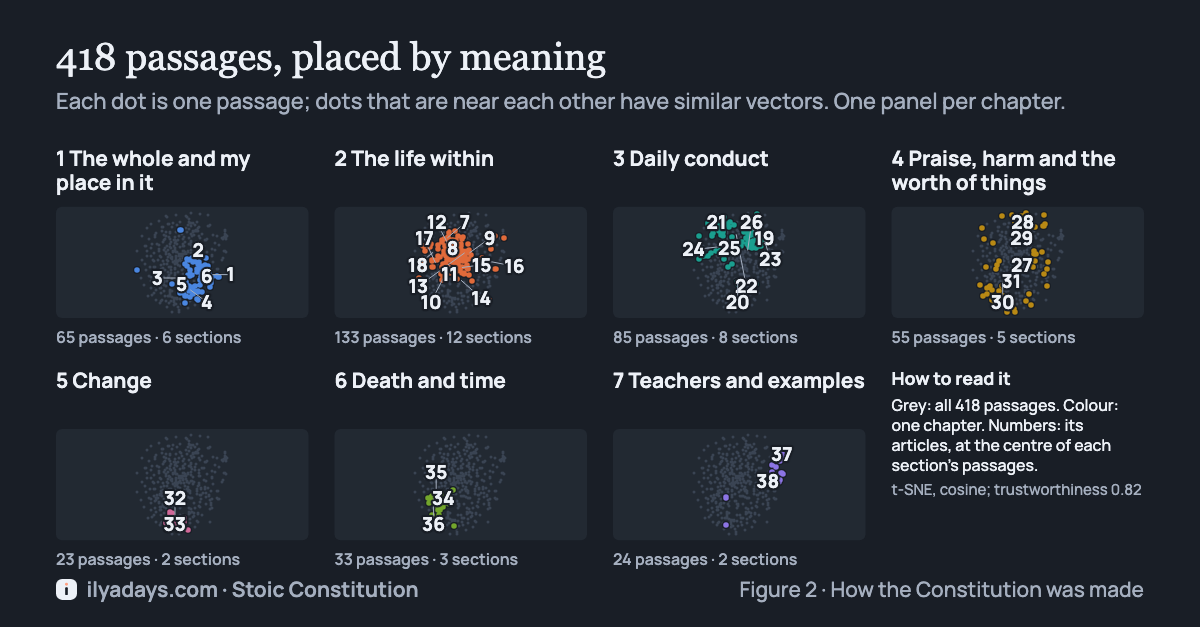


Code and data: apps/aurelius/aurelius/embeddings.py · scripts/stoic-method-diagram-data.py · public/apps/stoic-method/diagram-data.json
3.2Clustering
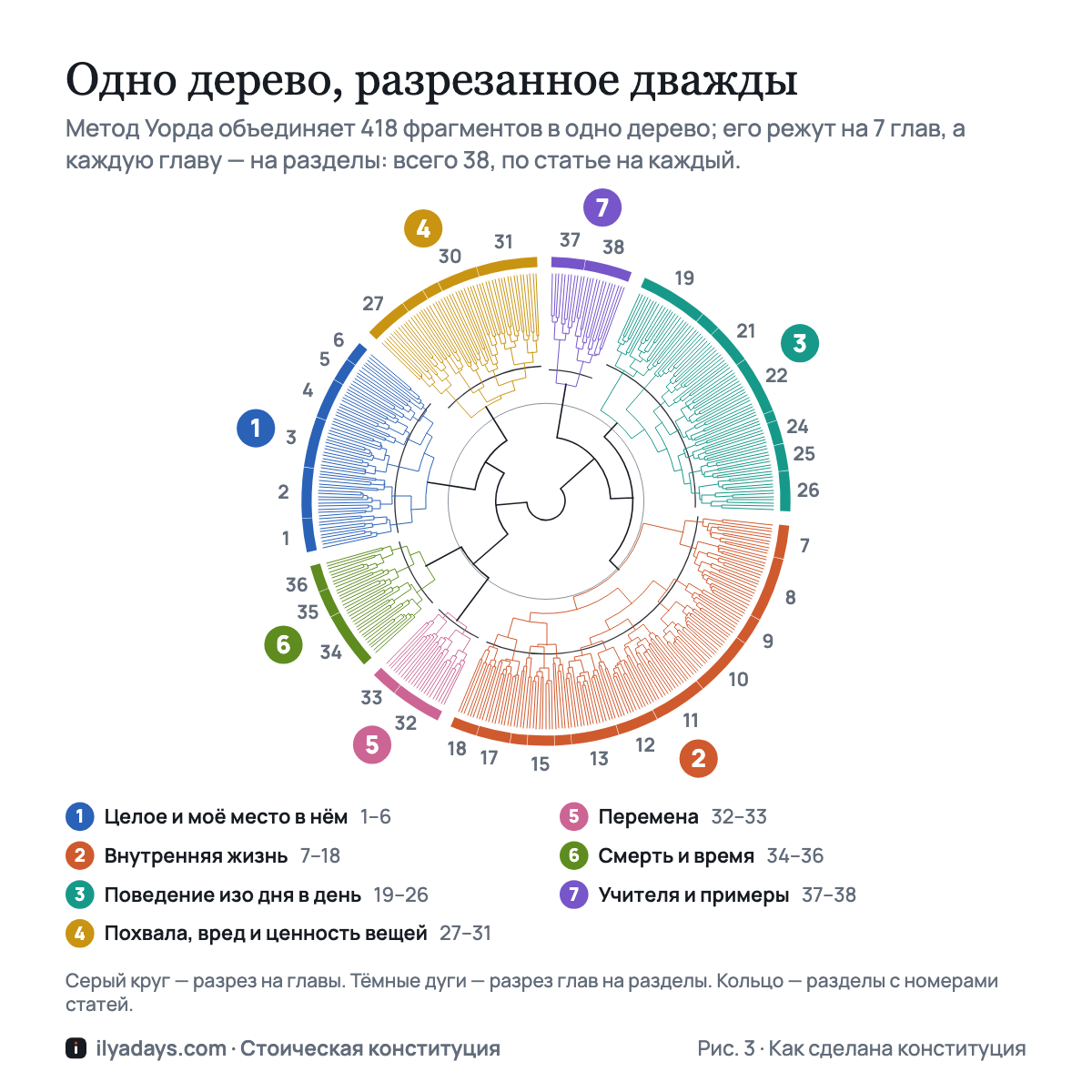
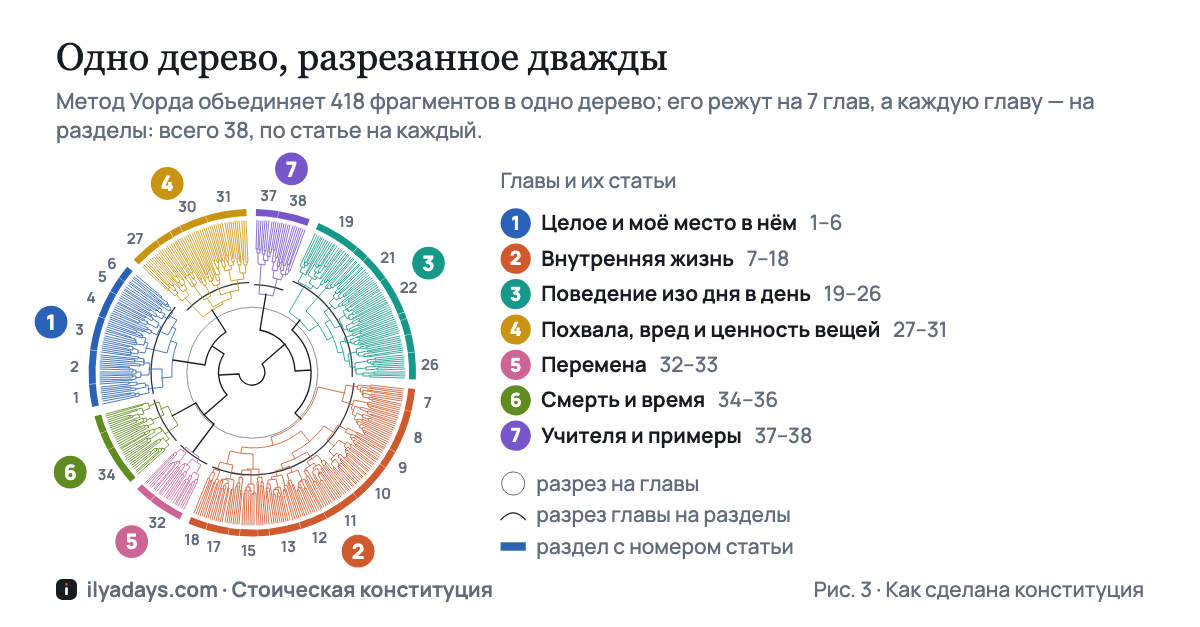
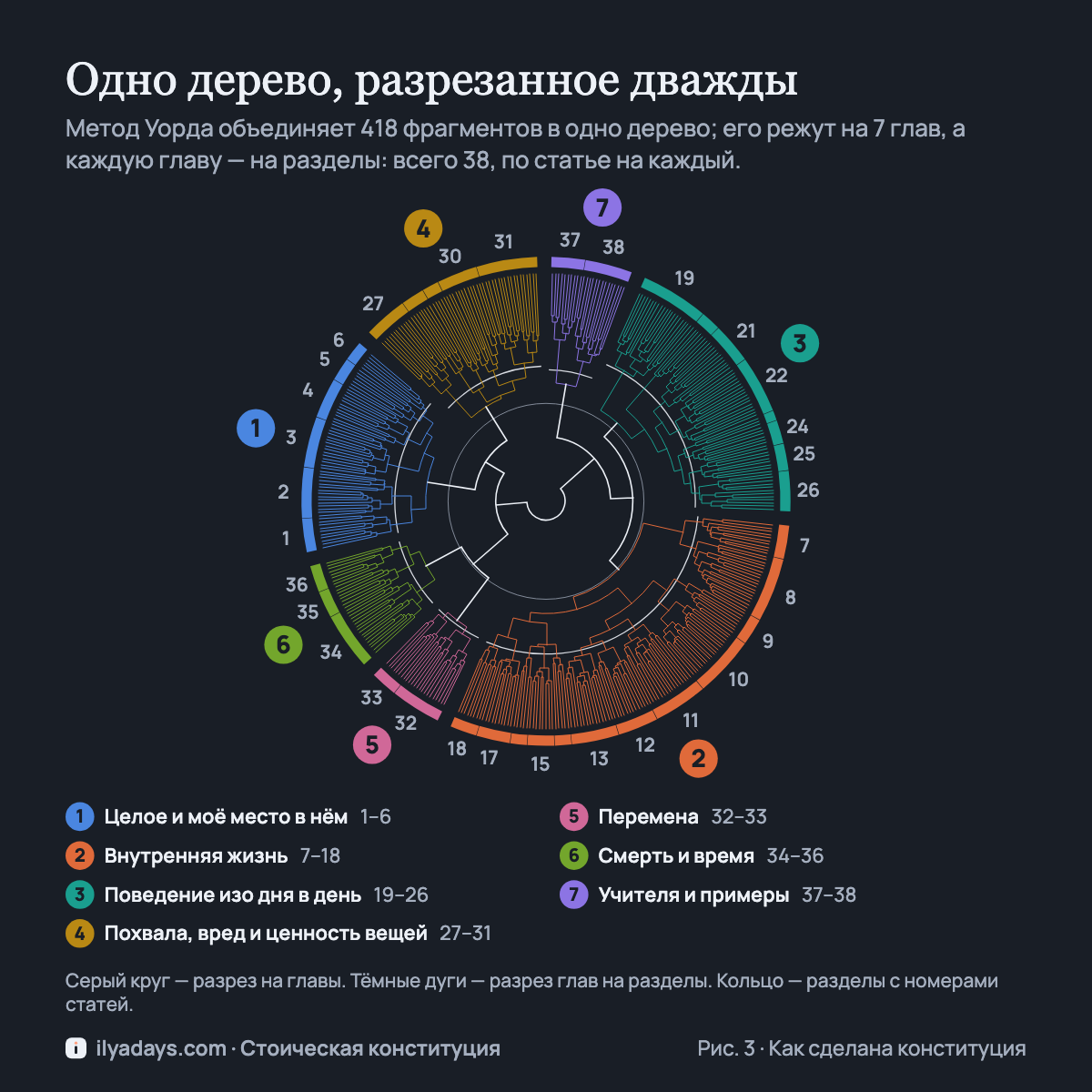
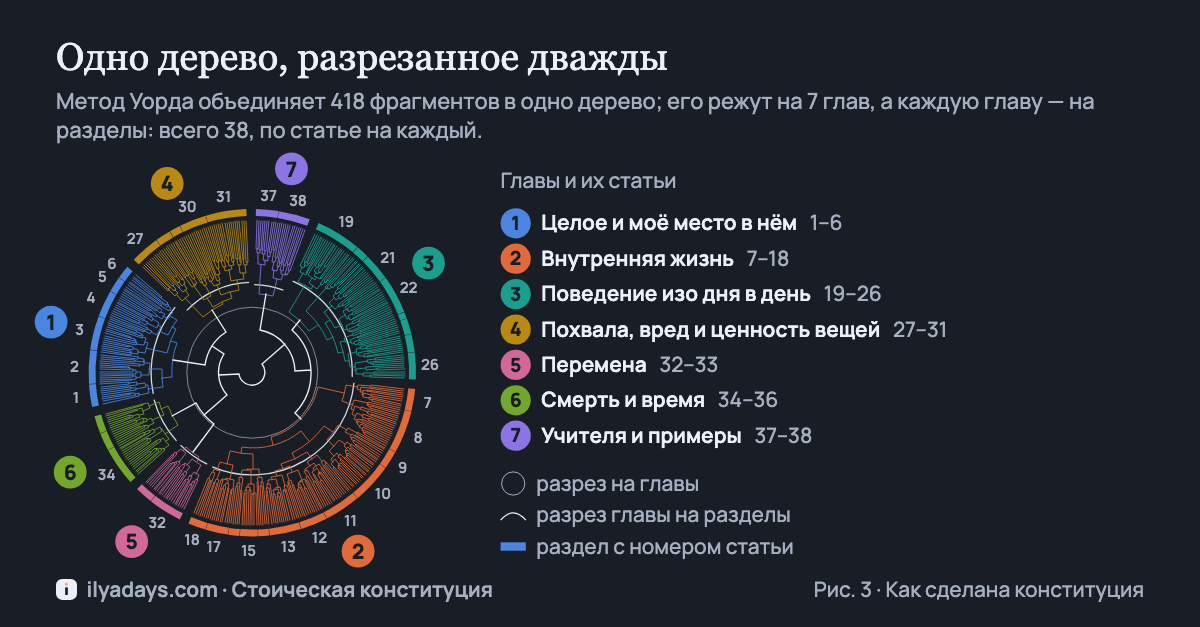
One tree was built over all vectors by Ward’s method [5]: starting from single passages, it repeatedly merges the two groups whose union adds the least within-group variance. Vectors were scaled to unit length first, so Euclidean distance orders pairs exactly as cosine similarity does. The number of chapters is a fixed choice, CHAPTERS = 7 in scripts/aurelius-topics.py, not the result of a rule. Version 2.0 of this paper and the script’s comment gave a rule, the largest number of groups before one has fewer than twenty passages; on this tree that rule gives 9, and no rule of that form gives seven, because at eight groups the smallest group is still 23 passages, as at seven (Table 2). The record gives no further reason for seven. Each chapter was then clustered again by the same method and cut into max(2, round(n ÷ 11)) sections, giving 38 sections (Figure 3). Each section became one article. The tree gives groups, not an order: inside a chapter the sections follow the tree, and the order of the chapters is an editorial choice (the chapter on the whole and my place in it comes first, because the others lean on it).
Ward was chosen over the planned average linkage because, at seven groups, average linkage puts 412 of 418 passages into one group (Table 2). The silhouette [6], which compares each passage’s closeness to its own group with its closeness to the next, is near zero for Ward. Average linkage scores higher (0.214) only because six of its seven groups are single passages, each far from the one large group; for so degenerate a cut the silhouette is no fair comparison. Section 5.3 sets these values against chance. A section is therefore treated as a neighbourhood of passages worth reading together, not as a proven theme: the article must find what its passages really share, and may set passages aside.
topics.json), and Ward cut at five to ten groups (from diagram-data.json), on the 1634 English.| Linkage | Group sizes | Largest share | Silhouette (cosine) |
|---|---|---|---|
| Ward (used) | 133, 85, 65, 55, 33, 24, 23 | 0.318 | 0.009 |
| Complete | 267, 109, 21, 8, 7, 4, 2 | 0.639 | 0.013 |
| Average | 412, 1, 1, 1, 1, 1, 1 | 0.986 | 0.214 |
Ward cut at five to ten groups (the cut used in bold)
| Chapters | Smallest group | Largest group | Silhouette (cosine) |
|---|---|---|---|
| 5 | 24 | 218 | 0.0365 |
| 6 | 24 | 133 | 0.0213 |
| 7 | 23 | 133 | 0.0086 |
| 8 | 23 | 104 | −0.0006 |
| 9 | 20 | 104 | 0.0009 |
| 10 | 13 | 104 | 0.0064 |
DownloadLightPNG squarePNG landscapeSVG squareSVG landscapeDarkPNG squarePNG landscapeSVG squareSVG landscapeAll figures
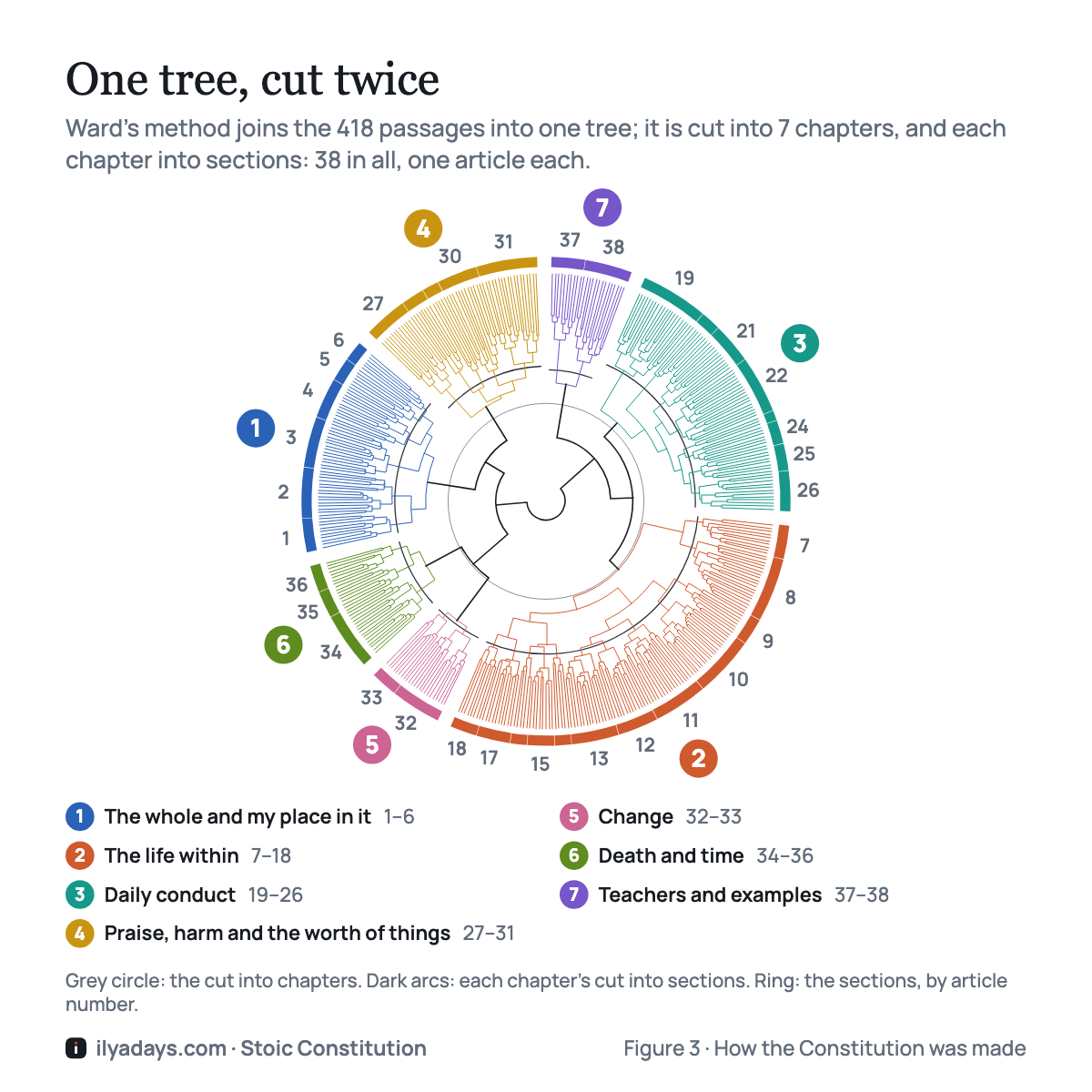
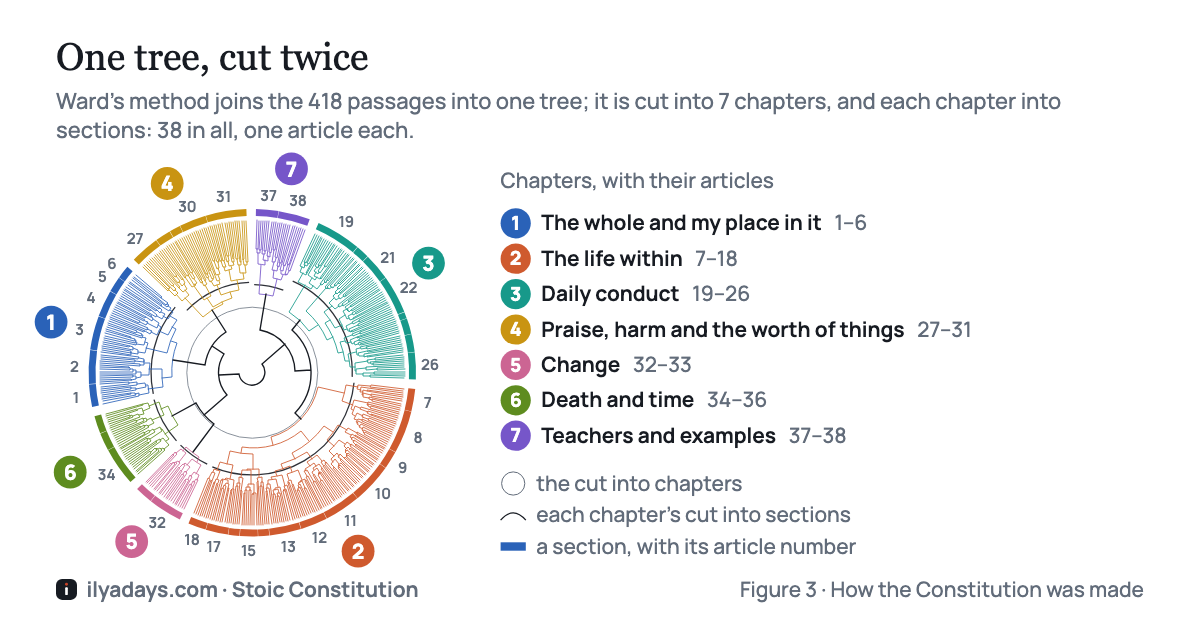


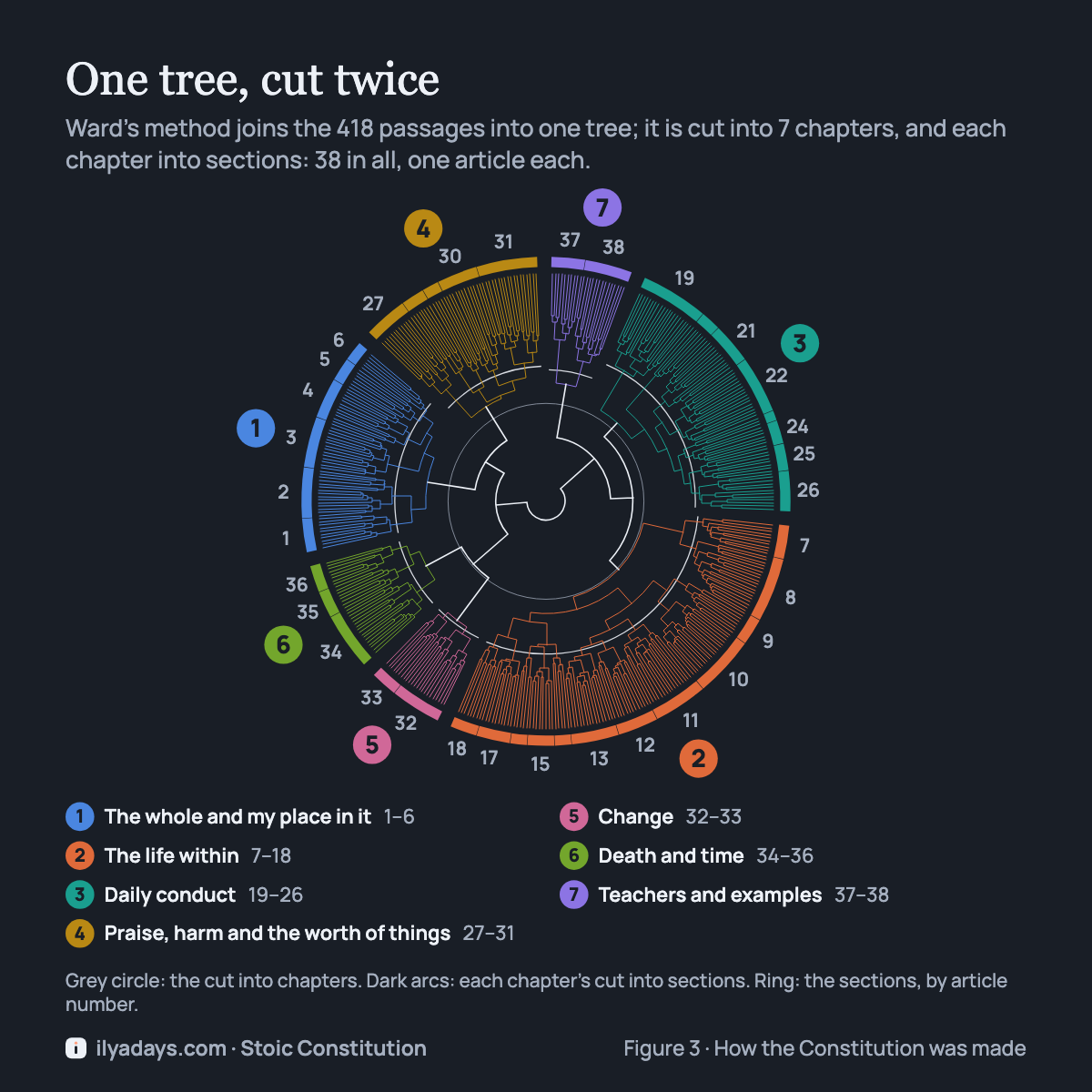
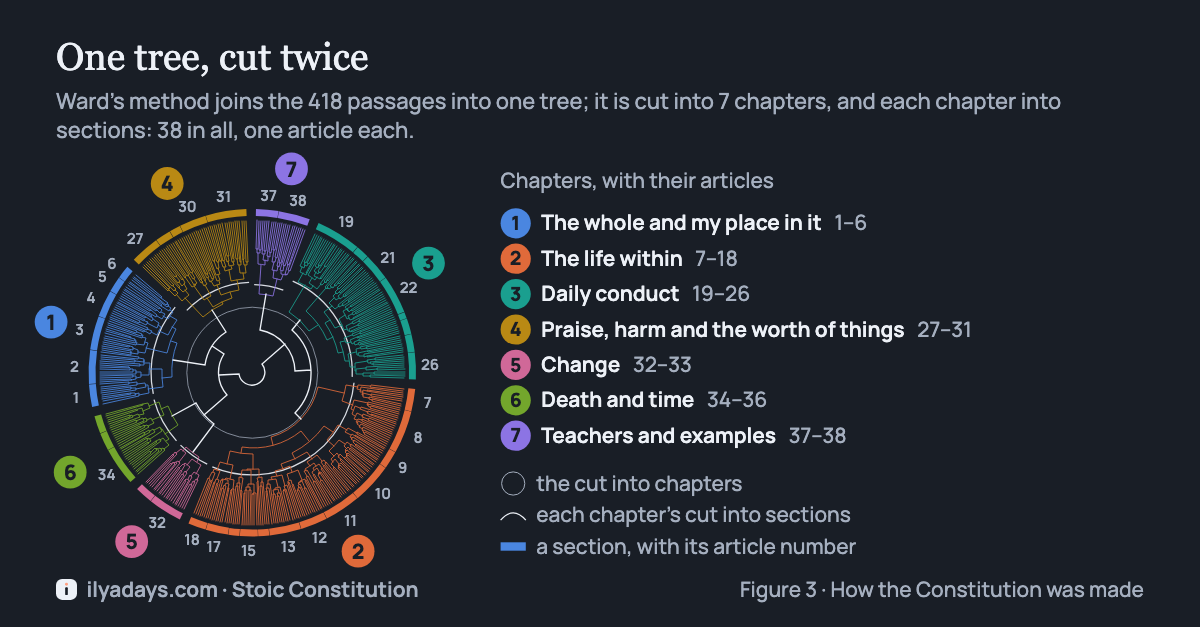


Order of work. The sections were grouped on the 1634 English, before the project’s translation existed. The cleaner order, later written down as a rule, is translate, embed, group, then write. How far the grouping carries over to the new English, measured in one space at a time, is in Section 5.3. The 38 sections were kept and nothing was moved.
Code and data: scripts/aurelius-topics.py · content/aurelius/topics.json
3.3Naming
Clustering yields numbers, not names. Each section first received a provisional name from its three most central passages. Each chapter was then read before its articles were written, every passage of every section whose translation existed: for Article 7’s chapter one section of 19 passages could not be read, because its translation did not yet exist; after that reading the chapter’s title, its one-line summary and each section’s title were confirmed or rewritten. Twelve section titles changed (for example “Opinion is in my power” became “My judgment is up to me”), each with its reason recorded. A section’s title is its article’s title. When all articles existed, each chapter’s title and summary were checked against its articles: three summaries were rewritten in the first person and chapter 7 was retitled “Praise, harm and the worth of things”.
Code and data: scripts/aurelius-topics.py · content/aurelius/topics.json · content/aurelius/constitution.json
3.4Fusion and the article schema
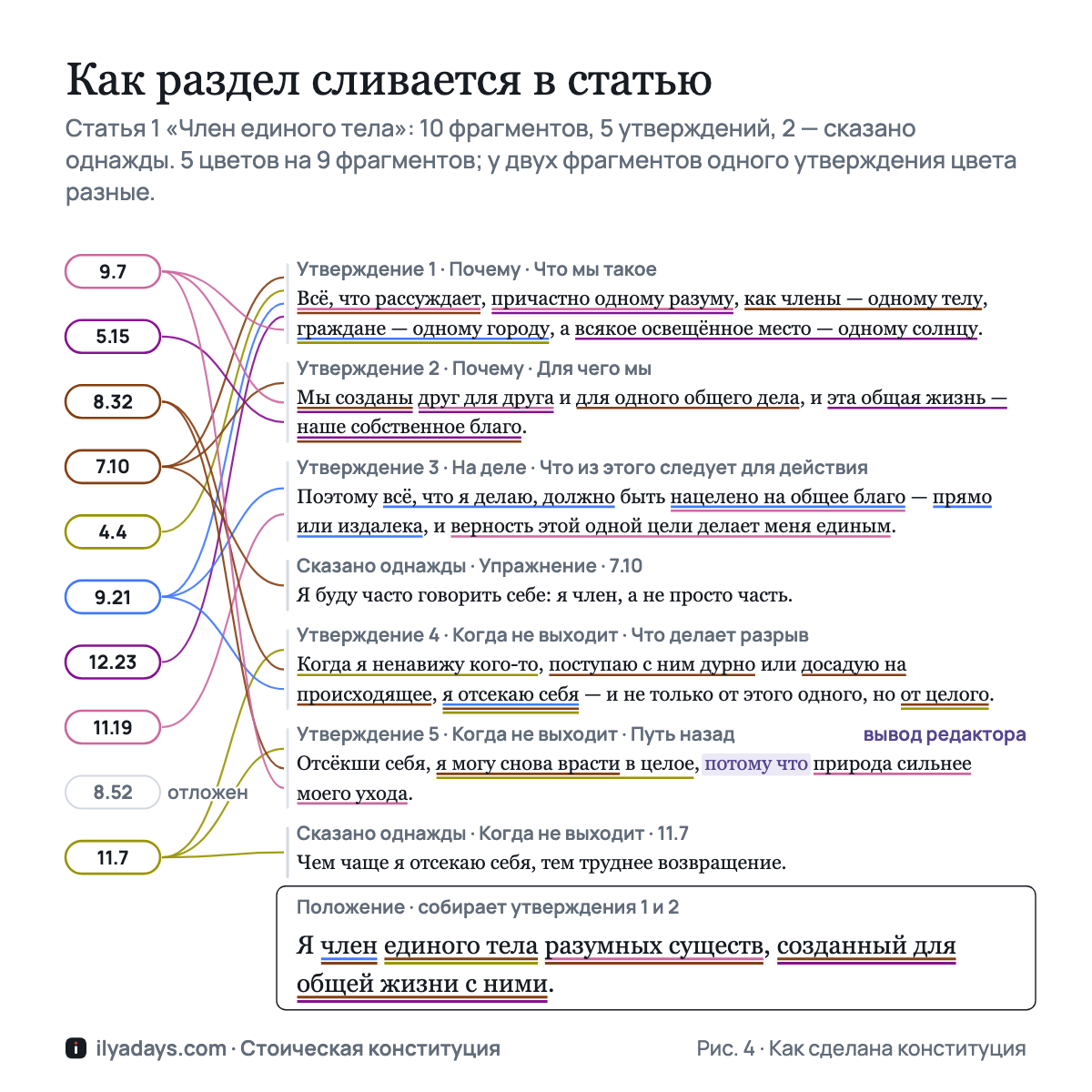
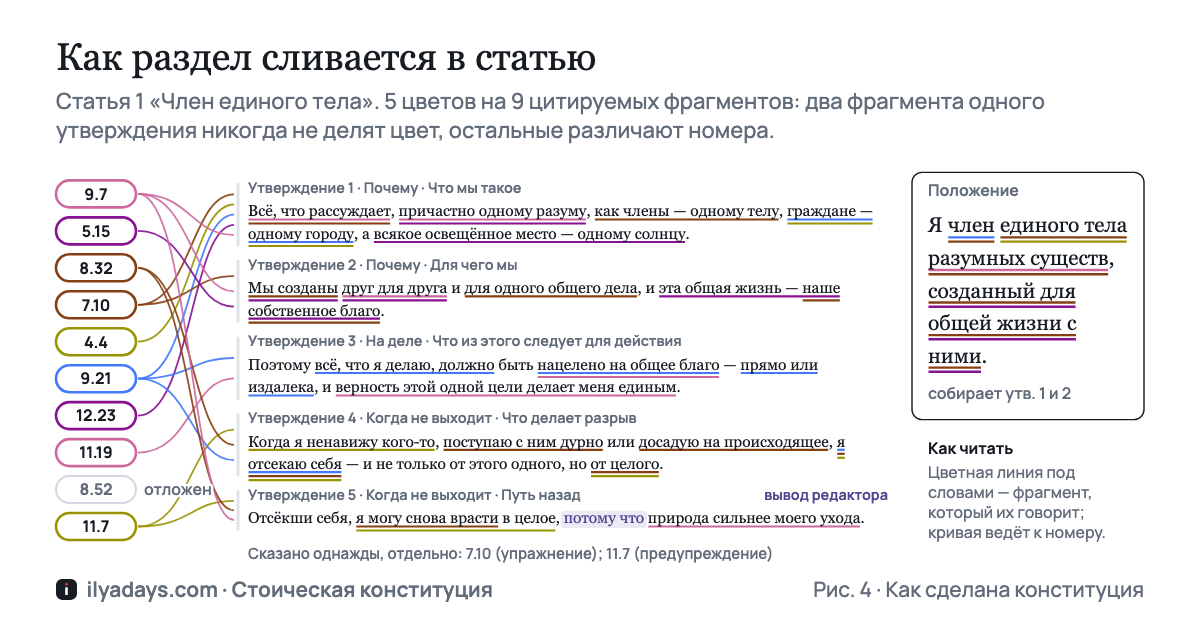
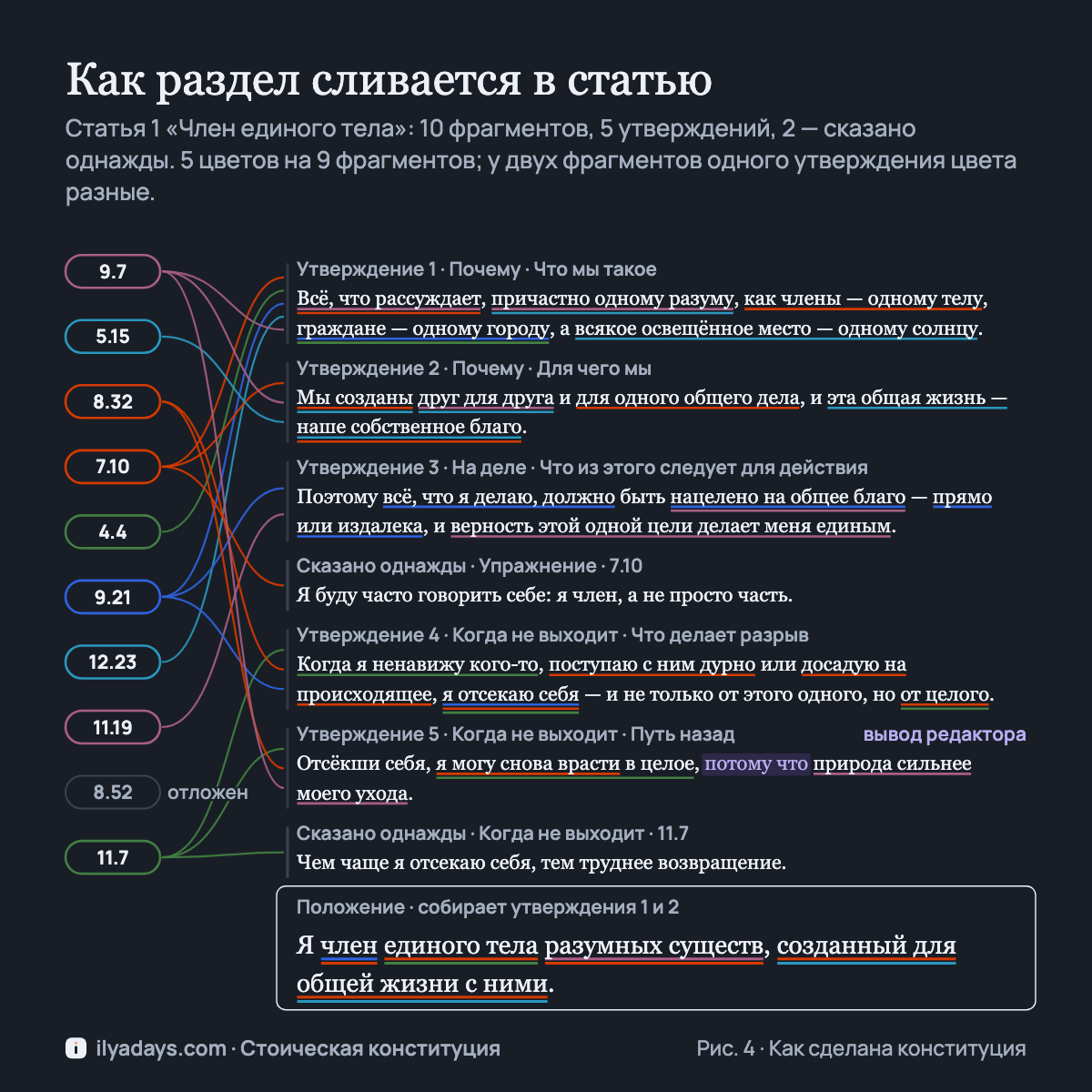
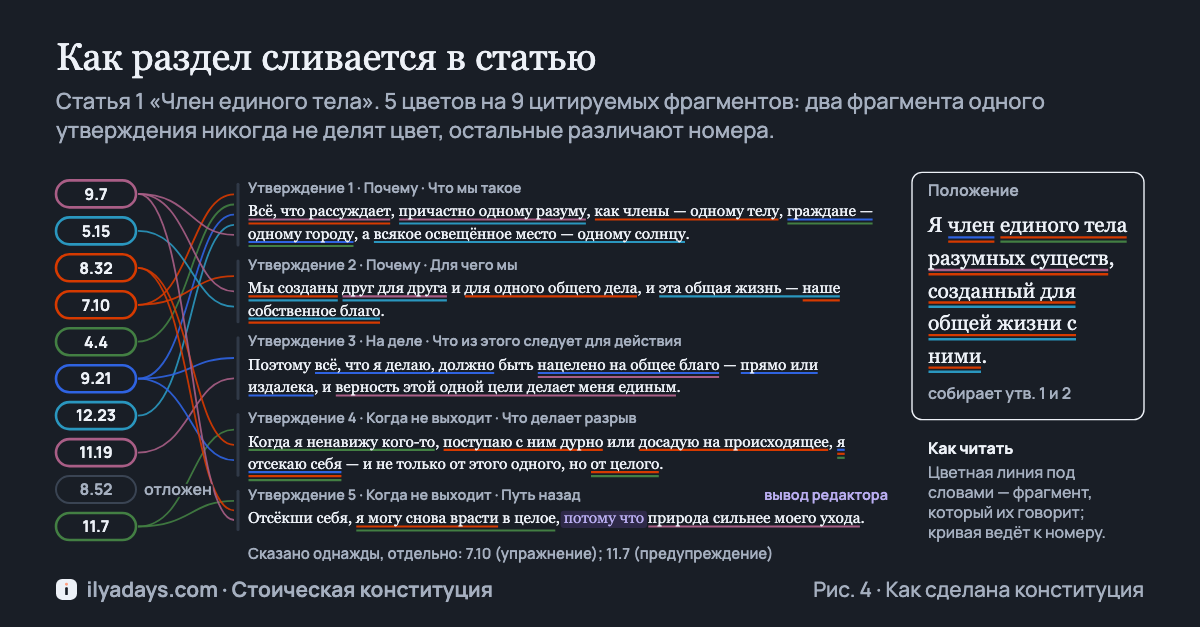
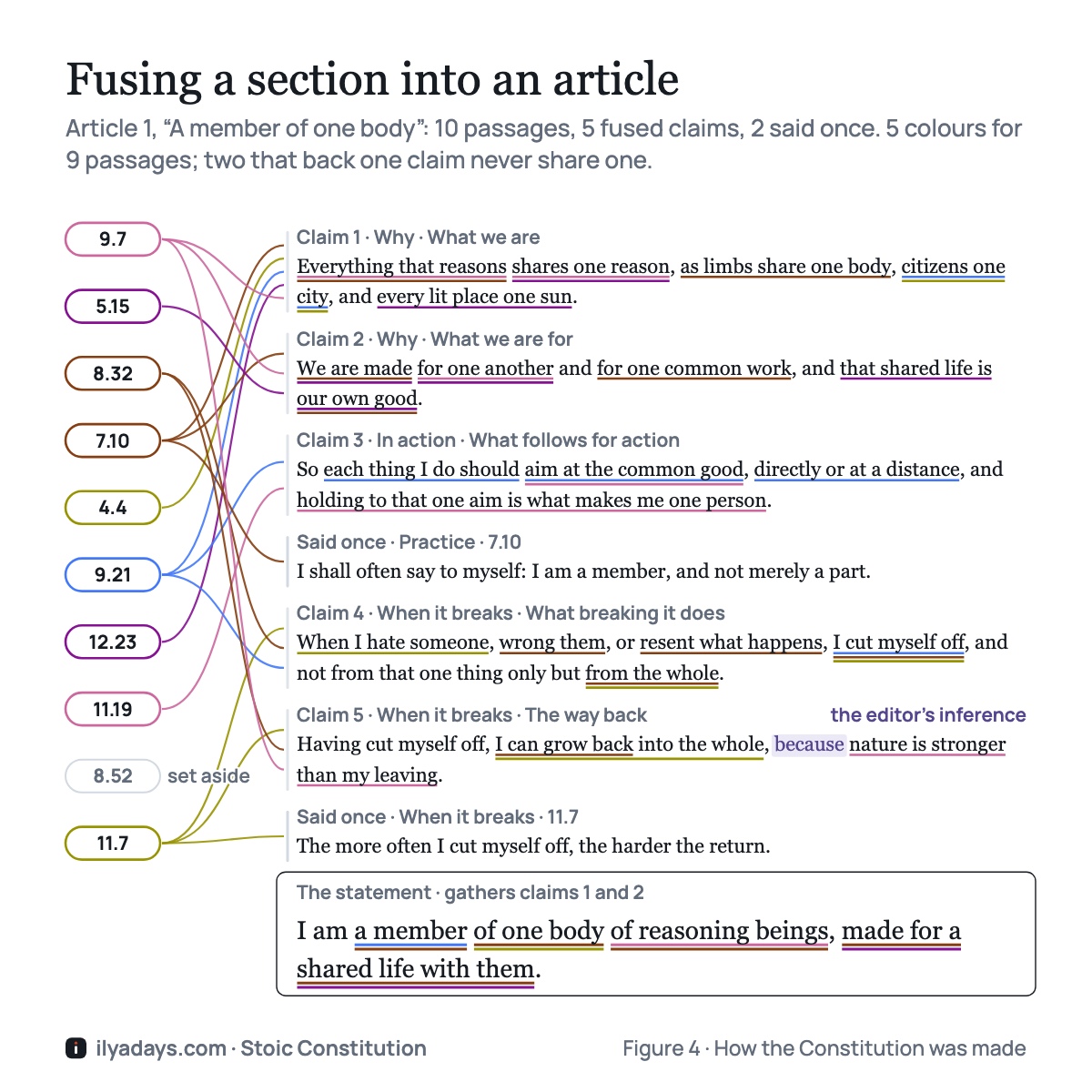
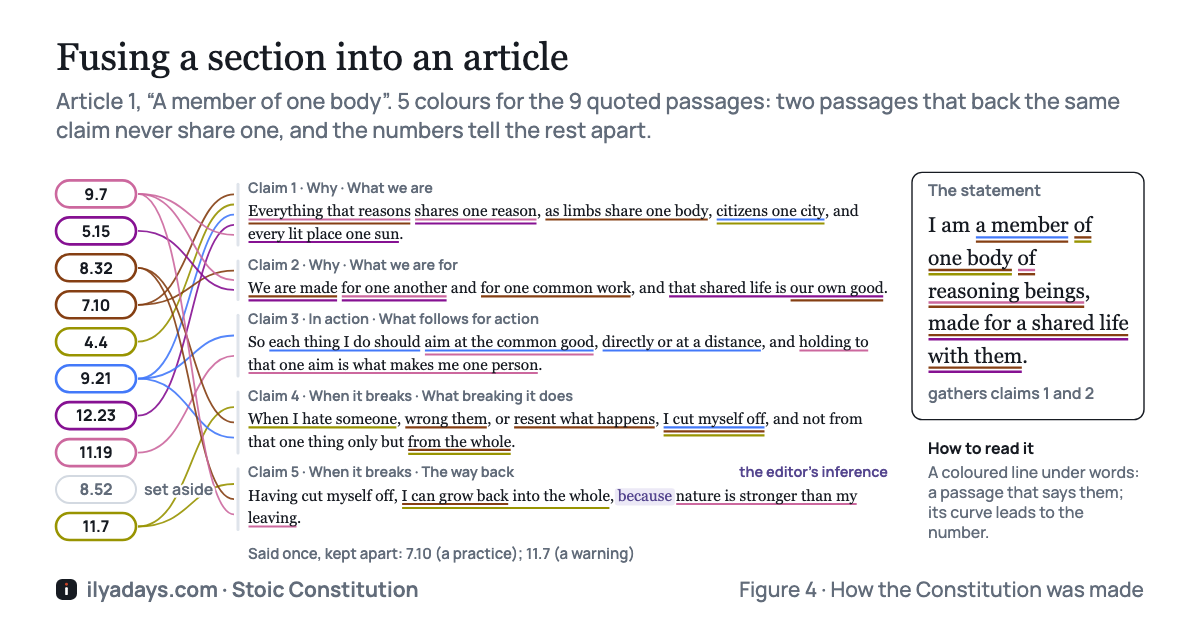
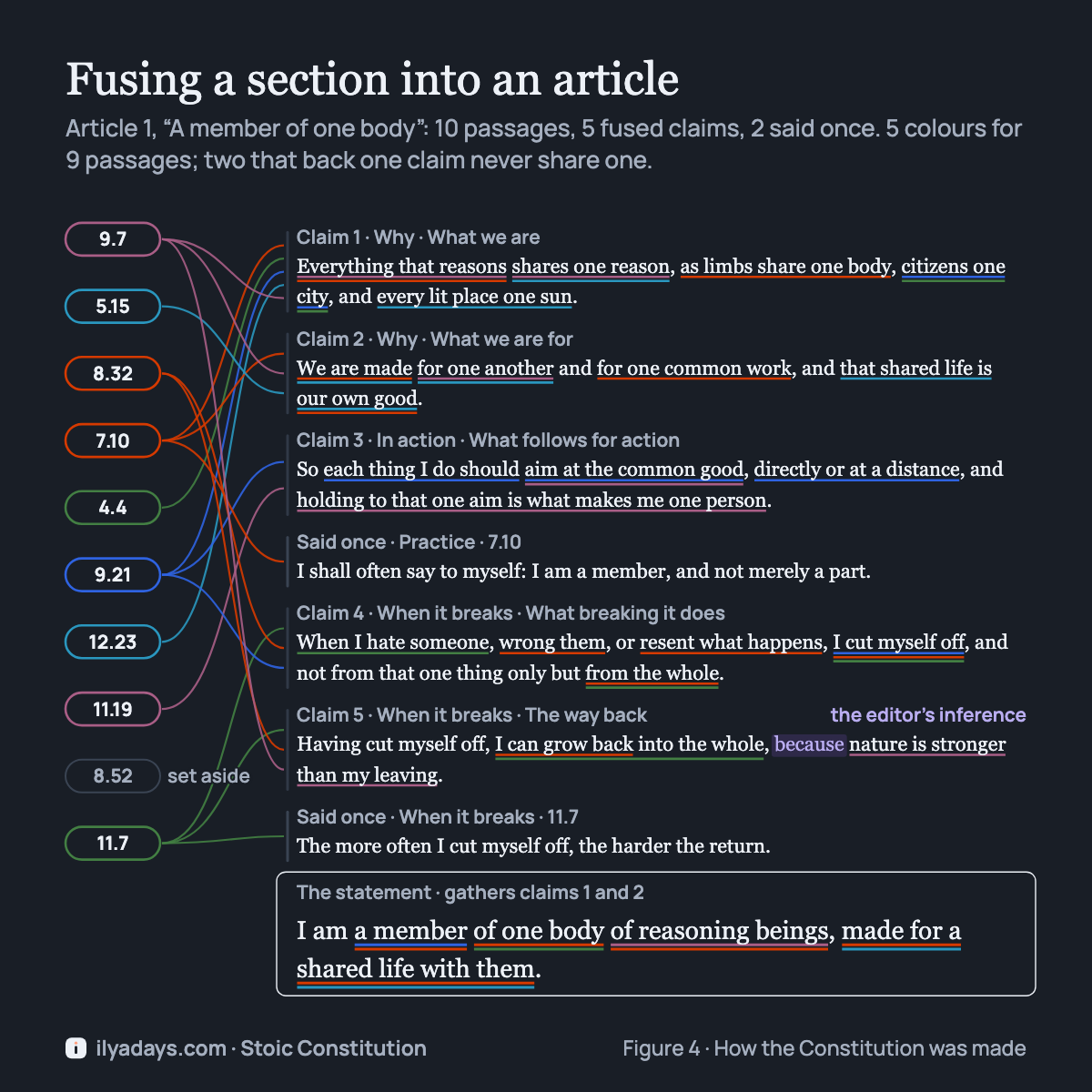
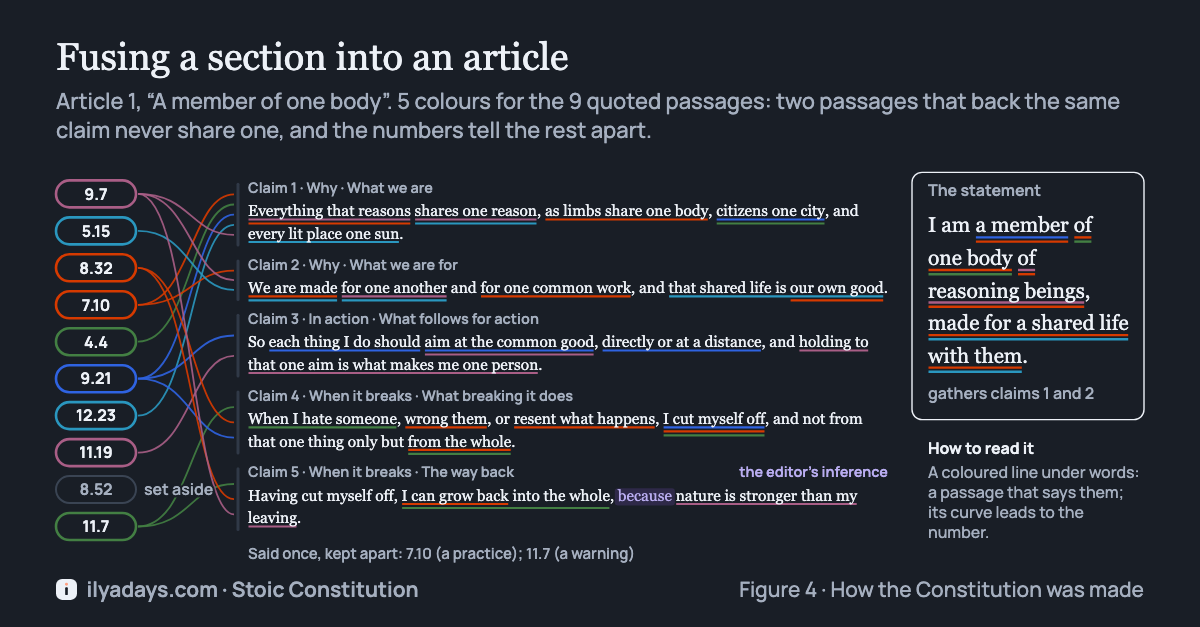
The central operation is fusion. Passages that the vectors place close together are read side by side; where two or more say the same thing in different words or images, that shared thing is stated once as a claim, and the claims are joined into one statement (Figure 4). The owner rejected the first drafts, which paraphrased one passage per point, as “concatenations” (Section 3.8). For one section the procedure is:
- read every passage and note the separate things it says;
- find parallels, the same thing said in two or more passages, and quote each instance exactly;
- fuse each group into one plain first-person claim, recording what the passages share and what the fusion generalised or dropped;
- for each quote, name the words of the claim it backs (“gives”) and write one sentence that follows from that quote alone (“what follows”);
- induce one statement of under 140 characters that joins the claims, split it into parts mapped to quotes, and name how it was reached: a chain of consequences, lists aligned into one, an argument by cases, a likeness, a rule with its hardest case;
- keep single witnesses apart as “said once”, with the reason;
- account for every passage: it feeds a claim, is quoted alone, or is set aside with a one-sentence reason;
- place every claim and said-once item under one of the five sides (Section 3.5), and write the editor’s disputable decisions and the article’s limit.
The result is one entry of the record in a fixed schema (Table 3).
| Part | What it holds | Rule |
|---|---|---|
| Statement | One first-person sentence; parts mapped to quotes; how it was reached | 30–140 characters; every part has a quoted witness and should rest on two passages |
| Fused claim | Plain first-person sentence; what the passages share; what was changed | At least two passages; at least one phrase said by two of them |
| Quote | Exact words of a passage; “gives”; “what follows” | Exactly one span of the passage; “gives” inside the claim |
| Said once | A point only one passage makes, with the reason | Never counted as fused |
| Inference | A “so”, “therefore” or “because” no passage says, with one sentence of why | Appears once, never inside words a passage backs; shown in purple |
| Sides | Every claim and said-once item under one of five labels | Exactly one label each; an empty label says why in one sentence |
| Aside, decisions, limit | Reasons for unused passages; the editor’s choices; where the article is weak | Every unused passage has a reason; a limit is required |
| Colours | One colour per passage across the article | Passages that meet never share a colour; at most five colours |
On the page, one coloured line runs under a phrase for each passage that says it, so two lines mean two witnesses; a passage keeps its colour in the sentence, its chip, its quoted row and its dot on the map of vectors. There are at most five colours, so passages share them, but two passages that meet in a claim or in a part of the statement never do (the build refuses it): a line is followed to its passage, not identified by its colour alone. Beside each statement a column shows the section’s passages laid out flat by metric multidimensional scaling of their cosine distances, with the stress of that flattening stated (0.211 for Article 1), the exact similarity of every pair, and the nearest sections. The scaling is metric (SMACOF [16]); the stress is the square root of the summed squared differences between drawn and true distances over the summed squared true distances. On Kruskal’s verbal scale [8] a value like Article 1’s counts as poor, so the map is a rough sketch and the printed similarities are the exact values.
Worked example: Article 1, “A member of one body”
The statement and two of the five claims of Article 1 are shown below with their lines; the quotes behind claim 1 are in Table 4.
Statement, with one line per witness
I am a member of one body of reasoning beings, made for a shared life with them.
Claim 1 (Why), fused from five passages
Everything that reasons shares one reason, as limbs share one body, citizens one city, and every lit place one sun.
| Passage | Quote (project English) | Gives | What follows from it alone |
|---|---|---|---|
| 7.10 | The relation that the limbs of the body have in things that are united is the relation that rational beings have in things that stand apart | as limbs share one body; Everything that reasons | Rational beings, who stand apart, have the same relation to one another that the limbs of one body have. |
| 4.4 | we are citizens. If that is so, we share in some civic body. If that is so, the universe is, as it were, a city. | citizens one city | We are citizens, we share in a civic body, and the universe is like a city. |
| 9.21 | you yourself help to complete a civic whole | citizens one city | I am one of those who make a civic whole complete. |
| 12.23 | One light of the sun, even if it is divided by walls, by mountains | every lit place one sun | The light of the sun is one, even where walls and mountains divide it. |
| 12.23 | One soul that has mind, even if it seems to be separated. | shares one reason | There is one soul that has mind, even though it seems to be separated. |
| 9.7 | one soul that has mind has been portioned out among the rational ones | shares one reason; Everything that reasons | The beings that reason share one soul, the soul that has mind. |
Claim 5 (When it breaks), with the editor’s inference
Having cut myself off, I can grow back into the whole, because nature is stronger than my leaving.
The inference is recorded with its reason: “No passage gives this reason: 11.7 credits the return to Zeus and 8.32 to god, and 9.7 speaks of people who run away and are overtaken, not of a return.” The statement was reached as “Many pictures, one claim; then its consequences”. Article 1 on the page.
DownloadLightPNG squarePNG landscapeSVG squareSVG landscapeDarkPNG squarePNG landscapeSVG squareSVG landscapeAll figures




Code and data: apps/aurelius/prompts/constitution-article.md · scripts/aurelius-constitution.py · content/aurelius/constitution.json
3.5The five sides
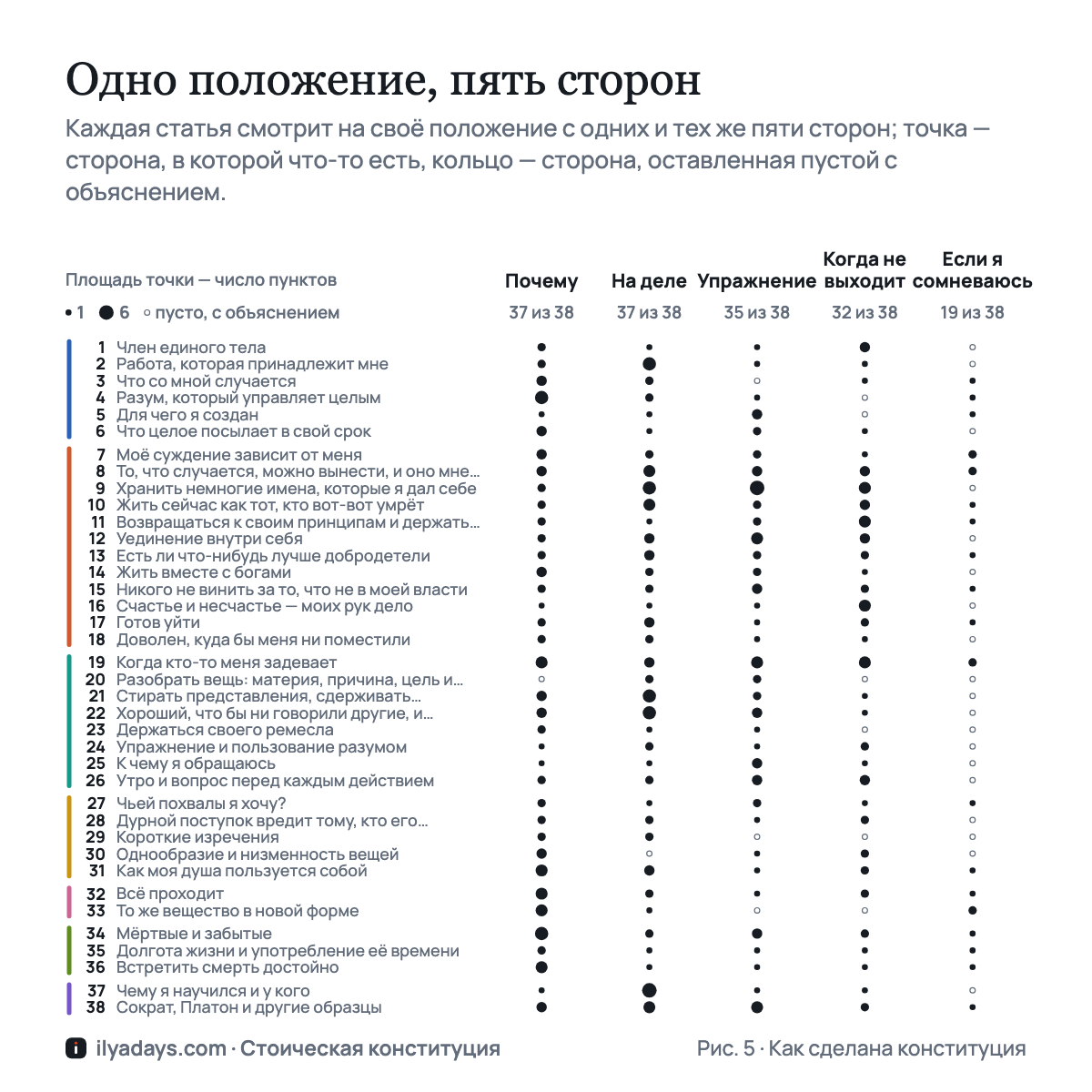
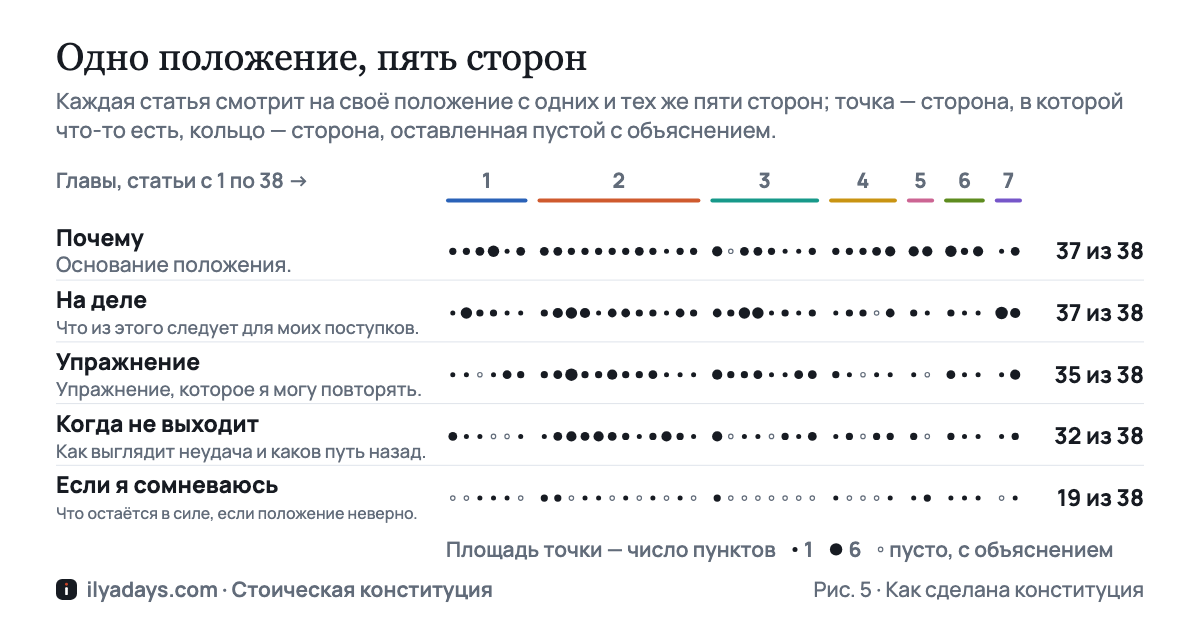
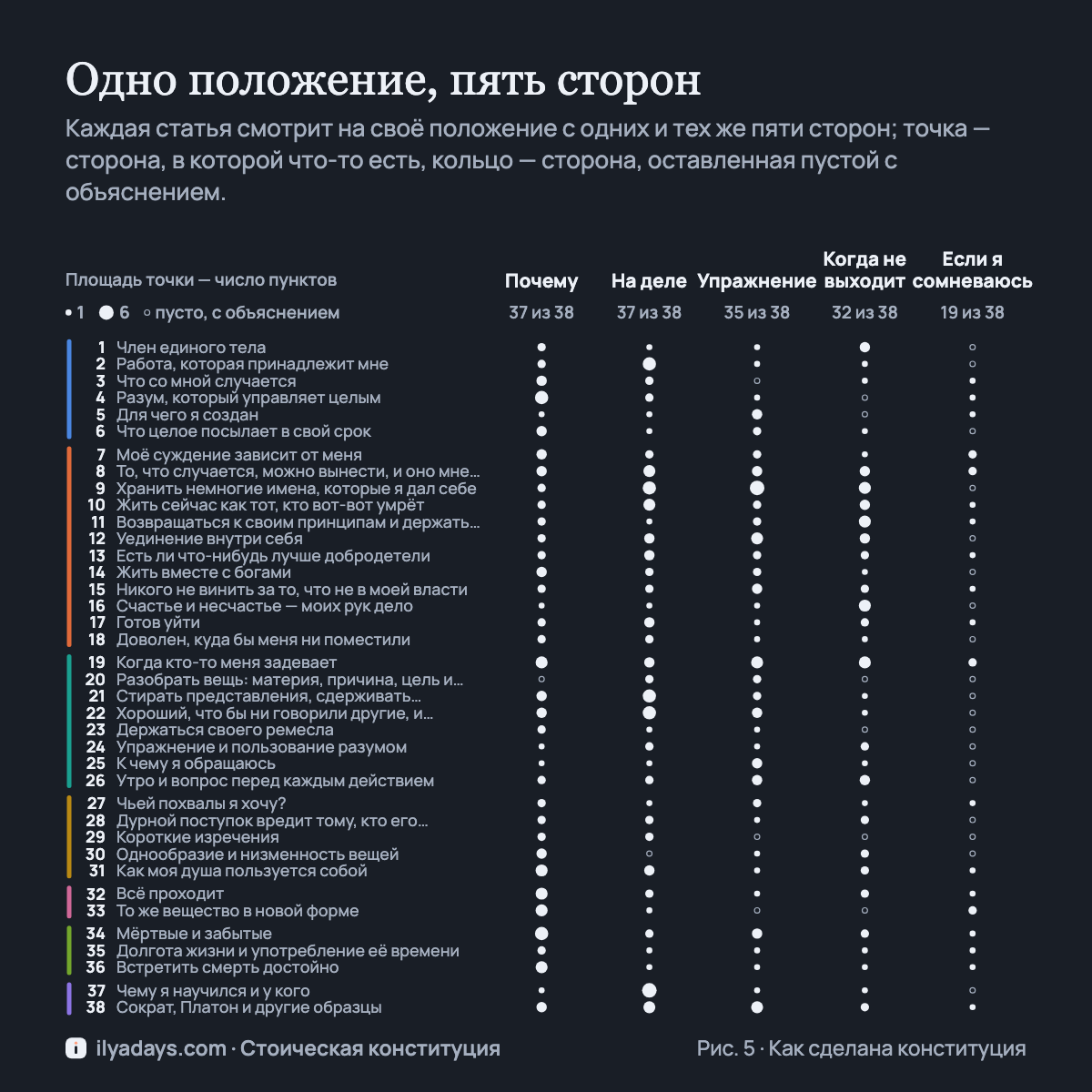
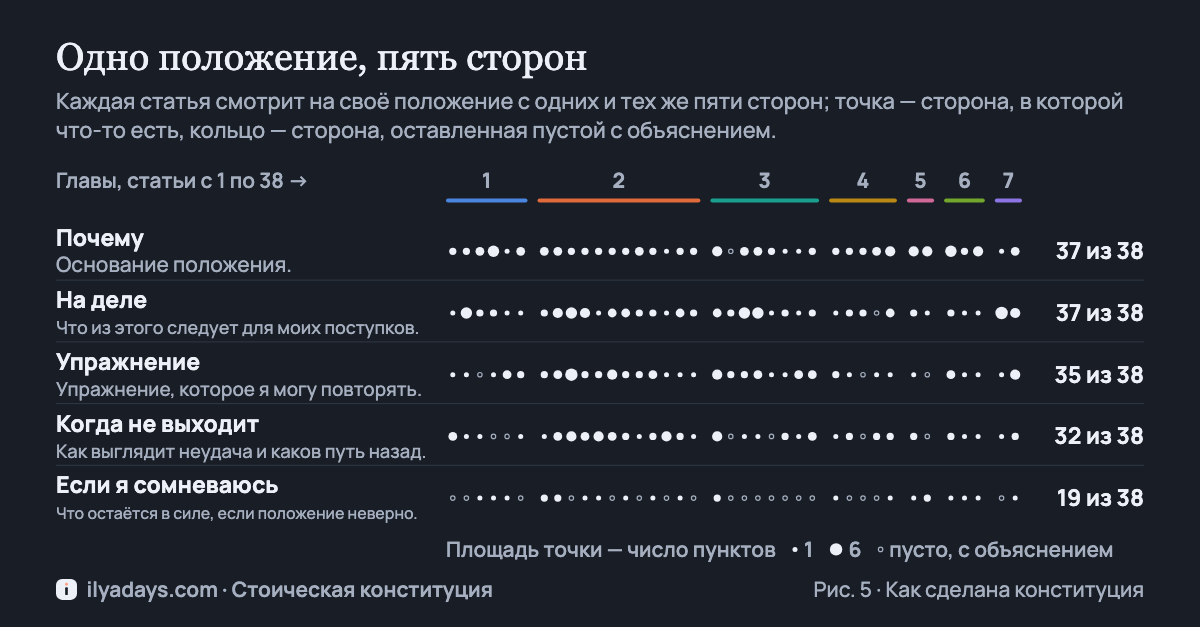
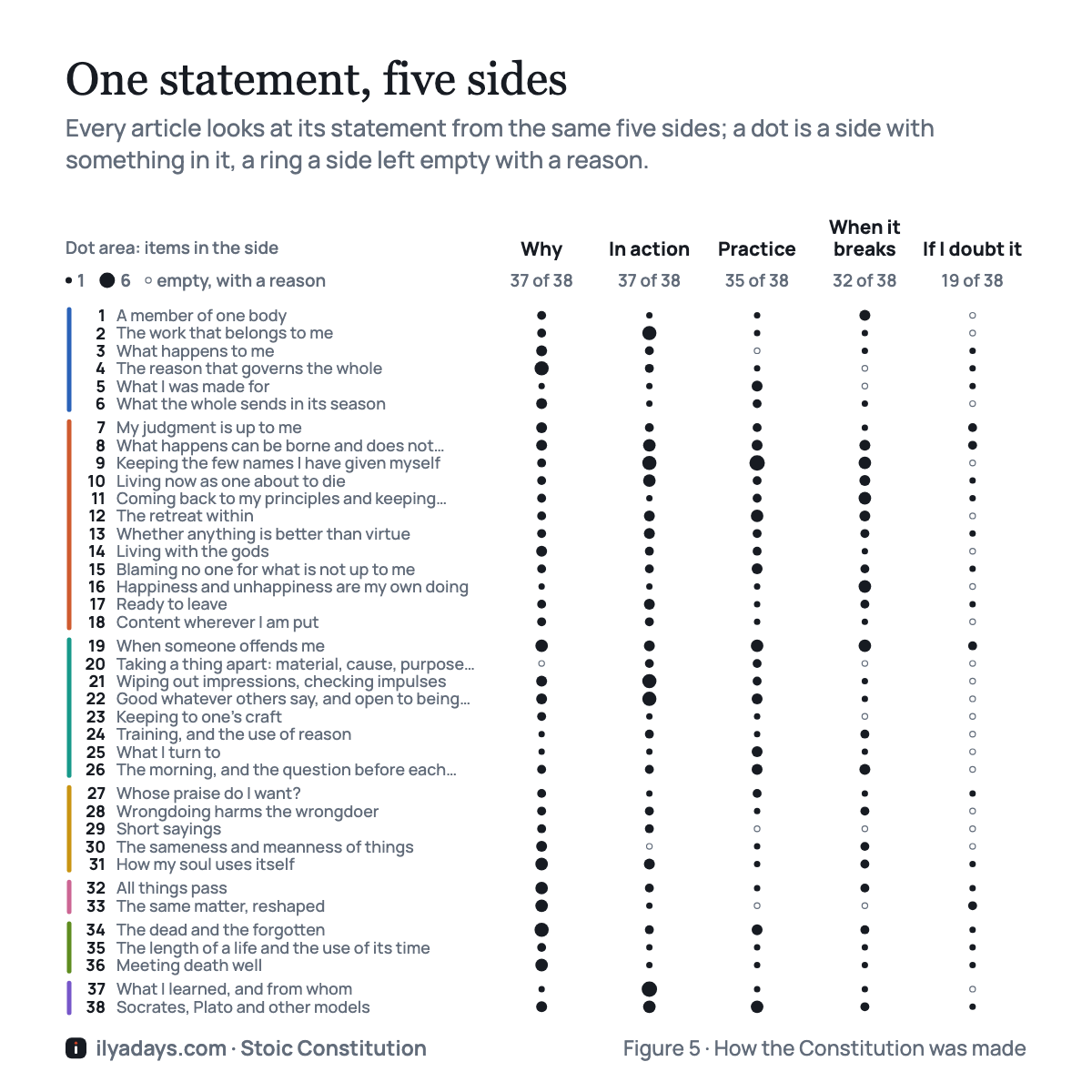
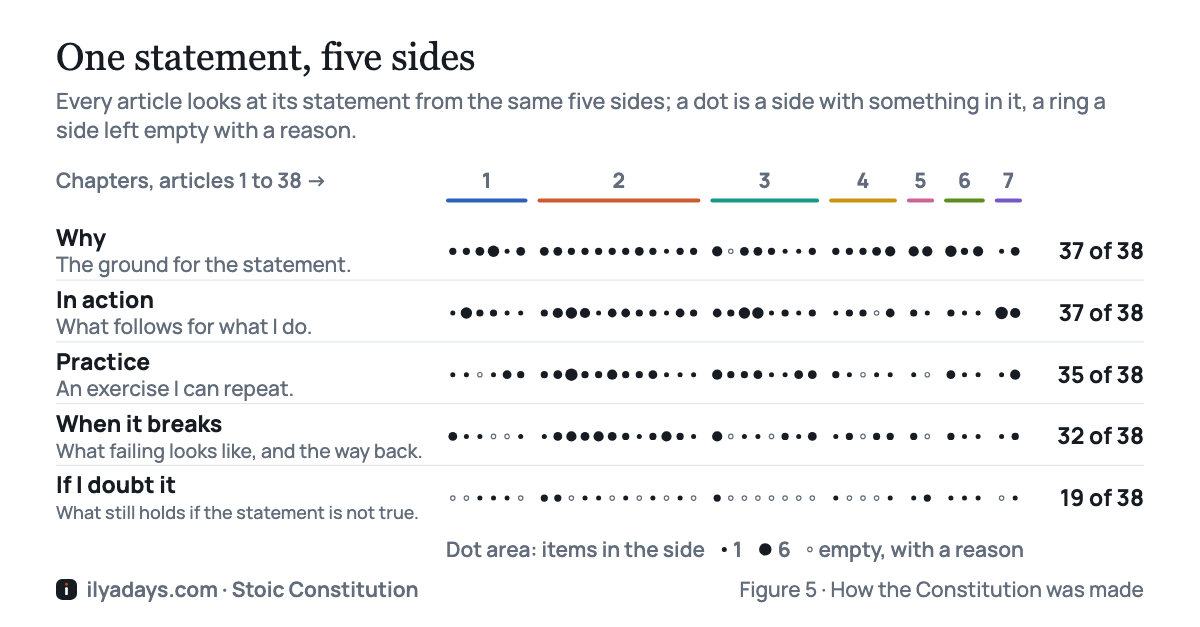
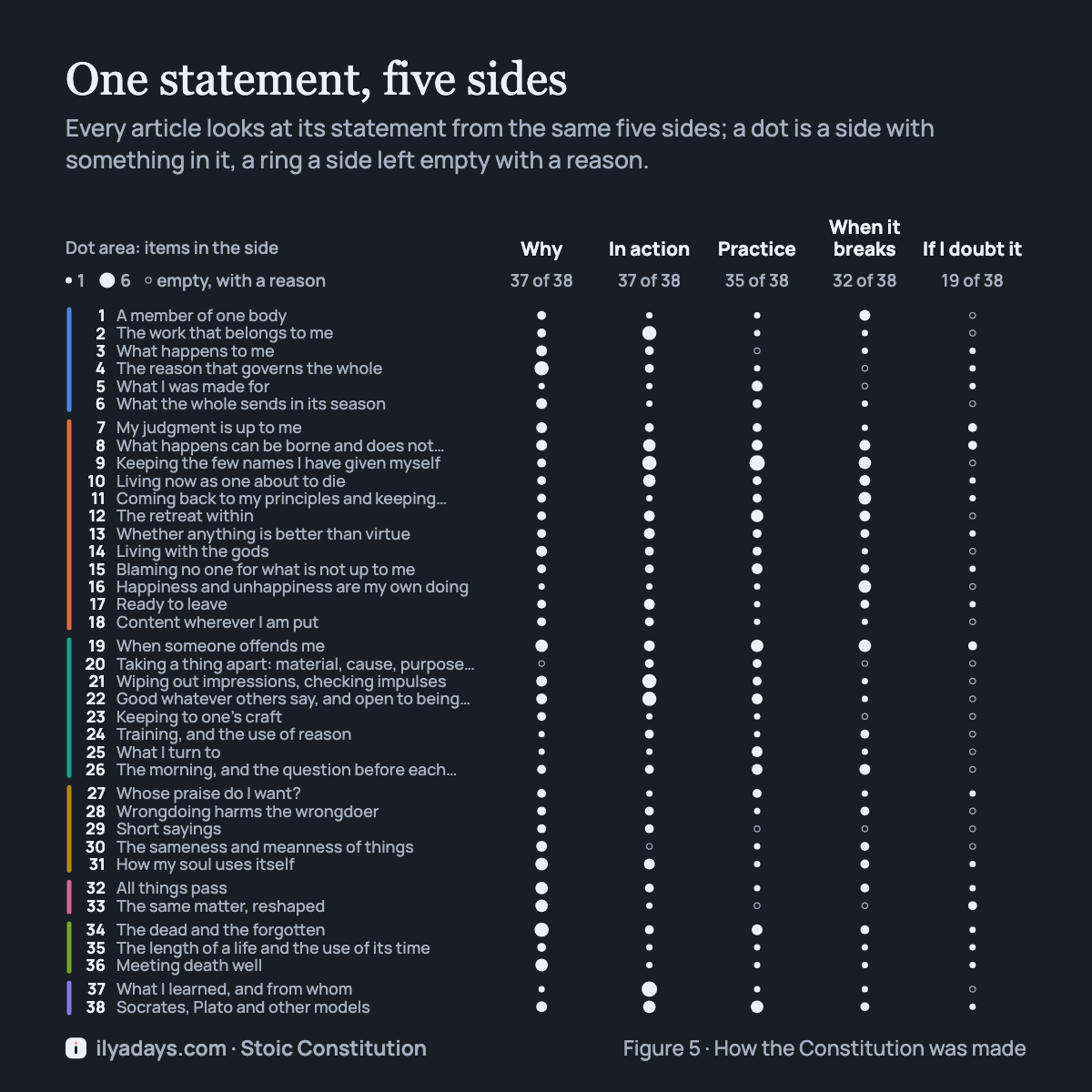
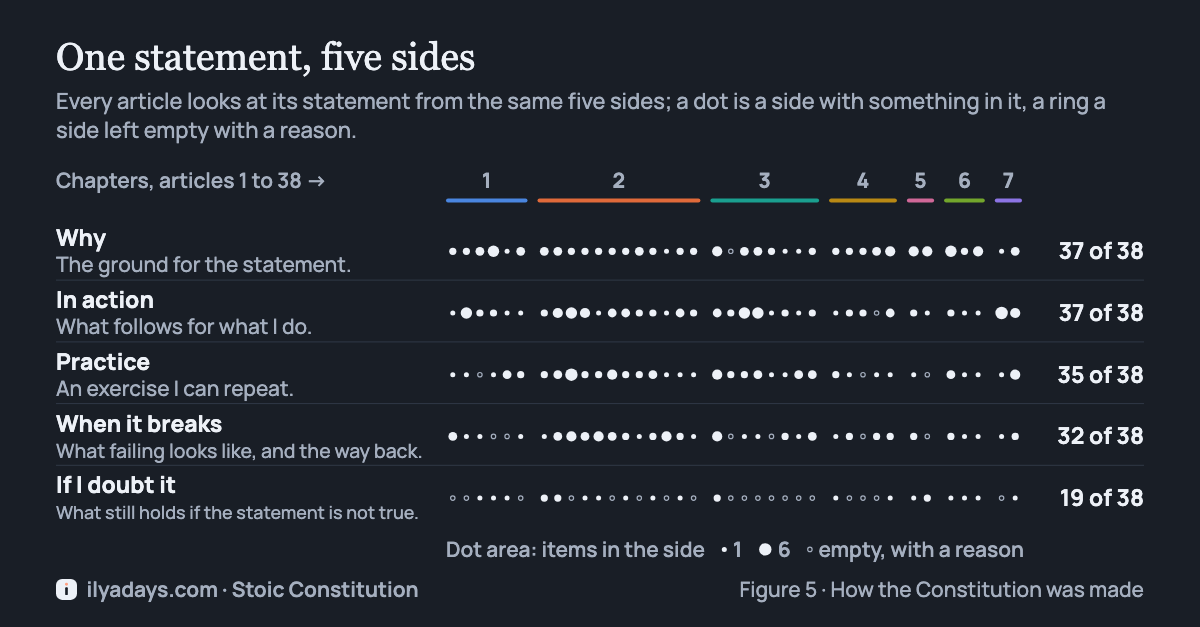
Every article opens with its statement and then approaches it from five fixed sides, the same in every article and in the same order, so that articles can be read and compared alike (Figure 5, Table 5). The owner asked for one statement with “subarticles [that] approach this theme from other perspectives … labeled somehow” and later named the first three (“why, in action, practice. maybe show them as columns?”). Every claim and said-once item sits under exactly one side. A side with no passage for it stays empty and says why in one sentence; it is never filled with the editor’s words.
DownloadLightPNG squarePNG landscapeSVG squareSVG landscapeDarkPNG squarePNG landscapeSVG squareSVG landscapeAll figures




| Side | Question | Purpose | Article 1 | Filled |
|---|---|---|---|---|
| Why | The ground for the statement. | The reasons to hold it, in the passages’ words | Claims 1 and 2 | 37 |
| In action | What follows for what I do. | A rule of life must change conduct | Claim 3 | 37 |
| Practice | An exercise I can repeat. | Marcus often tells himself what to say or do again | Said once, 7.10: “I shall often say to myself: I am a member, and not merely a part.” | 35 |
| When it breaks | What failing looks like, and the way back. | A rule silent on failure leaves the reader alone at the first failure | Claims 4 and 5; a warning said once (11.7) | 32 |
| If I doubt it | What still holds if the statement is not true. | Marcus often argues by cases (providence or atoms) | Empty: no passage in the section considers that reasoning beings might not be one | 19 |
Code and data: apps/aurelius/prompts/constitution-article.md · scripts/aurelius-constitution.py
3.6Adding a second author
Seneca is added to Marcus, not mixed into him: Marcus’s sections, claims and words stay as they are, and every word of Seneca’s is marked as his. The reader switches him on or off for the whole page.
Why Seneca. The record gives no reason for choosing Seneca first. Epictetus, whom Marcus names and quotes, is the planned next voice (32-delegation-plan.md, W10). Seneca’s letters are a large body of Stoic prose (124 letters) in another genre: letters to a friend, not notes to oneself.
Retrieval. Gummere’s English of all 124 letters was split at the standard section numbers into 2140 passages and embedded with the same model. For each article every letter passage was ranked by similarity to the section’s centre and to the article’s own sentences. Similarities across authors run lower than within one (medians: 0.468 Marcus–Marcus, 0.330 Seneca–Seneca, 0.351 across), and the vectors were treated as a net rather than a judge. The comparison also crosses two translators three centuries apart (Gummere’s English against Casaubon’s). The writers’ brief warns that about half of what the vectors return is off the point and that some of the best passages rank low (32-delegation-plan.md); that is an impression from the first articles, never measured, and no recall was measured either. Each article therefore also logged at least three searches by the section’s own key words, with every passage considered and rejected and why (kept in the authored record, not published, since it records searches of Gummere’s text). Before a quote backs anything, the letter around it is read and one sentence of context says what that part of the letter is about and what the quote’s key word refers to; a quote whose context is about something else is not evidence. The record does not keep which route, vectors or word search, found each item.
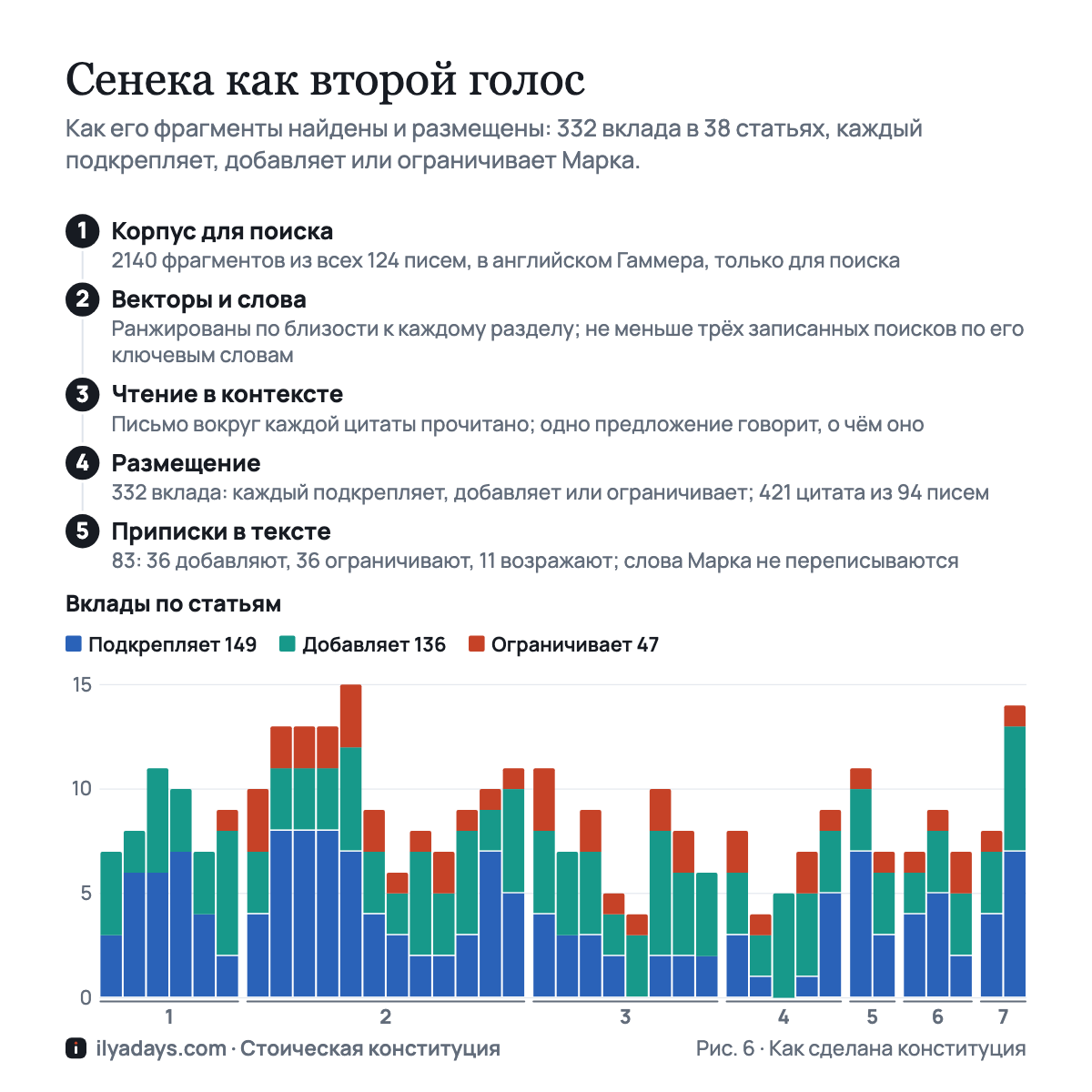
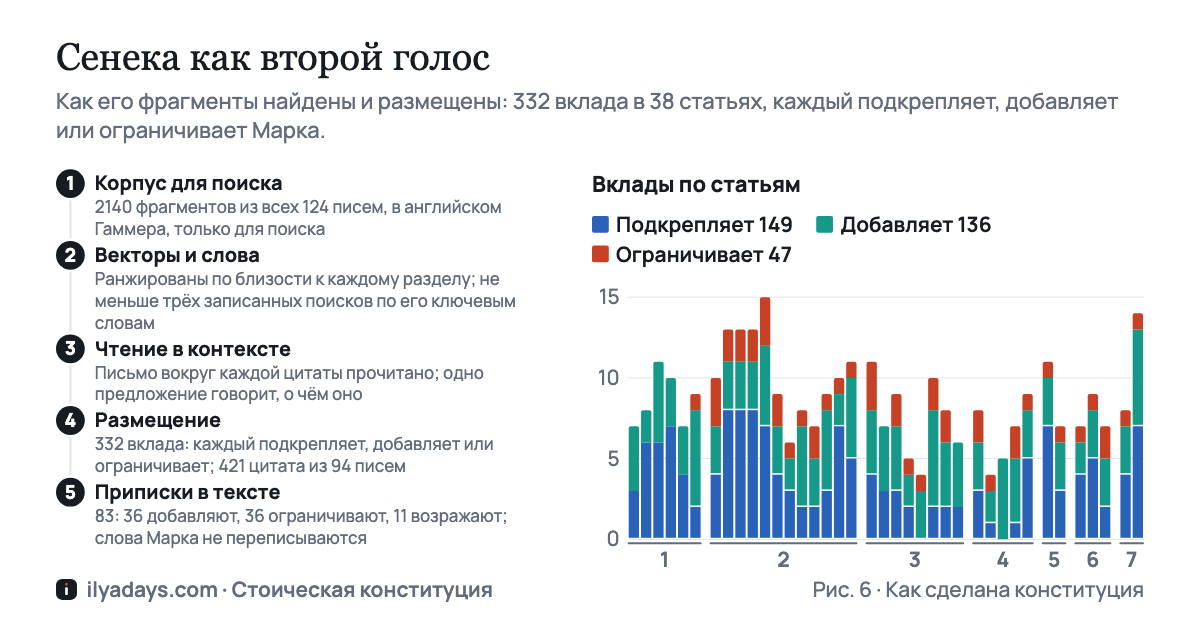
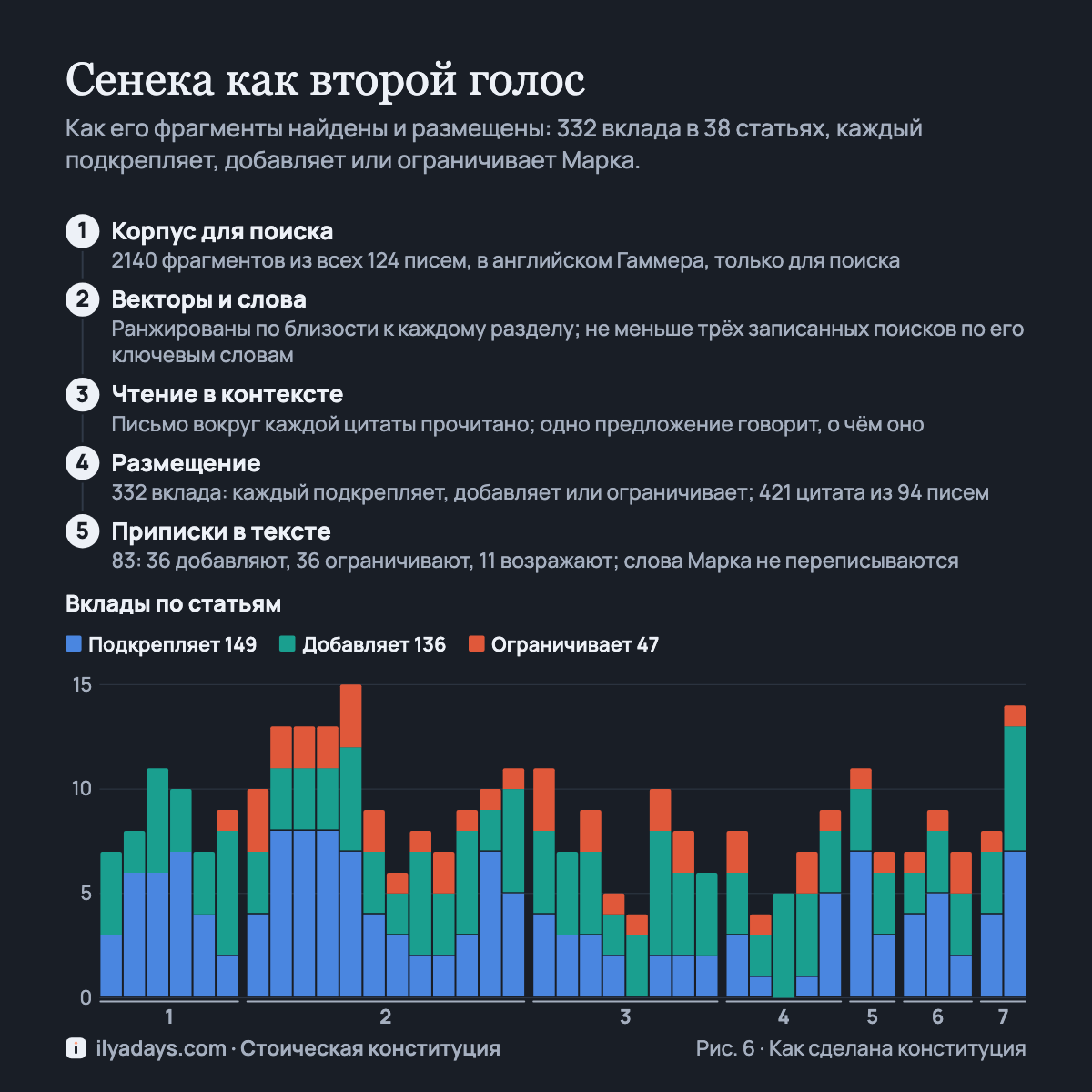
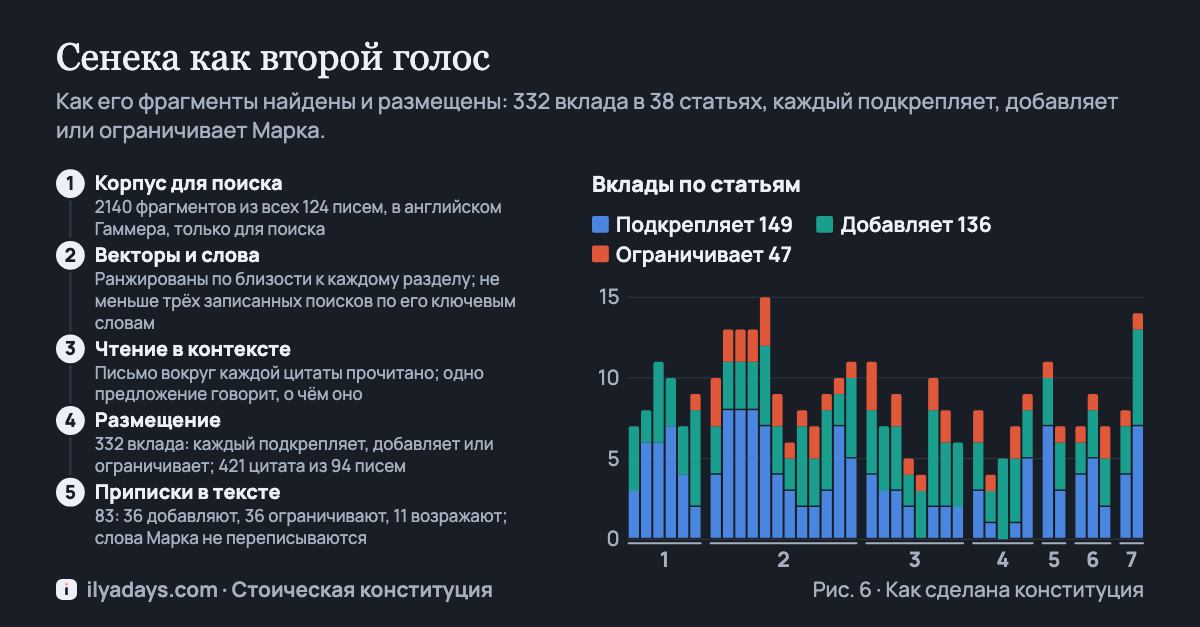
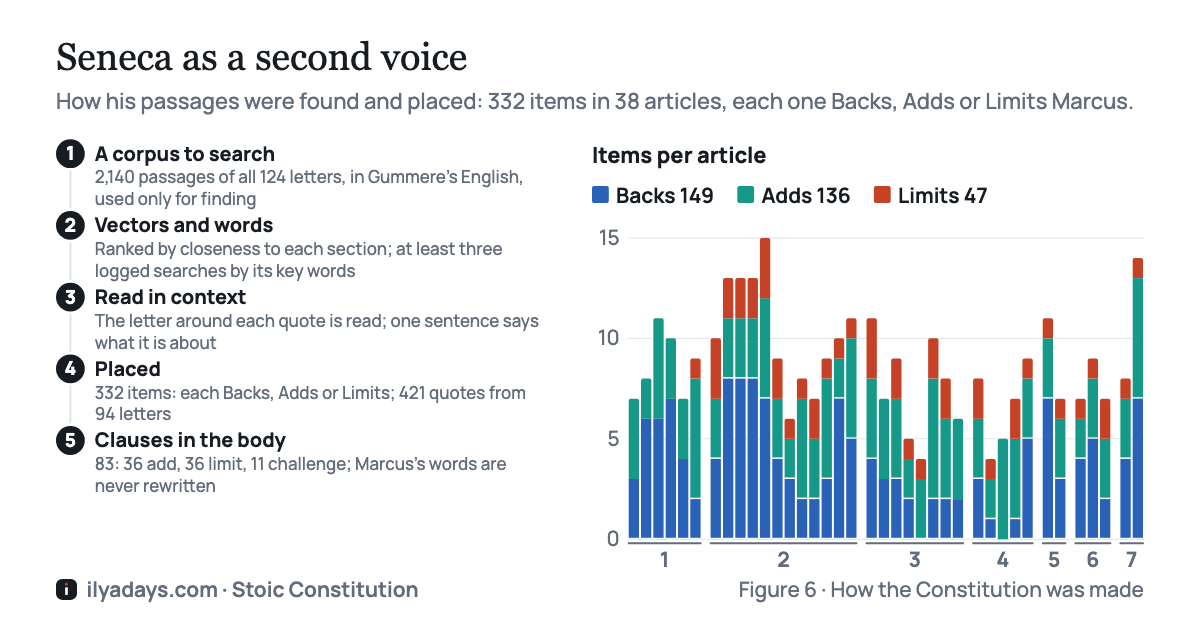
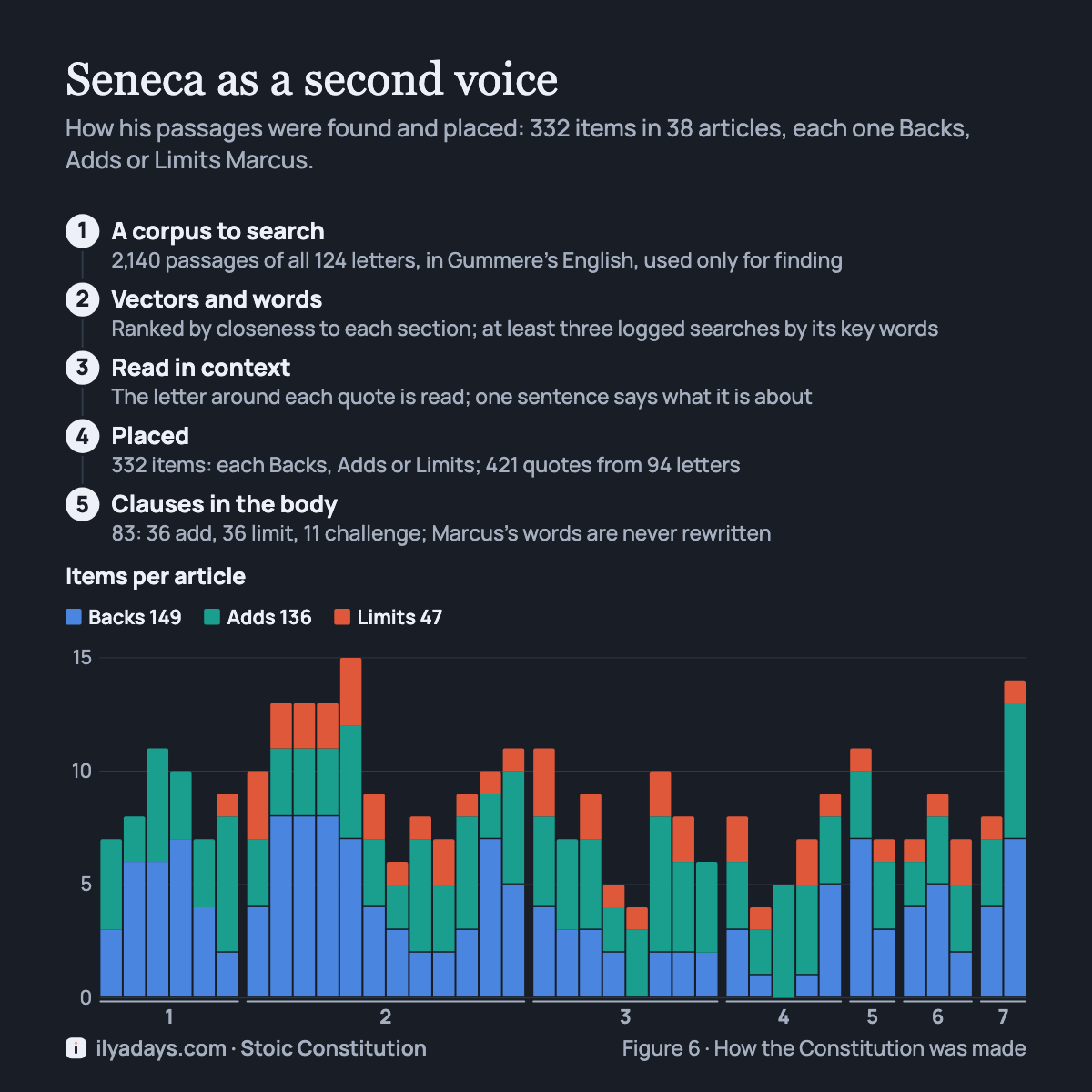
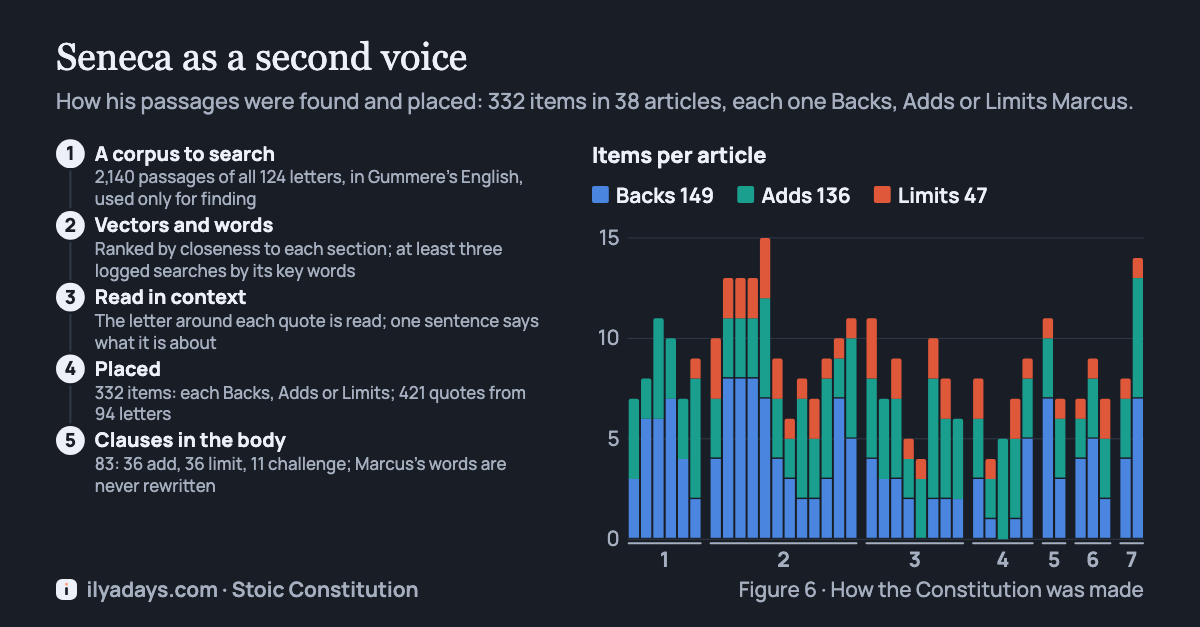
Placement. Each Seneca item has exactly one effect (Table 6, Figure 6). When he adds to or limits a sentence, one clause is appended to Marcus’s sentence while Seneca is on, tagged and drawn with his dotted line; Marcus’s words are never rewritten. A clause continues the sentence (it begins with a comma or semicolon and has no full stop), stays under 140 characters, names the items it comes from and cites only their quotes; a limiting or challenging clause must come from a Limits item on the same sentence. Each article also says in one sentence what it becomes with Seneca, and whether its statement still stands. On an article’s map Seneca’s passages are not part of the scaling: each is placed afterwards where its distances to Marcus’s fixed points fit best (least squares), after its similarities are raised by 0.117, the gap between the median similarity within Marcus and across the two authors, so that he does not land in a ring outside; the stated stress covers Marcus’s points only. Two examples follow: a clause that adds, with the item behind it (Table 7), and a clause that challenges.
| Effect | Meaning | Items |
|---|---|---|
| Backs | His words say what words of an existing claim say | 149 |
| Adds | Something Marcus does not say here, under one of the five sides (preferably an empty one) | 136 |
| Limits | He narrows or disputes a claim; the difference is stated, not blended; “challenge” only for a real disagreement | 47 |
| Clauses appended to Marcus’s sentences: adds 36, limits 36, challenges 11 | 83 | |
Adds: Article 1, statement
I am a member of one body of reasoning beings, made for a shared life with them, each of us holding the others up as the stones of an arch doSeneca adds
| Ep. 95.53 | Our fellowship is very like an arch of stones, which would fall if the stones did not block one another, and is held up by that very thing |
| What follows | Human fellowship stands the way an arch of stones does: only because its parts hold one another up. |
| Context | Seneca’s short rule for how to treat other people, given after the rule for worshipping the gods. “Our fellowship” is human fellowship as a whole, not one friendship. |
| Why added | Marcus has body, city, sunlight and soul. The arch adds something none of them states: that the whole stands only because its parts hold one another up. |
Challenges: Article 8, statement
Nothing happens to me that I cannot bear; what happens harms me only if I judge it bad, and it does not stop me from being good and just; but a pain I cannot bear may still come, and then it is shortSeneca challenges
With Seneca on, Article 8 says its first part “does not stand as it is worded: Seneca, like Marcus in 10.3, allows a pain I cannot bear, and says only that it will not last, though elsewhere he says nothing is unbearable.” Article 1 · Article 8 with Seneca on.
DownloadLightPNG squarePNG landscapeSVG squareSVG landscapeDarkPNG squarePNG landscapeSVG squareSVG landscapeAll figures
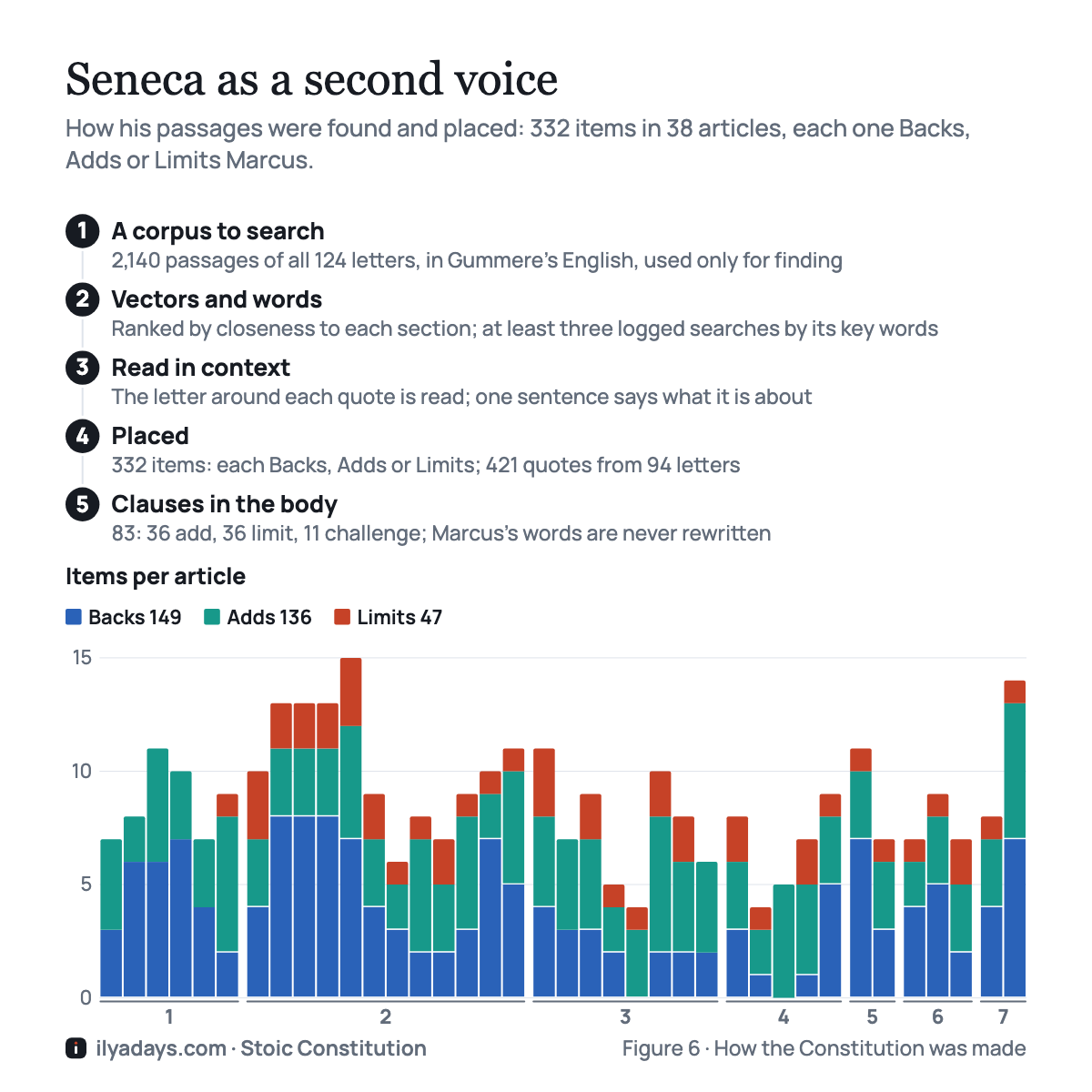




Seneca was first quoted from Gummere. Once the rights facts were gathered, the owner chose to translate him within the project (“let’s translate seneca ourselves?”); after the translation (Section 3.7) all 421 quotes were cut again from the new English and every article was checked by script and by a reader who saw only the Latin and the new English.
Code and data: scripts/aurelius-seneca.py · content/aurelius/translation/seneca-v1.json · scripts/aurelius-constitution.py
3.7Translation
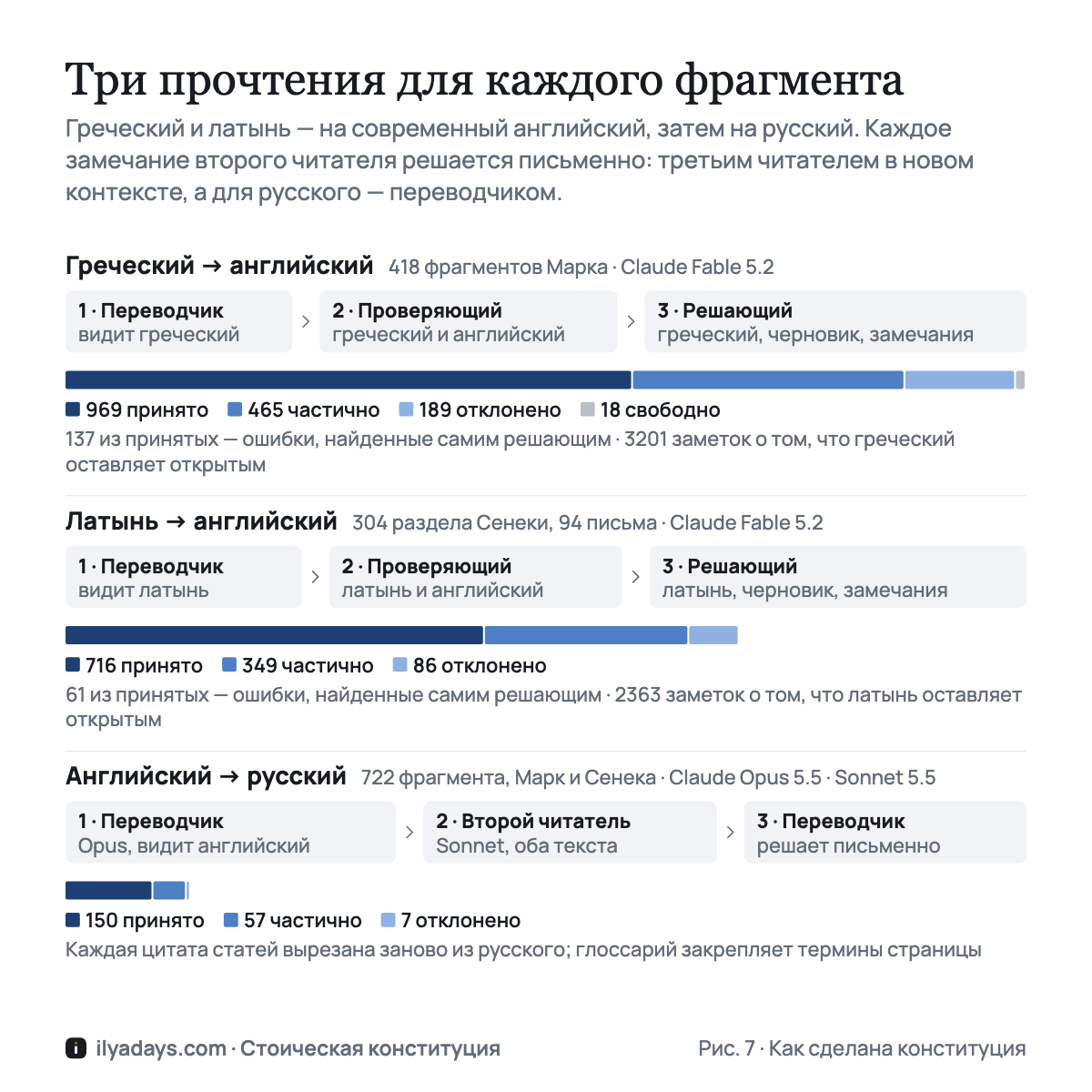
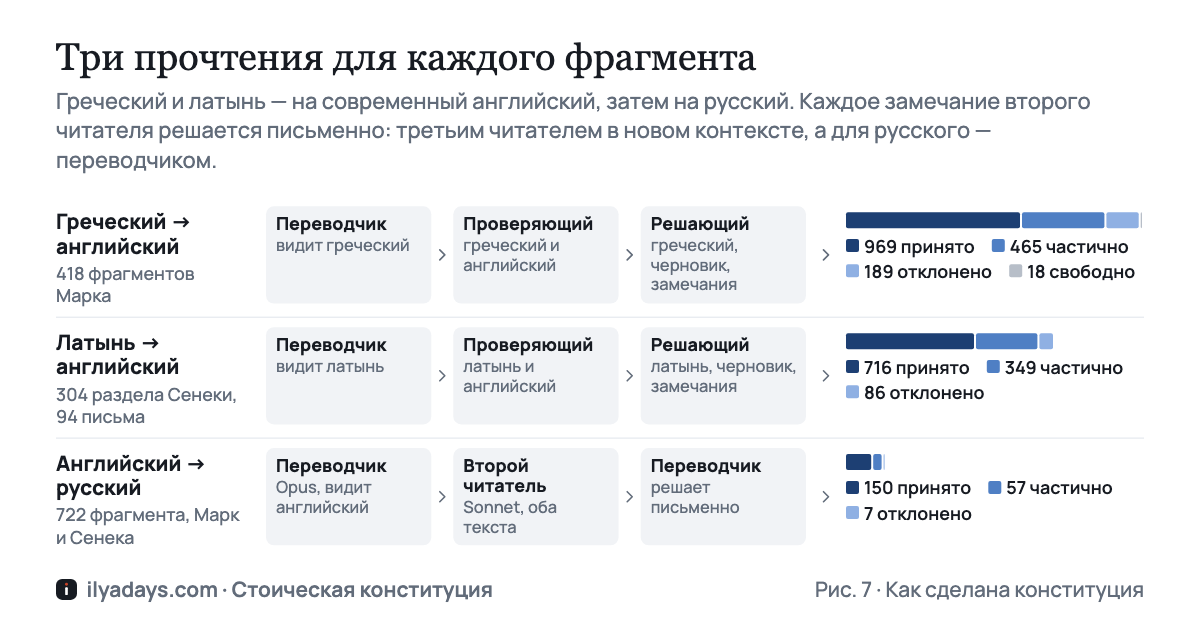
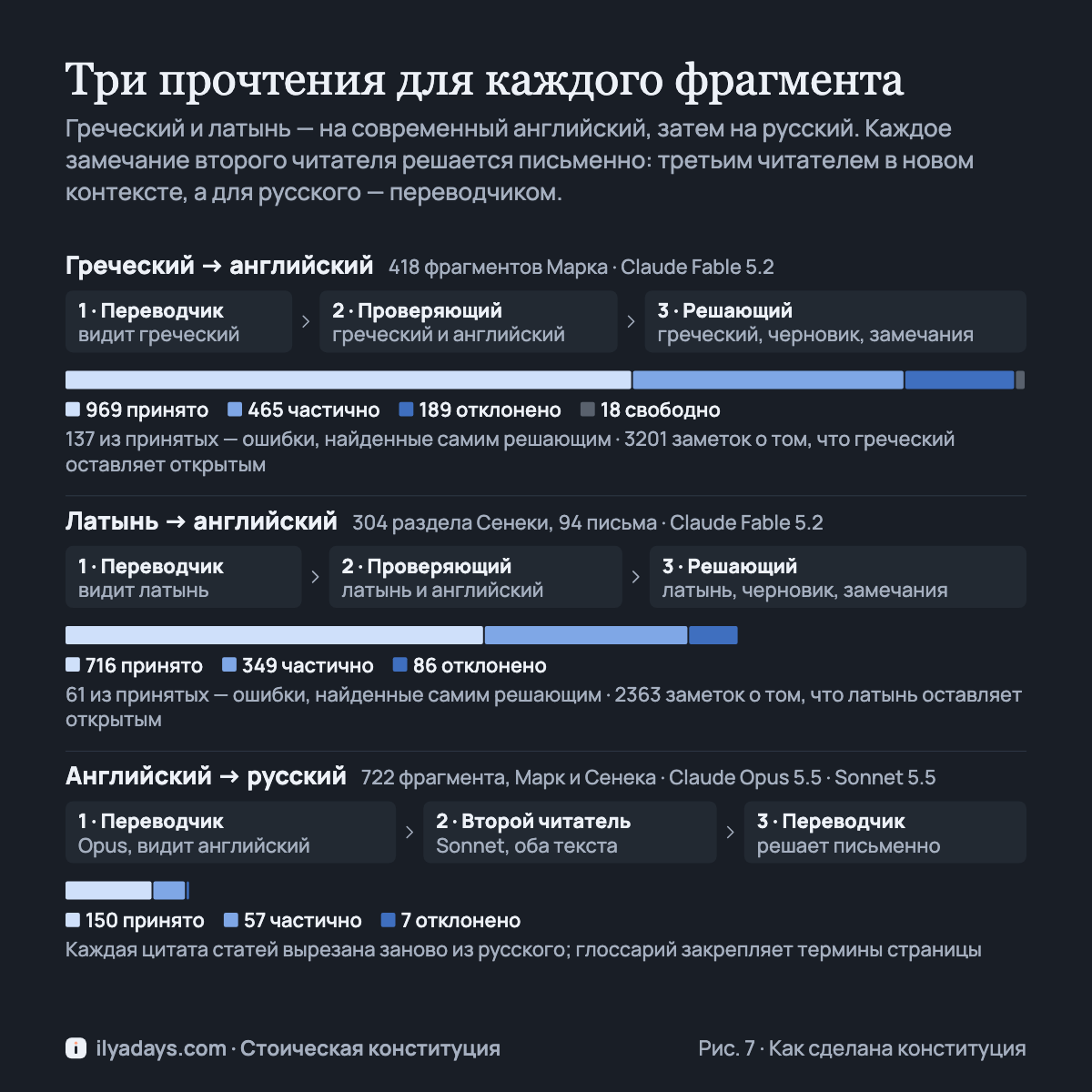
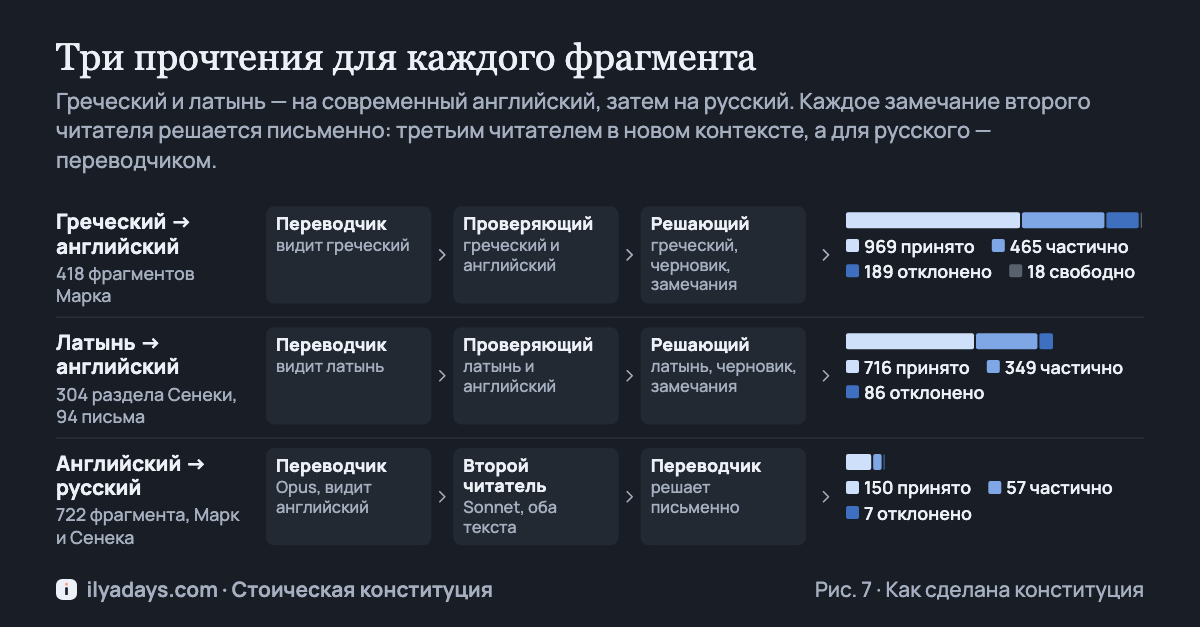
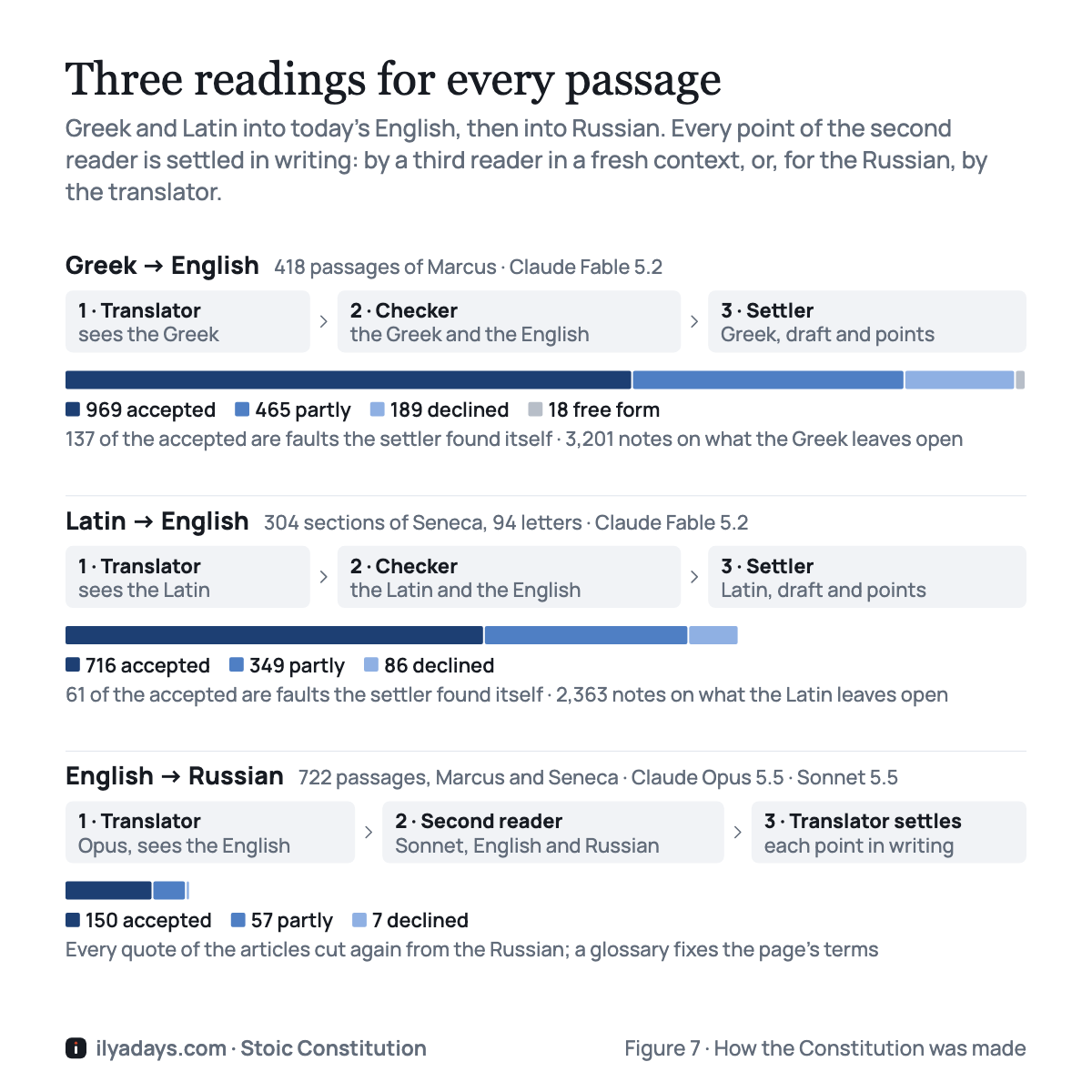
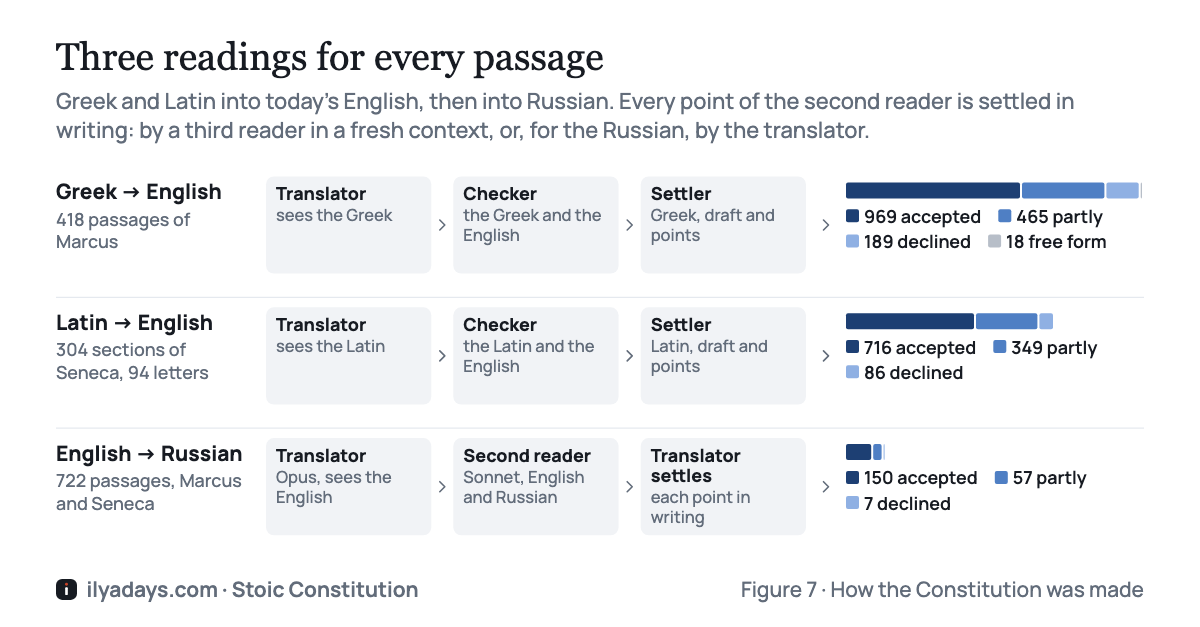
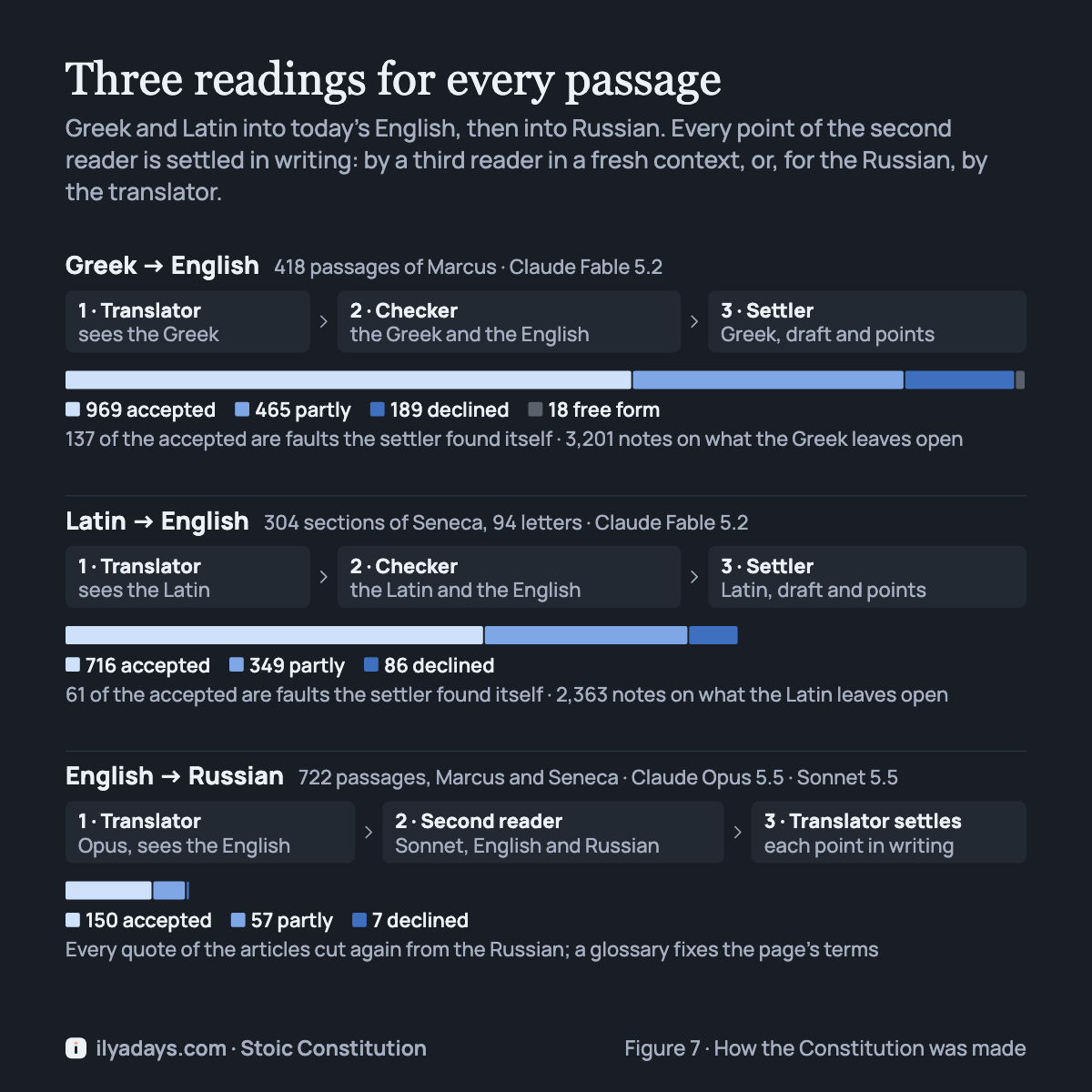
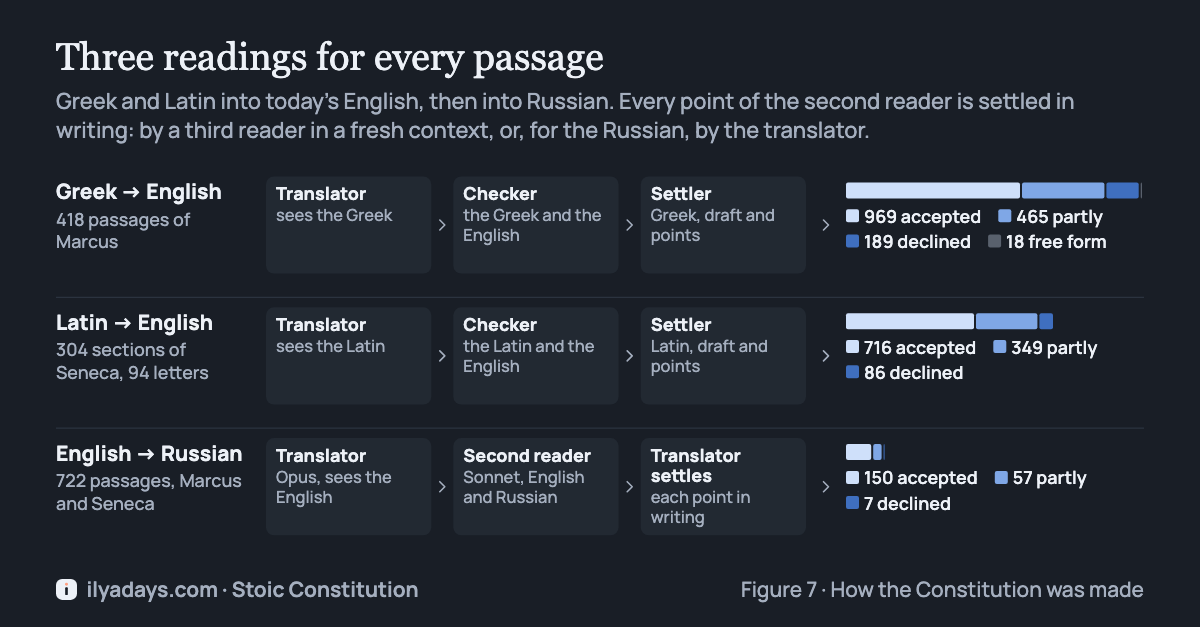
Greek into English. The 1634 translation numbers and cuts its passages differently from modern editions, so each of its passages was matched to the Greek by reading openings and endings side by side, after a whole-book alignment had proposed matches. Together the 418 passages cover every chapter of the Greek exactly once; 74 join two or more modern chapters and 63 cut inside one, saying which Greek they leave out; 16 do both. Each section was then translated by three readings (Figure 7), all by Claude Fable 5.2, each in a fresh context: a translator who saw only the Greek; a checker who saw only the Greek and the English, without the translator’s notes, and listed every place where the English says more, less or other; and a settler who settled every point in writing (accepted, partly accepted or declined, with the reason) and gave the final English. A glossary kept one English word for one Greek term. A script checked every quoted Greek word, every decision and the typography before a section was stored; a stored passage is never edited, and a correction is a new revision. The settlement is summarised in Table 13.
Latin into English. The same three readings, with a Latin glossary that keeps shared Stoic terms in the English used for Marcus. No reader was shown Gummere or any other published translation; what a model remembers from its training cannot be ruled out (Section 6). Two sections where one Latin source starts the next section a sentence early (56.12, 65.10) were taken from the other source and translated again. Letter titles are new, written from each letter’s Latin.
English into Russian. At the owner’s choice (“we're translating from english so it should be easier than latin and greek”), the Russian was made from the settled English: Claude Opus 5.5 translated, Claude Sonnet 5.5 compared each passage with the English, and the translator, resumed in its own context rather than a fresh one, settled each point in writing. Articles were re-cut, not re-translated: their own words were translated, but every quote was cut again from the Russian of its passage, every “gives” phrase and statement part had to stand inside its Russian sentence, and the Russian build reruns every rule of the English build. It refuses an article whose English changed after translation and a passage whose Russian was made from an older English. The page’s terms were fixed in one glossary before translation began (Appendix C, Table 15), because eleven translators had chosen four sets of names for the sides (rule 25 of the article prompt).
DownloadLightPNG squarePNG landscapeSVG squareSVG landscapeDarkPNG squarePNG landscapeSVG squareSVG landscapeAll figures




Code and data: apps/aurelius/prompts/translation-translator.md · apps/aurelius/prompts/translation-checker.md · apps/aurelius/prompts/translation-settler.md · scripts/aurelius-translation.py · content/aurelius/translation/project-v1.json · content/aurelius/translation/ru-v1.json
3.8Prompting and feedback as rules
One prompt governs every article, whoever writes it (constitution-article.md). It has two parts: the task (the procedure of Section 3.4) and rules learned from the owner’s review. Its opening instruction defines the feedback loop:
“When the owner gives feedback on any article, generalise it into a rule, add it to the second part with the date and their words, and apply it to every existing article, not only the one they pointed at.”
There are 25 rules, each followed by the words it came from (Appendix A). Four examples:
“These look like concatenations of exact quotes… I don't see any level of merging into common concepts… from parts to the whole, from parts to a higher thought.”Rule 1, fuse; do not concatenate (23 Nov 2026)
“Bits like this aren't clear enough: ‘That work is finished in the doing’.”Rule 4, say it plainly
“I think I also want a parallel conclusions column to show what follows from the passage.”Rule 9, every quote gets its own conclusion
“maybe we should've translated source ones first? into modern english … just make sure to do embeddings on new translation”Rule 21, vectors follow the text the reader is shown
Where a rule can be checked mechanically it became a gate: since 23 November an empty side must explain itself in one sentence (rule 7) and a Seneca context may not point back to another quote (rule 22). The other briefs (the independent reviewer and the translation readers) are listed in Appendix B; the Russian briefs were working files of their session and are not in the repository.
Code and data: apps/aurelius/prompts/constitution-article.md · apps/aurelius/prompts/article-review.md
4Validation
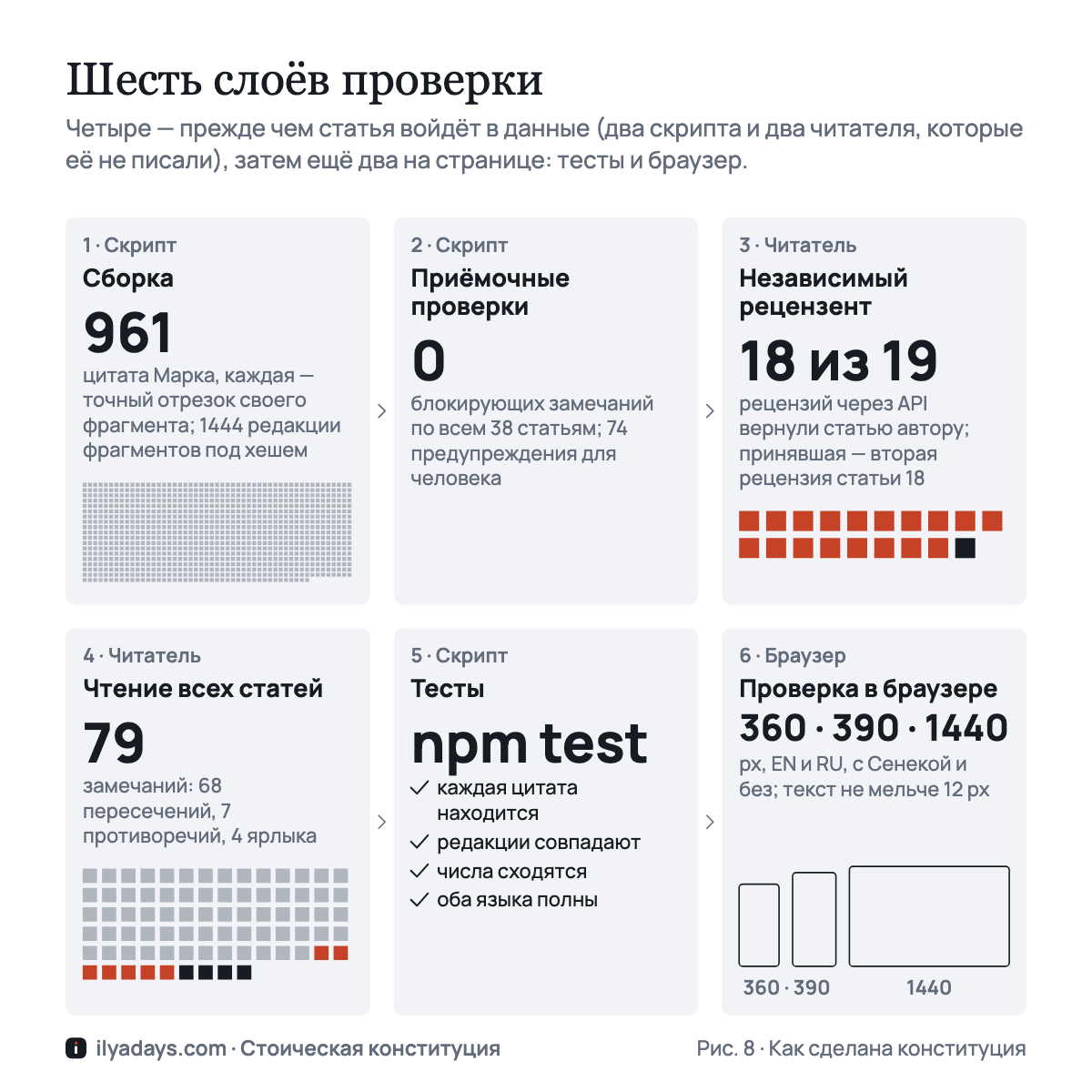
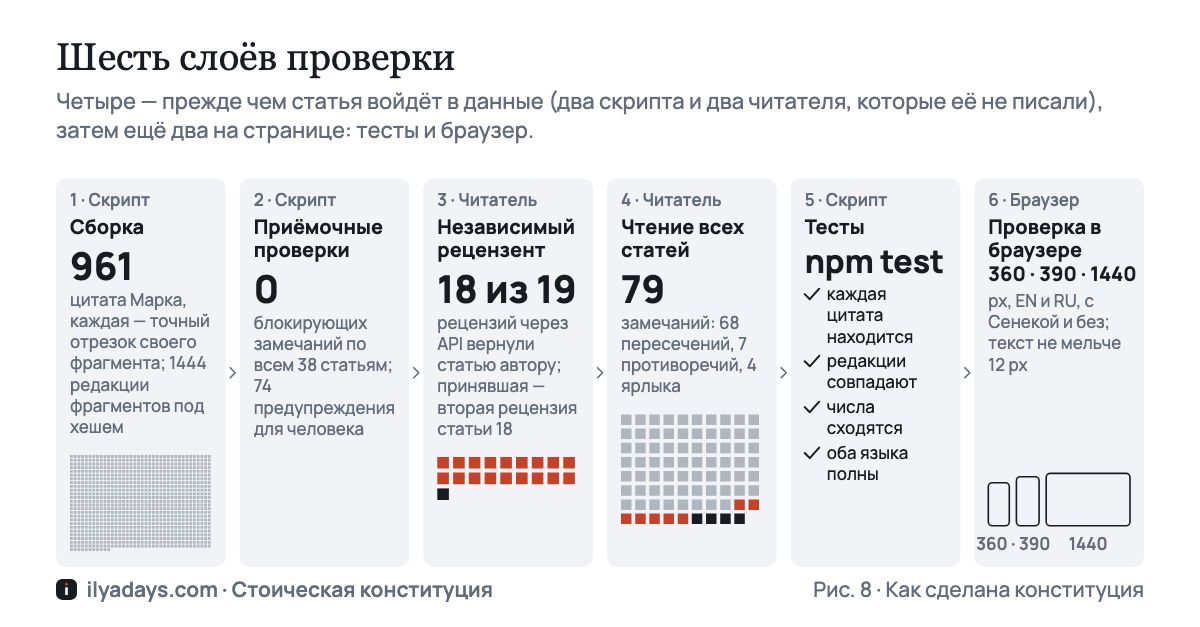
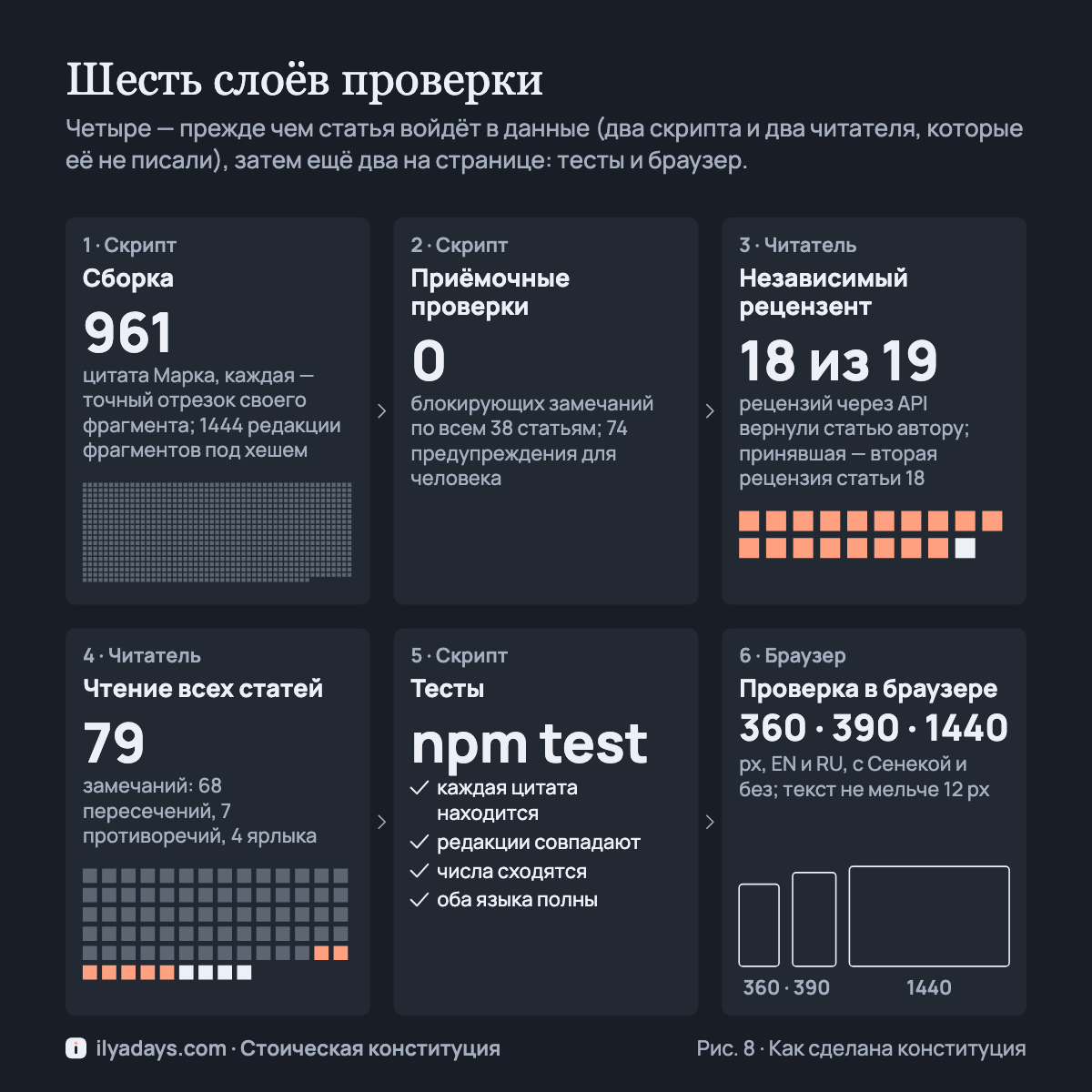
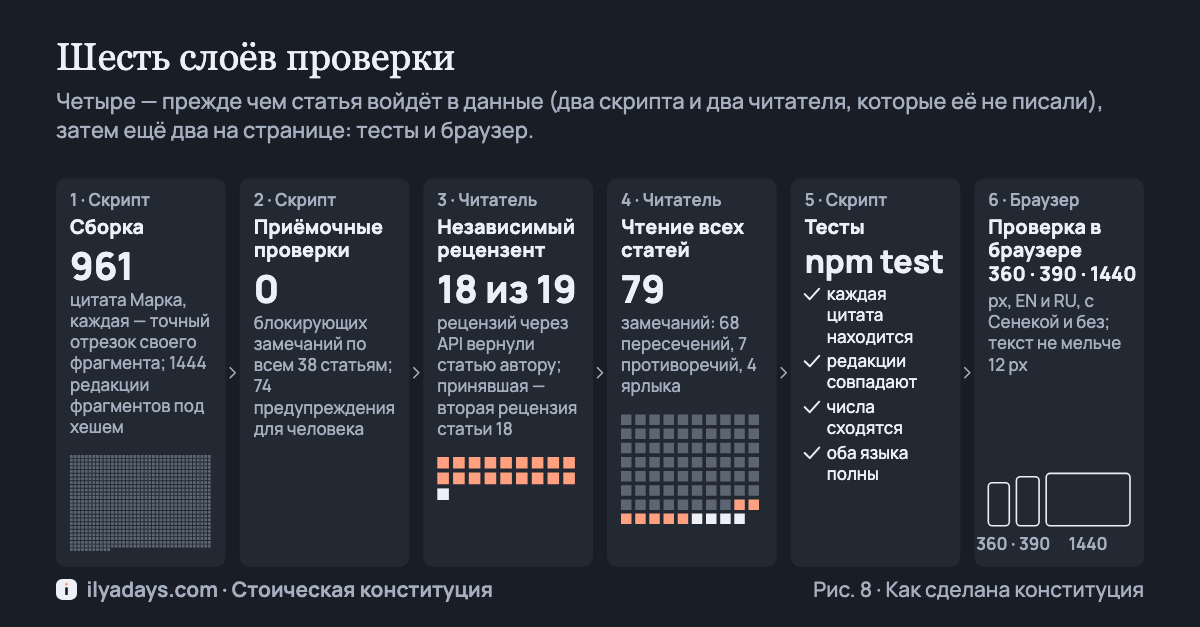
Figure 8 shows six layers of checks. Four come before an article enters the record: the build, the acceptance gates, an independent reviewer and a reading across all articles. Two come after: the test suite and the browser check of the published page. Table 8 lists what the build refuses, Table 9 what the gates check, and Table 10 the record of review.
DownloadLightPNG squarePNG landscapeSVG squareSVG landscapeDarkPNG squarePNG landscapeSVG squareSVG landscapeAll figures
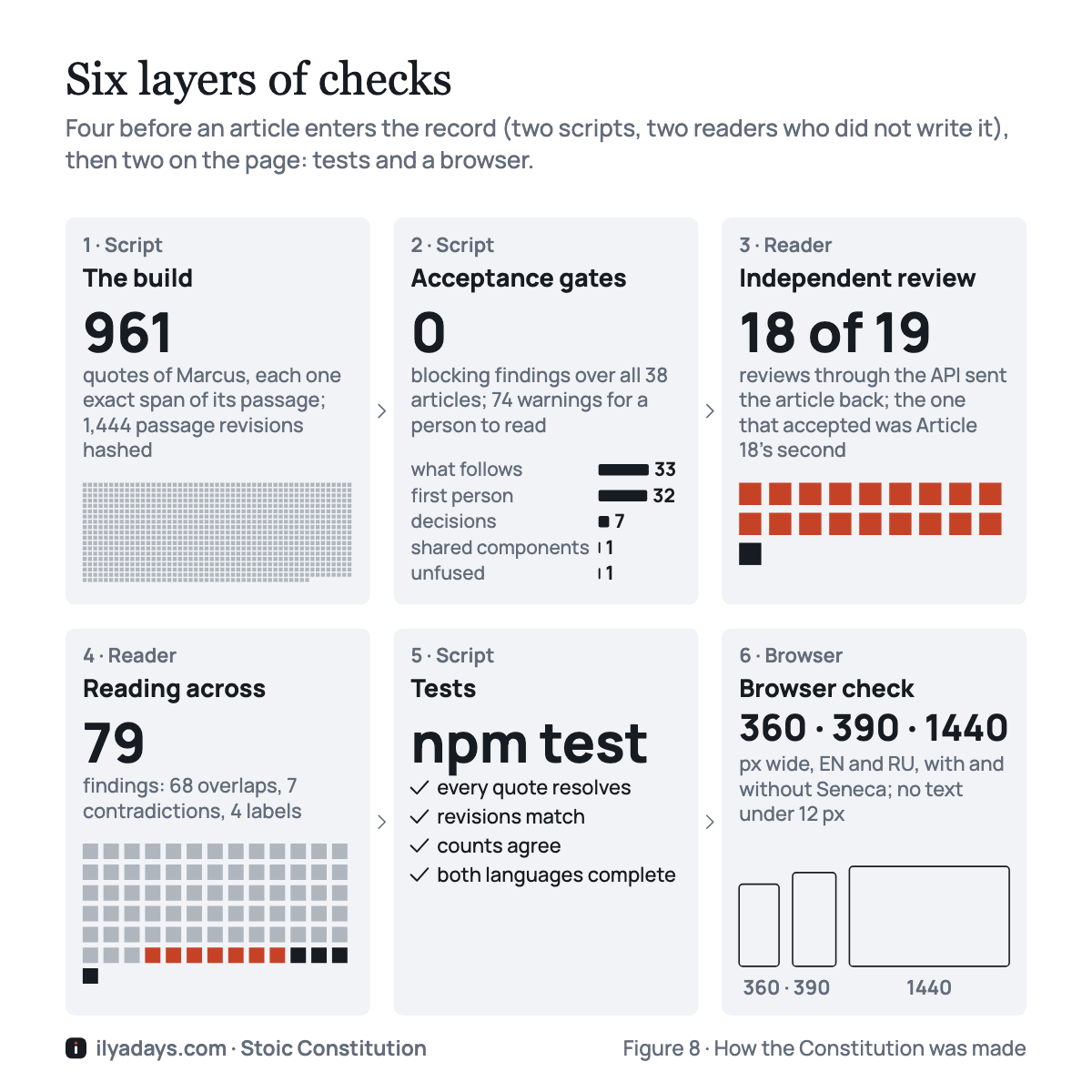
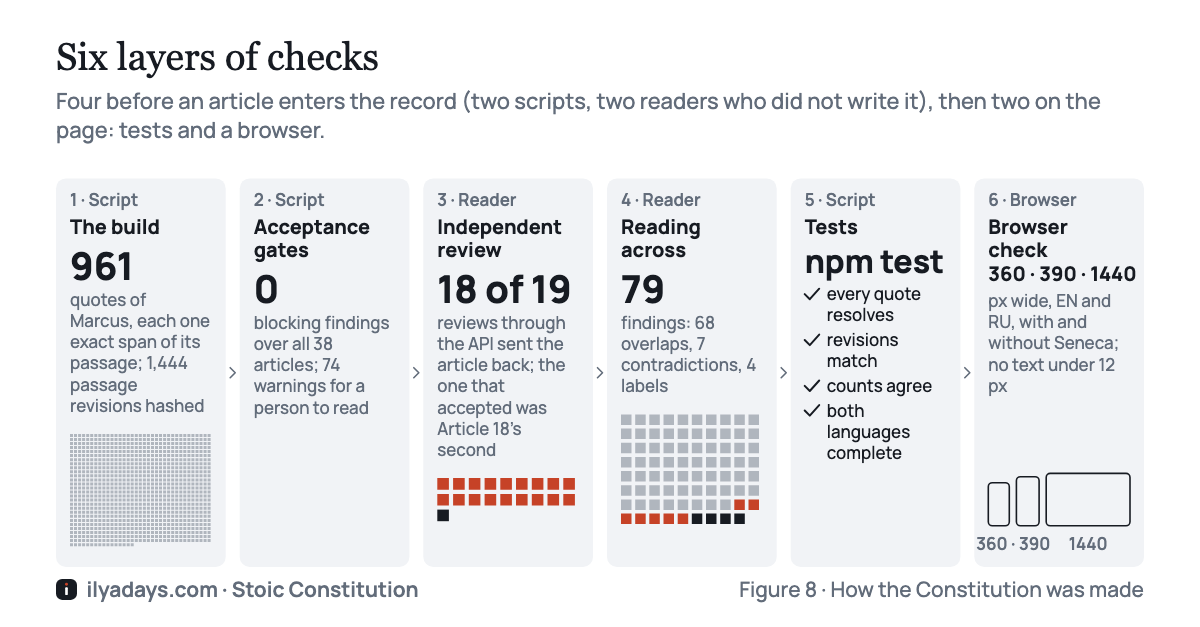


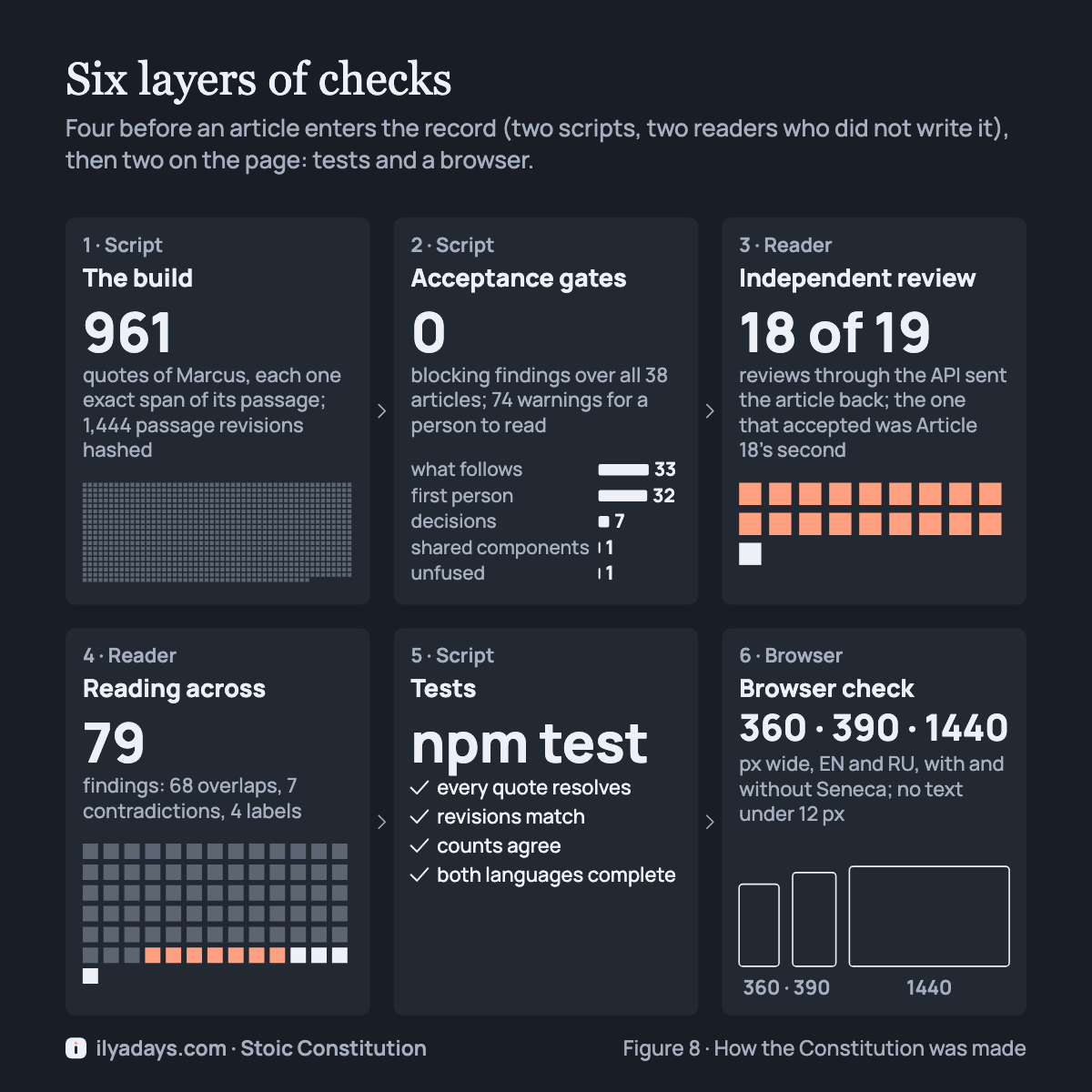
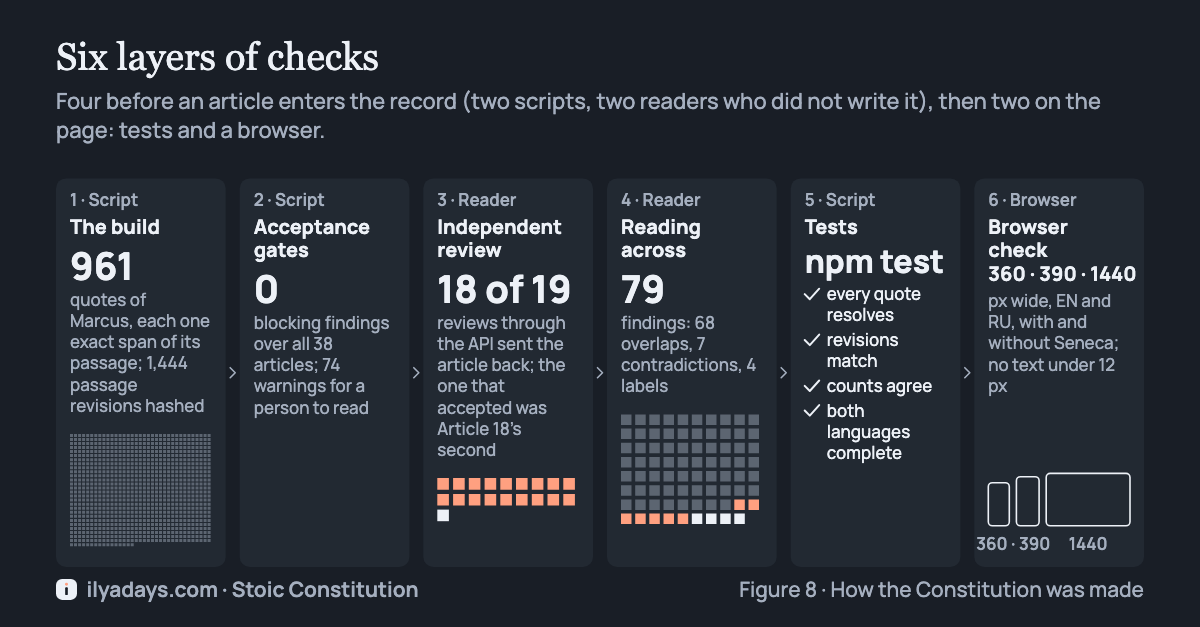


npm test). The browser check at 360, 390 and 1440 px, English and Russian, with and without Seneca. The build, the gates and the tests are scripts; review and reading across are readers who did not write the article; the browser check runs on the published page.aurelius-constitution.py) refuses to publish.| Area | Refused |
|---|---|
| Quotes | A quote that is not exactly one span of its passage; a quote without “what follows” |
| Claims | A claim on fewer than two passages; a “gives” phrase not in its claim |
| Statement | A part not in the statement, or with no quoted witness |
| Structure | A claim or said-once item not under exactly one side; an unused passage without a reason; an article with neither a claim nor a stated reason for having none |
| Colour | A sixth colour, or two meeting passages in one colour |
| Inferences | A declared inference word that appears more than once or inside words a passage backs, or that lacks its reason. Only declared words are checked: an undeclared connective passes the build and is caught, if at all, by review (Article 1’s claim 3 opens with an undeclared “So”) |
| Translation | An article quoting a translation whose passages are not all translated and embedded; an edited passage without a new revision (hash); a Russian passage made from an older English |
| Seneca | A quote not in the project’s translation; a missing context or search log; a clause that does not continue its sentence, cites another item’s quote, or limits without a Limits item; any clause of Gummere’s |
aurelius-qa.py). BLOCKING when a reader would be misled or a stated rule is broken; WARNING when a person should look. The gates are tested by 16 tests in test_qa.py: 13 plant a known fault in a real article or passage, and 3 check that the real record passes.| Gate | Checks |
|---|---|
| Typography, plain words | No straight quotes, no dash as a pause, no archaic forms |
| Voice | Statement of 30–140 characters in the first person; claims as complete sentences |
| Fusion | At least two passages back words of each claim; some words backed by two; a third of components shared (warning) |
| What follows | One sentence of 21–169 characters, not a near-copy of its quote |
| Accounting | Two to four decisions; a limit; empty sides explained in one sentence; the new English quoted |
| Seneca | Strip sentences; contexts of 20–200 characters that do not point back; at least three searches; clauses from the right items |
| Repetition | Overlap with another article not named in the limit |
| Translation | Latin letters inside Greek words, archaic forms, missing notes, glossary drift |
| Check | Result |
|---|---|
| Acceptance gates over all 38 articles | 0 blocking, 74 warnings |
| Independent review (fixed rubric, fresh context; at most two rounds) | The first 19 reviews were made through the API by Claude Fable 5.2: 18 sent the article back, and the one acceptance (Article 18) was a second review. After the paid budget was spent, Opus reviewers in Claude Code, each given at most two articles, reviewed the rest; all 32 new articles were accepted after revision. Their individual verdicts are kept in working files outside the repository and are not counted here. One narrow extra round for a single exact fix: Articles 8, 14, 15, 31 and 35 |
| Reading across all 38 articles | 79 findings: 68 overlaps, 7 contradictions, 4 Seneca passages labelled differently in two articles |
| References between articles | 212 mentions checked; 7 stale and 2 inaccurate corrected |
| Seneca re-quoted on the new English | 25 articles accepted at once, 13 sent back with exact fixes |
| Fault fixtures | Known faults planted in copies of the record; the build and tests must reject each |
Tests (npm test) | Every quote resolves, revisions match, counts agree, both languages complete; this paper’s numbers and examples match the record |
| Browser check | 360 px dark, 390 px and 1440 px, with and without Seneca, English and Russian: no sideways scroll, no text under 12 px, no button under 40 px, no script error; named cases that once failed |
Code and data: scripts/aurelius-constitution.py · scripts/aurelius-qa.py · apps/aurelius/tests/test_qa.py · tests/aurelius/constitution.test.mjs · scripts/aurelius-constitution-check.py · scripts/stoic-method-check.py
5Results
Where the numbers come from. 164 numbers on this page are marked as computed: a test recomputes each from the published files (the record, the translation stores, topics.json, diagram-data.json) and fails if one changes. 112, underlined with dots, are quoted from a file in the repository: hand-written ones (the project’s finish log, a plan, a script’s settings) or diagram-data.json, which a script computes from the private vectors, so the test cannot rerun it. For those the test checks only that the file says them, not that the file is right. Most of the review counts in Table 10 are of this kind.
5.1What the corpus became
The 418 passages became 38 articles in 7 chapters (Table 11).
| Quantity | Count |
|---|---|
| Passages of the Meditations | 418 |
| Chapters / sections = articles | 7 / 38 |
| Fused claims | 178 |
| Points said once | 165 |
| Passages quoted (the rest set aside with a reason) | 391 |
| Editor’s inferences marked | 12 |
| Articles with no fused claim (Article 29) | 1 |
| Seneca items / different quotes / uses | 332 / 421 / 550 |
| Seneca sections quoted / letters | 303 / 94 |
5.2Coverage
391 of the 418 passages are quoted; each of the rest is set aside with a one-sentence reason. Why and In action are each filled in 37 of 38 articles, but “If I doubt it” only in 19 of 38 (Table 5): Marcus does not consider doubt in every section, and the rule forbids filling a side with the editor’s words. One section (Article 29, “Short sayings”) yielded no fused claim: its writer tested every pair of its five passages and found none that say the same thing, so it is kept as separate sayings with the reason.
5.3Cluster quality
The clusters are weak but not random. The cosine silhouette [6] of the seven chapters is 0.0086; with the chapter labels shuffled 200 times, group sizes kept, it averages −0.0318 ± 0.0107, and no shuffle reaches it. The 38 sections, each of which became an article, score 0.0012 against shuffles at −0.1164 ± 0.0149. Near zero, then, but well above chance: the sections are neighbourhoods of passages, not separated themes.
Carrying over to the new English. Version 2.0 of this paper said that 352 of 418 passages were still nearest their own section on the new English. That count sets each passage’s new-English vector against section centres built from the 1634 vectors, and so mixes a change of text with a change of space. Measured in one space at a time, each passage left out of its own section’s centre, 315 of 418 are nearest their own section among the 38 on the 1634 English, and 248 on the new English. Re-cutting a tree of the new-English vectors reproduces the grouping only weakly: the adjusted Rand index (zero for chance, one for identical) is 0.202 against the published chapters and 0.213 against the sections, where a flat cut of the 1634 tree itself gives 0.873 (the published sections are cut inside each chapter). Every section is less tight on the new English (38 of 38; tightness is the mean similarity of a section’s pairs), but so is the whole book: the median similarity of two passages fell from 0.468 to 0.354, and relative to that median 20 of 38 sections are tighter on the new English. Article 1’s section went from 0.603 to 0.502.
Length. Passage length confounds closeness: the longer a passage, the nearer it lies to its section’s centre (Pearson’s r between the logarithm of the word count and the similarity to the own centre is 0.654 on the 1634 English and 0.697 on the new). The chapters’ median lengths run from 49 to 174 words. Article 29’s section (“Short sayings”, the one without a fused claim) is five passages of 6 to 24 words, grouped by form more than by theme. No length-controlled check (a silhouette with length regressed out, or vectors of windows of equal length) has been run. Every number in this section is recomputed by scripts/stoic-method-diagram-data.py into public/apps/stoic-method/diagram-data.json.
The reading across articles found 68 overlaps between articles (Table 10), consistent with neighbourhoods that are not sharply separated; the heaviest are listed for the owner as candidates for merging sections.
5.4Seneca’s effects
Seneca contributes 332 items: he backs Marcus 149 times, adds 136 things Marcus does not say in that section and limits a claim 47 times (Table 6). 83 clauses change article bodies, 11 of them real challenges; in Article 8 a challenge means the statement’s first part does not stand as worded. The items use 421 different quotes from 303 sections of 94 letters. Table 12 gives the effects article by article.
Show all 38 articles
| No. | Article | Backs | Adds | Limits |
|---|---|---|---|---|
| 1 | A member of one body | 3 | 4 | 0 |
| 2 | The work that belongs to me | 6 | 2 | 0 |
| 3 | What happens to me | 6 | 5 | 0 |
| 4 | The reason that governs the whole | 7 | 3 | 0 |
| 5 | What I was made for | 4 | 3 | 0 |
| 6 | What the whole sends in its season | 2 | 6 | 1 |
| 7 | My judgment is up to me | 4 | 3 | 3 |
| 8 | What happens can be borne and does not harm me | 8 | 3 | 2 |
| 9 | Keeping the few names I have given myself | 8 | 3 | 2 |
| 10 | Living now as one about to die | 8 | 3 | 2 |
| 11 | Coming back to my principles and keeping them ready | 7 | 5 | 3 |
| 12 | The retreat within | 4 | 3 | 2 |
| 13 | Whether anything is better than virtue | 3 | 2 | 1 |
| 14 | Living with the gods | 2 | 5 | 1 |
| 15 | Blaming no one for what is not up to me | 2 | 3 | 2 |
| 16 | Happiness and unhappiness are my own doing | 3 | 5 | 1 |
| 17 | Ready to leave | 7 | 2 | 1 |
| 18 | Content wherever I am put | 5 | 5 | 1 |
| 19 | When someone offends me | 4 | 4 | 3 |
| 20 | Taking a thing apart: material, cause, purpose and time | 3 | 4 | 0 |
| 21 | Wiping out impressions, checking impulses | 3 | 4 | 2 |
| 22 | Good whatever others say, and open to being set right | 2 | 2 | 1 |
| 23 | Keeping to one’s craft | 0 | 3 | 1 |
| 24 | Training, and the use of reason | 2 | 6 | 2 |
| 25 | What I turn to | 2 | 4 | 2 |
| 26 | The morning, and the question before each action | 2 | 4 | 0 |
| 27 | Whose praise do I want? | 3 | 3 | 2 |
| 28 | Wrongdoing harms the wrongdoer | 1 | 2 | 1 |
| 29 | Short sayings | 0 | 5 | 0 |
| 30 | The sameness and meanness of things | 1 | 4 | 2 |
| 31 | How my soul uses itself | 5 | 3 | 1 |
| 32 | All things pass | 7 | 3 | 1 |
| 33 | The same matter, reshaped | 3 | 3 | 1 |
| 34 | The dead and the forgotten | 4 | 2 | 1 |
| 35 | The length of a life and the use of its time | 5 | 3 | 1 |
| 36 | Meeting death well | 2 | 3 | 2 |
| 37 | What I learned, and from whom | 4 | 3 | 1 |
| 38 | Socrates, Plato and other models | 7 | 6 | 1 |
5.5Translation settlement
All 418 passages of Marcus, 304 sections of Seneca and 722 Russian passages were translated and settled (Table 13). For the Greek, the checker called 132 passages sound, 275 open to minor fixes and 5 wrong in a way that changed what Marcus says (the other six passages, the pilot, were checked in free form); the settler also found 137 faults neither earlier reader had caught, and in the Latin 61. Of 3,201 notes on what the Greek leaves open, 205 notes, in 148 passages, rely on memory of the manuscripts or of editors’ conjectures and say so with the words “from memory, unchecked”: 123 in brackets at the end of a note, 82 at the start of a sentence. In three Latin places the settler kept its reading against the checker (51.9, 74.18, 95.53). A pass across the Russian harmonised one phrase rendered four ways (“do wrong”, now «поступать дурно» in 13 passages). The Greek changed articles: where the 1634 English adds what the Greek lacks, the article follows the Greek, as when Article 5’s statement lost “by nature”.
| Translation | Units | Points settled | Accepted | Partly | Declined |
|---|---|---|---|---|---|
| Greek → English (Marcus) | 418 passages | 1,641* | 969 | 465 | 189 |
| Latin → English (Seneca) | 304 sections | 1,151 | 716 | 349 | 86 |
| English → Russian (passages) | 722 passages | 214 | 150 | 57 | 7 |
| English → Russian (articles) | 39 units | 121 | 103 | 17 | 1 |
Counted from the records project-v1.json, seneca-v1.json and ru-v1.json. Settled points include those the settler found itself (“Found while settling”: 137 Greek, 61 Latin), all counted as accepted. * Also 18 points of the six-passage pilot, settled in free form. The Russian total includes two corrections accepted on 24 November from the article translators (8.3 and 3.11a). The article row (39 units) is from the project log.
Code and data: public/apps/stoic-constitution.json · tests/aurelius/method-page.test.mjs
6Limitations and open questions
- Not yet reviewed by the owner. Topic names, selections and article wordings are an editorial draft; the review tools on the Constitution page (a verdict on every part, notes, copy and download) exist for that review.
- No human reader of the source languages. All translations were made and checked by language models. The owner read six passages of the Greek translation (“looks good”); no person who reads Greek, Latin or Russian has checked any translation. Model Greek and Latin can be confidently wrong; the source is shown beside every passage so that anyone who reads it can object.
- Model judgment throughout. Finding parallels, deciding what passages share, choosing the side, labelling a Seneca item, and reviewing were done by models under written rules. The rules and gates constrain the form of that judgment, not its correctness.
- Support is judged, not checked. The build proves the tracing, not the support: whether a quote says what its phrase says is the writer’s and the reviewer’s judgment, and it awaits the owner. Inference marking is only as complete as the writer’s declarations. Open fault: Article 1’s claim 3 opens with “So”, an inference no passage states, which is not declared and passes the build. No blinded human audit of claim–quote pairs has been made.
- One model family, correlated errors. Every reader is a Claude model. Fable 5.2 made, checked and settled every Greek and Latin translation; for the Russian, Opus 5.5 translated and, resumed in its own context, settled the points of a Sonnet 5.5 checker; after the paid budget was spent, Opus reviewers reviewed articles that Opus writers had finished. Separate contexts keep one reader from seeing another’s notes; they do not remove the biases a model family shares.
- Memorised translations. For Marcus, reuse of published translations is prevented only by an instruction to the translator (translation-translator.md). The one mechanical overlap check is for Seneca: the build refuses any clause of 30 or more characters found in Gummere. Nothing compares the project’s English of Marcus with modern translations still under copyright, and what a model remembers cannot be ruled out. Before the CC0 text is reused, an overlap scan against the translations the owner can lawfully consult is still to be made.
- Weak clusters, grouped on an older text, confounded with length. The silhouettes are near zero, though above chance; the grouping was done on the 1634 English, and a re-cut on the new English reproduces it only weakly (adjusted Rand index 0.202 for the chapters); long passages sit nearer their section’s centre than short ones (Section 5.3). Sections overlap (Article 17 restated Article 10 almost whole; Article 23’s one claim is Article 22’s first); merging is the owner’s call.
- Provisional names and editorial order. Section titles come from one reading per chapter (partial for one chapter, Section 3.3); seven chapters is a fixed choice (Section 3.2), and the order of chapters an editorial one.
- Decisions waiting on the owner, as listed in 37-owner-points.md:
- Sections that overlap: Article 17 restated Article 10 almost whole; Article 36 repeats parts of Articles 10, 32, 33 and 34; Article 23’s one claim is Article 22’s first; Articles 11 and 20 share the “take it apart” exercise; Articles 16 and 18 made the same claim. Each now says what it adds and names the other; nothing was merged.
- Article 29 (“Short sayings”) has no fused claim; its writer recommends no article.
- With Seneca on, part of Article 8’s statement (“nothing happens to me that I cannot bear”) does not stand as worded.
- Article 23 rests on one reading of the Greek of 6.50, which the Greek allows but does not require.
- Article 6’s Seneca clause is tagged “adds” where a reviewer argued “limits”.
- Articles 8, 14, 15, 31 and 35 each had one narrow review round beyond the two allowed, for a single exact fix.
- In the translation of 7.23, “Not in the least” can read in English as a denial, though the Greek agrees.
- The gates report 74 warnings, none blocking.
- A chapter was retitled (c7, now “Praise, harm and the worth of things”), and c1 to c3 got first-person summaries.
- The Seneca translation (304 sections) has been read by neither the owner nor a Latin reader; three places where the settler kept its reading against a checker wait for one (51.9, 74.18, 95.53).
- The titles of Seneca’s letters are new, written from each letter’s Latin.
- Spending on the language-model API, about $279 in all.
- Choice of embedding. One commercial model and one linkage were used; other models or a re-grouping on the new English might give other sections. The vectors are cached, but re-running the embedding depends on the provider.
7Conclusion
A book of notes can be turned into a constitution that keeps its provenance. Embedding similarity finds neighbourhoods worth reading together; fusion states once what several passages share; and a strict record (exact quotes, two witnesses per claim, marked inferences, typed contributions of a second author) lets a script, not trust, say whether each phrase is traced to the exact words of at least two passages; whether those words support it remains a judgment, made visible so that the owner can check it. The method does not make the editor’s judgment unnecessary; it makes that judgment visible and checkable. What it still needs is people: the owner’s verdicts, and readers of Greek, Latin and Russian.
References
- [1] Marcus Aurelius. Meditations, translated by Meric Casaubon (1634). Project Gutenberg eBook 2680. gutenberg.org/ebooks/2680
- [2] Leopold, J. H. (ed.) (1908). M. Antoninus Imperator ad se ipsum. Oxford: Clarendon Press (the Perseus file’s header gives Leipzig: Teubner). Digital text: Perseus Digital Library, urn:cts:greekLit:tlg0562.tlg001.perseus-grc2, CC BY-SA. perseus.tufts.edu
- [3] Seneca. Ad Lucilium Epistulae Morales, translated by Richard M. Gummere. Loeb Classical Library, 3 vols., 1917, 1920, 1925. Transcription: English Wikisource. en.wikisource.org/wiki/Moral_letters_to_Lucilius
- [4] Seneca. Epistulae morales ad Lucilium, Latin text. The Latin Library, thelatinlibrary.com/sen.html; checked against Latin Wikisource.
- [5] Ward, J. H., Jr. (1963). Hierarchical grouping to optimize an objective function. Journal of the American Statistical Association 58(301), 236–244. doi:10.1080/01621459.1963.10500845
- [6] Rousseeuw, P. J. (1987). Silhouettes: a graphical aid to the interpretation and validation of cluster analysis. Journal of Computational and Applied Mathematics 20, 53–65. doi:10.1016/0377-0427(87)90125-7
- [7] OpenAI. Vector embeddings (text-embedding-3-large, 3,072 dimensions). platform.openai.com/docs/guides/embeddings
- [8] Kruskal, J. B. (1964). Multidimensional scaling by optimizing goodness of fit to a nonmetric hypothesis. Psychometrika 29(1), 1–27. doi:10.1007/BF02289565
- [9] Virtanen, P., et al. (2020). SciPy 1.0: fundamental algorithms for scientific computing in Python. Nature Methods 17, 261–272. doi:10.1038/s41592-019-0686-2
- [10] Pedregosa, F., et al. (2011). Scikit-learn: machine learning in Python. Journal of Machine Learning Research 12, 2825–2830.
- [11] Harris, C. R., et al. (2020). Array programming with NumPy. Nature 585, 357–362. doi:10.1038/s41586-020-2649-2
- [12] Anthropic. Claude models (Claude Fable 5.2, Claude Opus 5.5, Claude Sonnet 5.5). docs.anthropic.com
- [13] Creative Commons. CC0 1.0 Universal Public Domain Dedication. creativecommons.org/publicdomain/zero/1.0
- [14] L. van der Maaten and G. Hinton (2008). Visualizing data using t-SNE. Journal of Machine Learning Research 9: 2579–2605. jmlr.org/papers/v9/vandermaaten08a
- [15] J. Venna and S. Kaski (2001). Neighborhood preservation in nonlinear projection methods: an experimental study. In Artificial Neural Networks — ICANN 2001, Lecture Notes in Computer Science 2130, 485–491. Springer. doi:10.1007/3-540-44668-0_68
- [16] I. Borg and P. J. F. Groenen (2005). Modern Multidimensional Scaling: Theory and Applications, 2nd ed. Springer. doi:10.1007/0-387-28981-X
The vectors come from the OpenAI API [7]. Clustering, silhouettes, metric MDS and t-SNE used NumPy 2.5.4, SciPy 1.18.1 and scikit-learn 1.9.1, as recorded in topics.json and diagram-data.json.
Appendix A · The prompt’s rules
The 25 rules of constitution-article.md, by their titles. Each rule in the file is followed by the owner’s words it came from, dated.
- Fuse; do not concatenate.
- Keep exact quote tracking under every fused statement.
- Write the article as an article.
- Say it plainly.
- Keep the page structure.
- Carry feedback forward.
- One statement, then labelled subarticles.
- Show several sources at once, component by component.
- Give every quoted passage its own conclusion.
- Colour means one thing: the source passage.
- Show the measurements behind the grouping.
- A second author is added to Marcus, and every word of his is marked as his.
- Adding or removing an author is one tap, and nothing gets lost.
- Whose words these are is one quiet mark, and an added author changes the body.
- The vectors are a column of their own.
- Read an added author’s quote where it stands.
- Search by words as well as by vectors, and log it.
- A clause never says more than its quote, and “challenges” is for a real disagreement.
- Mark the editor’s inferences.
- Evidence in today’s English, with the Greek and the older translation on request.
- Vectors follow the text the reader is shown.
- Every line a reader meets alone must stand alone.
- Translate a section with three readers, and keep the briefs.
- Other languages are made from the settled text, and from the Greek (superseded: the Russian is made from the settled English).
- An article in another language is re-cut, not re-translated.
Appendix B · File map
| File | Role |
|---|---|
| embeddings.py | Embedding model, dimensions, cache (3.1) |
| aurelius-topics.py | Ward clustering into chapters and sections (3.2) |
| topics.json | The hierarchy: references and numbers only |
| constitution.json | The authored articles, chapter names, Seneca’s parts, rights record |
| aurelius-constitution.py | The build and its rules (Table 8), English and Russian |
| aurelius-qa.py · test_qa.py | Acceptance gates and their fault tests (Table 9) |
| aurelius-seneca.py | Seneca search corpus: fetch, split, embed, attach (3.6) |
| aurelius-translation.py | Checks and publishes the Greek translation; embeds the new English |
| project-v1.json · seneca-v1.json · ru-v1.json · articles-ru-v1.json | The translations, with notes and settled points (3.7) |
| constitution-article.md · article-review.md | The article prompt (Appendix A) and the reviewer’s rubric |
| translator · checker · settler · glossary · matcher · lead | The translation briefs |
| constitution.test.mjs · method-page.test.mjs · fixtures · browser check | Tests (Table 10) |
| aurelius-downloads.py | The CC0 downloads |
| 36-finish-log.md · 37-owner-points.md · 32-delegation-plan.md | The running log, the open decisions, the procedure |
| stoic-method.html | This paper |
Appendix C · Glossary
| English | Russian | Meaning |
|---|---|---|
| article | статья | One section of the book fused into a statement with its sides |
| statement | положение | The article’s one short sentence |
| claim | утверждение | A point fused from two or more passages |
| said once | сказано однажды | A point only one passage makes |
| passage | фрагмент | One numbered entry of the 1634 English, with its Greek |
| section · chapter | раздел · глава | Groups found by clustering |
| Backs · Adds · Limits | Подкрепляет · Добавляет · Ограничивает | The effects of a second author’s item |
| Why · In action · Practice · When it breaks · If I doubt it | Почему · На деле · Упражнение · Когда не выходит · Если я сомневаюсь | The five sides |
| clause | приписка | A second author’s words appended to a sentence |
| the editor’s inference | вывод редактора | A step no passage takes, marked in purple |